Audi Brake Pad Wear Sensor Not Resetting: Causes, Diagnosis, and Repair
EuroX Performance | Golden, Colorado
If you own an Audi and recently replaced your brake pads, you may expect the brake pad warning light to disappear automatically. However, many Audi owners are surprised when the brake pad wear warning remains on even after new pads and sensors have been installed. One of the most common questions we hear at EuroX Performance in Golden, Colorado, is: “Why won’t my Audi brake pad wear sensor reset?”
The answer is that several issues can prevent the system from recognizing new brake components. From damaged sensors and wiring problems to electronic faults and improper installation, multiple factors can keep the warning light active.
In this guide, we’ll explain how Audi brake pad wear sensors work, why they sometimes fail to reset, and what repairs may be necessary to restore proper operation.
How Audi Brake Pad Wear Sensors Work
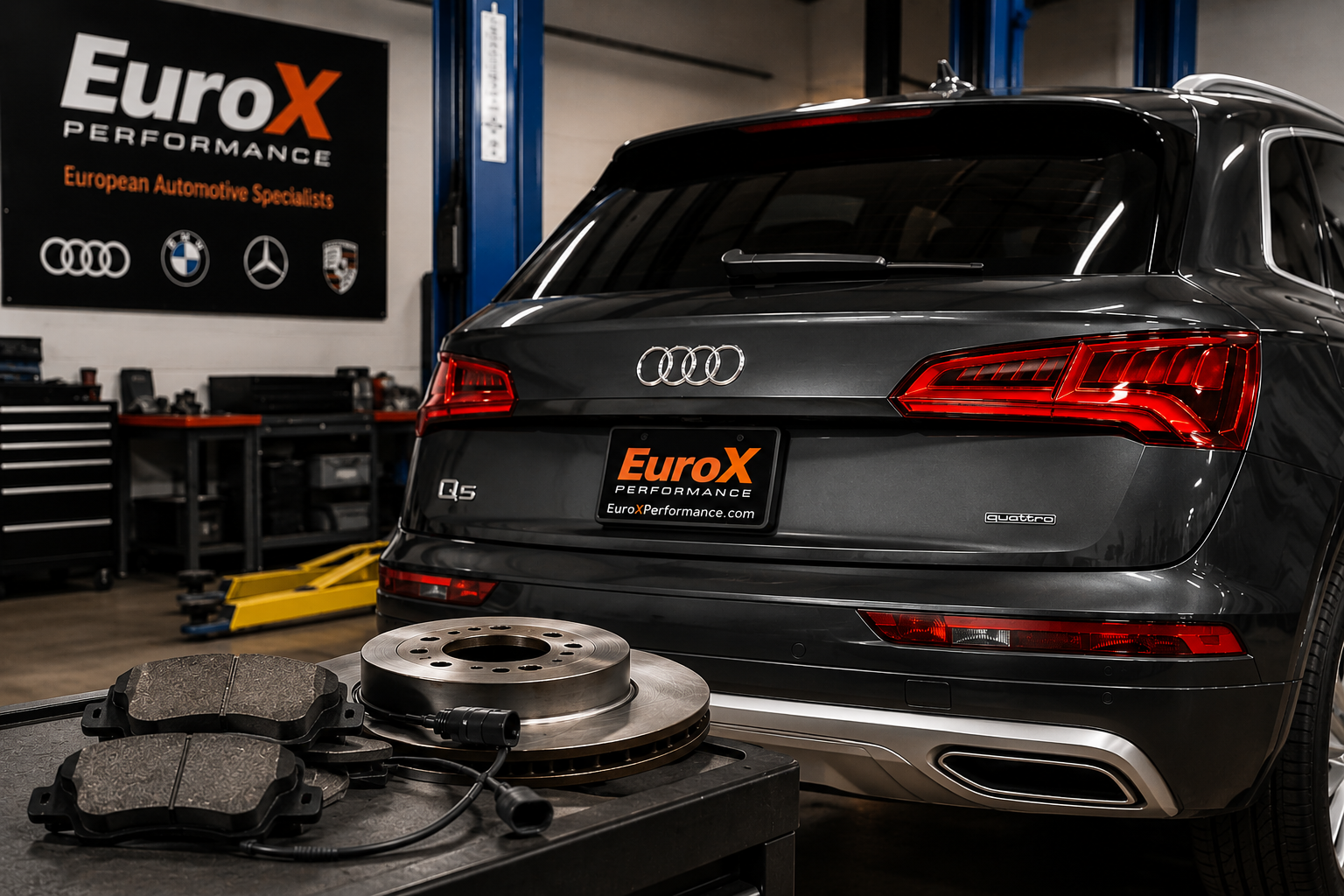
Many modern Audi models use electronic brake pad wear sensors to monitor pad thickness. These sensors are typically installed in one or more brake pads and are designed to alert the driver when the friction material reaches a predetermined wear limit.
The system operates through a simple electrical circuit. When the brake pad wears down to a specific thickness, the sensor circuit is broken. The vehicle’s control module detects this interruption and triggers a warning message on the dashboard.
Depending on the model, you may see messages such as:
- Brake Pads Worn
- Brake Service Due
- Check Brake Pads
- Brake Warning Light
Popular Audi models equipped with wear sensors include:
- Audi A4
- Audi A5
- Audi A6
- Audi A7
- Audi Q5
- Audi Q7
- Audi SQ5
- Audi S4
- Audi S5
After replacing worn pads, the system should recognize the new sensor and clear the warning. When it does not, additional diagnosis is required.
Common Reasons the Brake Pad Wear Sensor Will Not Reset
The Wear Sensor Was Not Replaced
One of the most common causes is simply reusing the old wear sensor.
Unlike traditional mechanical wear indicators, Audi’s electronic sensors are generally considered one-time-use components. Once the sensor circuit has been worn through, it cannot be repaired.
If new brake pads are installed while the old sensor remains in place, the vehicle will continue to detect an open circuit, and the warning light will remain illuminated.
During any brake service, replacing the sensor is strongly recommended whenever the original sensor has been triggered.
Damaged Sensor Wiring
Another frequent issue involves damaged wiring between the brake pad sensor and the vehicle harness.
The wiring is exposed to:
- Road debris
- Water intrusion
- Salt corrosion
- Suspension movement
- Extreme temperatures
Over time, wires can become brittle, cracked, or broken.
Even if a new sensor has been installed correctly, damaged wiring can prevent communication with the control module. The vehicle then interprets the problem as worn brake pads.
At EuroX Performance, technicians often inspect the entire sensor circuit when diagnosing persistent brake warnings.
Improper Sensor Installation
Brake pad wear sensors must be fully seated and properly connected.
Common installation mistakes include:
- Loose electrical connectors
- Sensor not clipped fully into the pad.
- Pinched wiring
- Incorrect routing of the harness
- Connector contamination
Even a minor installation error can prevent the system from recognizing the new sensor.
This is especially common when aftermarket brake kits are installed without following Audi service procedures.
Faulty Aftermarket Sensors
Not all aftermarket sensors are manufactured to the same standards as OEM components.
Low-quality sensors may have:
- Incorrect resistance values
- Poor connector fitment
- Manufacturing defects
- Inferior wiring insulation
In some situations, the vehicle’s control module may reject the sensor signal entirely.
Using high-quality OEM or OE-equivalent components often eliminates recurring warning light issues.
When customers visit our shop from Arvada, Wheat Ridge, and Lakewood, Colorado, we frequently find brake warning problems linked to low-quality aftermarket parts.
Control Module Faults
Although less common, electronic faults within the vehicle can also prevent the brake warning from resetting.
Potential issues include:
- ABS module faults
- Instrument cluster communication errors
- Gateway module problems
- Software glitches
Modern Audis rely heavily on communication between multiple control modules. If one module fails to process sensor information correctly, the warning may remain active despite a successful brake repair.
Advanced diagnostic equipment is often required to identify these faults.
Stored Fault Codes
Sometimes the warning light remains active because fault codes have not been cleared.
Certain Audi models require:
- Fault memory clearing
- Service reset procedures
- Adaptation resets
Even after replacing pads and sensors, stored faults may continue triggering warning messages until the system is properly reset using professional diagnostic equipment.
If your Audi continues displaying brake warnings after repairs, a scan tool inspection is usually the next step.
Water or Corrosion Damage
Colorado weather can be hard on electrical systems.
Vehicles driven regularly through:
- Snow
- Ice
- Road salt
- Mountain conditions
It can develop corrosion in electrical connectors.
Corrosion increases resistance and interferes with signal transmission. In severe cases, it can completely interrupt the sensor circuit.
Drivers from Evergreen and surrounding mountain communities often experience electrical issues caused by moisture intrusion and by winter road-treatment chemicals.
Which Audi Models Experience This Problem Most Often?
While brake sensor issues can affect nearly any Audi model, we frequently diagnose the problem on:
- Audi A4 B8 and B9
- Audi A5 Sportback
- Audi Q5
- Audi SQ5
- Audi A6
- Audi A7
- Audi Q7
Higher-mileage vehicles tend to be more susceptible due to aging wiring and repeated brake service over the years.
Diagnosing an Audi Brake Pad Wear Warning
Proper diagnosis is essential before replacing additional parts.
A professional inspection typically includes:
Visual Inspection
Technicians inspect:
- Brake pad thickness
- Sensor condition
- Wiring integrity
- Connector security
Electrical Testing
Using a multimeter, the sensor circuit can be checked for:
- Continuity
- Resistance values
- Open circuits
- Short circuits
Diagnostic Scan
Factory-level scan tools allow technicians to:
- Read fault codes
- Monitor brake sensor data.
- Reset service reminders
- Verify communication between modules.
This process helps identify the exact cause rather than simply replacing parts based on guesswork.
Why Ignoring the Warning Is Not Recommended
Some drivers become accustomed to seeing the brake warning and choose to ignore it.
This creates several risks:
Missed Brake Wear
If the warning system is already malfunctioning, future brake wear may go unnoticed.
Inspection Issues
Persistent warning lights can cause problems during vehicle inspections or pre-purchase evaluations.
Hidden Electrical Problems
The brake warning may indicate wiring or module issues that could eventually affect other systems.
Reduced Resale Value
Warning lights often raise concerns for potential buyers and can negatively impact resale value.
Addressing the problem early is usually less expensive than waiting for additional electrical failures to develop.
Preventing Future Brake Sensor Problems
Several maintenance practices can help reduce future issues.
Use Quality Parts
OEM or OE-quality sensors generally provide the most reliable performance.
Replace Sensors During Brake Service
Whenever the sensor has been triggered, replacement is recommended.
Inspect Wiring Routinely
Regular inspections can catch damaged wiring before it causes warning lights.
Address Corrosion Early
Cleaning connectors and repairing damaged insulation can prevent larger electrical failures.
Perform Professional Brake Service
Proper installation and system resets help ensure the warning system functions correctly after repairs.
Audi Brake Service in Golden, Colorado
When an Audi brake pad wear sensor refuses to reset, the issue is often more complex than simply replacing brake pads. The warning may be caused by damaged wiring, faulty sensors, stored fault codes, corrosion, or issues with electronic modules.
At EuroX Performance, we specialize in diagnosing and repairing Audi brake system problems for drivers throughout Golden, Colorado; Arvada; Wheat Ridge; Lakewood, Colorado; Evergreen; and surrounding communities. Our technicians use advanced diagnostic equipment and extensive European vehicle expertise to identify the root cause and perform the correct repair the first time.
Whether your Audi continues to display a brake warning after a recent brake service or you’re experiencing other braking concerns, a professional diagnosis can save time, prevent unnecessary parts replacement, and restore confidence in your vehicle’s safety systems.
For professional Audi maintenance and diagnostics, visit our Audi service page:
https://euroxperformance.com/services/
You can also learn more about European vehicle maintenance through these EuroX resources:
To schedule an inspection or discuss your Audi brake concerns, contact EuroX Performance:
https://euroxperformance.com/about/
Our team proudly serves Golden, Colorado, and nearby communities with specialized European automotive repair and maintenance services.
If you’re in Golden, Arvada, Wheat Ridge, Lakewood, or Evergreen, and your Audi needs attention, bring it to a shop that understands these engines inside and out.
👉 Schedule service or diagnostics:
https://euroxperformance.com/
Schedule professional diagnostics and fix the issue correctly — the first time.
European engines demand precision. Get it serviced by specialists who understand them.
👉 Schedule service with EuroX Performance in Golden, Colorado
https://euroxperformance.com/services/
EuroX Performance in Golden, Colorado, is here to help keep your BMW, Audi, Mercedes-Benz, Volkswagen, Porsche, or MINI running at the temperature it was engineered for.
Schedule expert diagnostics with EuroX Performance in Golden, Colorado, proudly serving drivers in Arvada, Evergreen, Wheat Ridge, and Lakewood.
View all European automotive services offered by EuroX Performance here:
👉 https://euroxperformance.com/services/
FAQs
Q:Why is my Audi brake pad warning light still on after replacing the brake pads?
A:The most common reasons include a worn sensor that was not replaced, damaged sensor wiring, improper installation, stored fault codes, or a faulty aftermarket sensor. A diagnostic inspection can identify the exact cause.
Q:Do Audi brake pad wear sensors need to be replaced with every brake job?
A:If the sensor has been triggered by worn brake pads, it should be replaced. Once the sensor circuit is worn through, it typically cannot be reused and may continue causing warning messages.
Q:Is it safe to drive with an Audi brake pad wear warning light on?
A:While the vehicle may still be drivable, the warning should not be ignored. It could indicate worn brake pads, a sensor failure, or an electrical issue that prevents the system from accurately monitoring brake condition.
At EuroX Performance, serving Golden CO, Wheat Ridge CO, Arvada and Westminster CO, we use mechanical gauges and diagnostic scanners to pinpoint the exact cause. We never guess or replace parts blindly.
If you noticed any of the signs that might indicate your European car needs attention, don’t wait. Call EuroX Performance at (303) 719-8888 or schedule an appointment online at www.euroxperformance.com. We’ll get your Audi, Mercedes, BMW or European vehicle back to running like new.
🛠️ Ready for Diagnostic?
Please don’t wait for a warning light to tell you it’s time. Keep your European engine running like new, book your following diagnostic with EuroX Performance today.
👉 Schedule Service | 🚘 Performance You Can Feel