Skip to content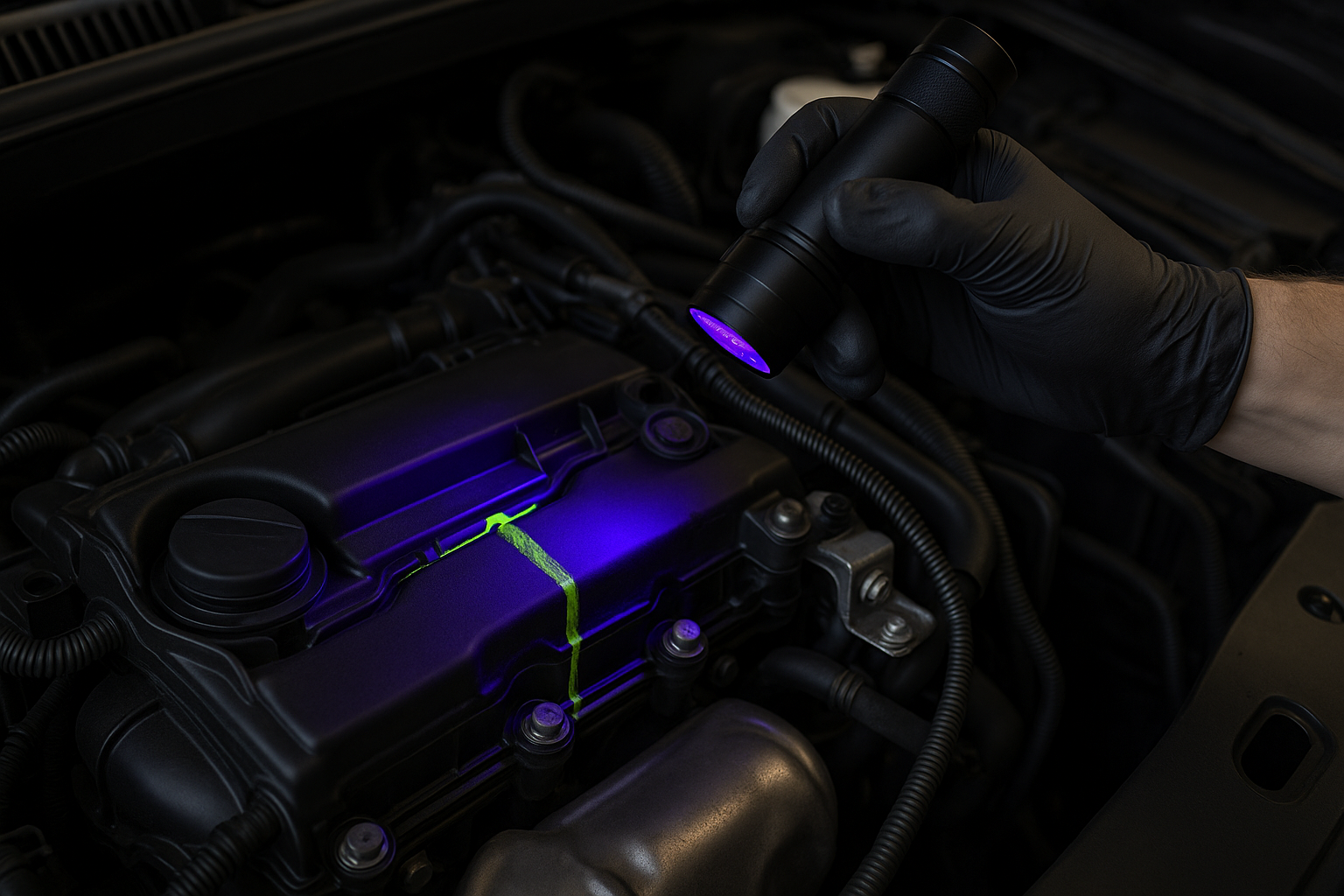
How to Diagnose Oil Leaks Without Tearing Down the Engine
EuroX Performance – European Car Specialists in Golden,Colorado
Oil leaks are one of the most common problems European vehicle owners face — especially in BMW, Audi, Mercedes-Benz, Porsche, Volkswagen, and MINI. When the first drop hits the driveway, panic hits fast. Drivers imagine thousands of dollars in repairs, full engine teardowns, or catastrophic failures waiting around the corner.
The good news: you don’t diagnose an oil leak by ripping an engine apart.
A proper diagnostic process uses precision tools, controlled testing, and methodical inspection — not guesswork, not unnecessary disassembly.
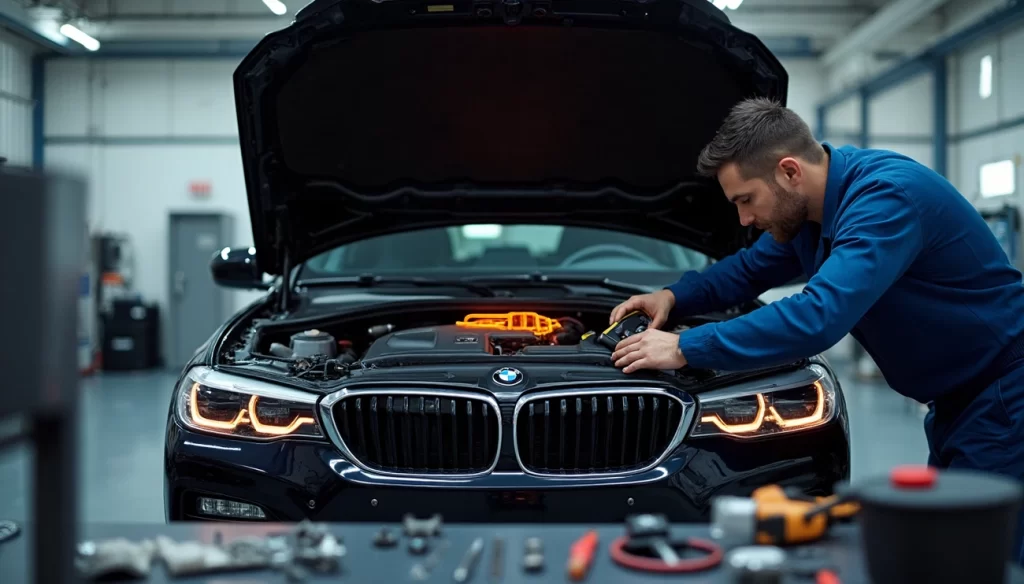
At EuroX Performance in Golden, Colorado, serving Arvada, Wheat Ridge, Lakewood, and the entire Denver metro, we specialize in pinpointing the exact source of oil leaks without tearing down your engine and without turning your repair into a science experiment.
This guide explains exactly how professionals do it — and how you can spot the early signs before the leak escalates.
Why European Cars Leak Oil More Often
European engines run tighter tolerances, higher heat, and more complex PCV systems. That means more gaskets, more seals, more pressure — and more potential failure points.
Common culprits:
- Valve cover gasket
- Oil filter housing gasket
- Oil cooler seals
- Front/rear main seal
- Camshaft cradle or cam carrier plate
- Turbo oil return lines
- PCV system failure causing crankcase over-pressure
The trick is pinpointing the true source, because multiple leaks can mask each other. That’s why method matters — and why tearing an engine apart too early is the wrong move.
Step-By-Step: How Professionals Diagnose Oil Leaks Without Engine Teardown
At EuroX, we follow a structured diagnostic sequence designed for European platforms. Here’s the process, broken down clearly.
1. Baseline Inspection — The Starting Point
Before touching any tools, the tech inspects:
- Undercarriage
- Engine exterior
- Oil pan
- Subframe
- Timing cover area
- Valve cover perimeter
- Turbocharger oil feed/return
This tells you:
- Where the leak lands (not necessarily where it starts)
- How long has it been leaking
- Whether it’s fresh or cooked-on residue
- Whether pressure or vacuum problems are contributing
This alone weeds out obvious problems like cracked oil pans, loose filters, or damaged drain plugs.
2. Clean-Down and Degreasing — Essential for Accuracy
If the engine is covered in oil, you cannot diagnose the origin. Period.
A professional shop uses:
- Solvent-based degreasers
- Steam cleaning
- Hot pressure washing (controlled)
- Biodegradable cleaners for aluminum housings
Cleaning resets the “canvas.”
Without this step, everything else is a guess.
At EuroX, we do a controlled clean-down and then re-check after the engine heats and cools. This alone reveals 40% of leak origins.
3. UV Dye and Blacklight Detection
This is the gold standard.
Here’s how it works:
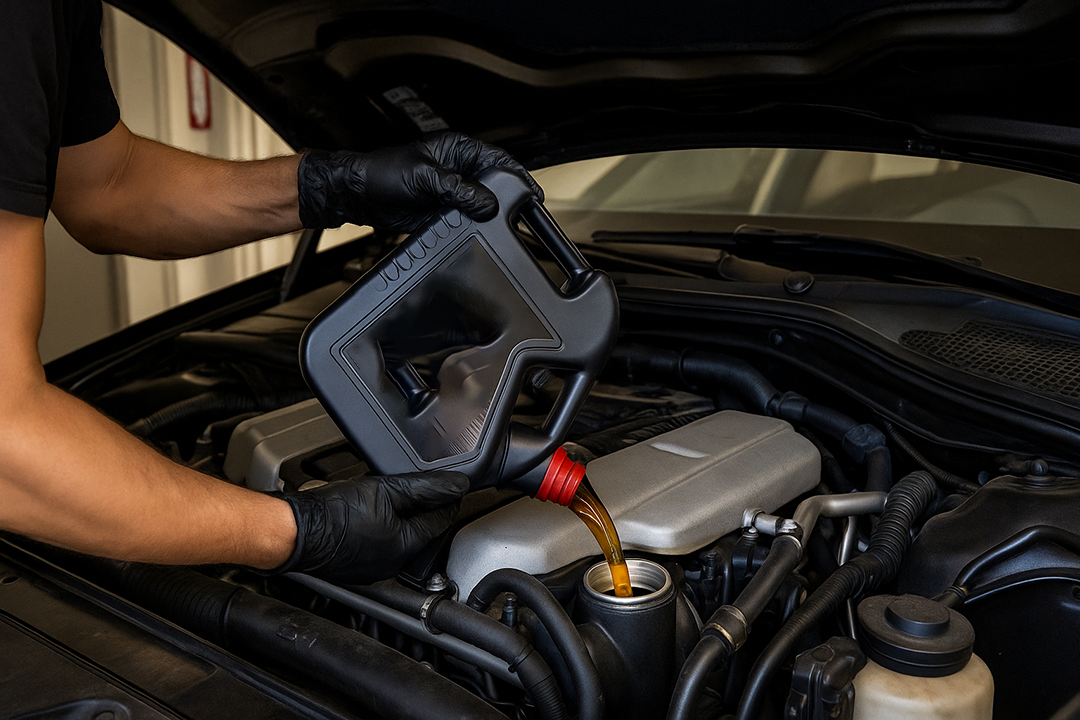
- We add fluorescent UV dye to the engine oil.
- The engine runs under various loads.
- We inspect the entire engine with a high-intensity UV lamp.
UV dye travels with the oil, so it exposes:
- Hairline cracks
- Pinholes
- Seepage points
- Gasket failures
- Turbo oil line leaks
- Oil cooler seal failures
It does not lie.
If you’re serious about leak diagnostics, you use dye. If a shop isn’t doing it, they’re guessing.
4. Pressure Testing the Crankcase — The Hidden Leak Maker
A failing PCV system creates excess crankcase pressure, which forces oil out of every weak seal. This is extremely common on:
- BMW N20, N26, N54, N55, B58
- Audi 2.0T and 3.0T
- Mercedes M278, M276
- VW/Audi 1.8T and 2.0T
Symptoms:
- Oil leaks that appear “everywhere”
- Whistling noise
- Rough idle
- High oil consumption
A proper shop uses:
- Crankcase vacuum gauge
- Smoke machine
- PCV flow test
If crankcase pressure isn’t right, the leak source you see may not be the true cause.
5. Smoke Testing — Finding Leaks That Dye Can’t Show
Smoke machines aren’t just for vacuum leaks. They help identify oil leak points when:
- The engine is cold
- The oil hasn’t traveled far
- The leak is blocked by components
- The leak is pressurized from the inside
We introduce low PSI smoke into the crankcase and watch where it escapes. This exposes:
- Rear main seal leaks
- Timing cover cracks
- Upper oil pan leaks
- Seals hidden behind pulleys
Another step that replaces guesswork with evidence.
6. High-Resolution Borescope Inspection
Some leak origins sit in places you can’t see by eye:
- Under intake manifolds
- Behind turbo assemblies
- Deep inside engine valleys
- Around gearbox mating surfaces
A borescope lets us inspect these areas without removing parts.
This is especially useful on:
- Audi and VW 2.0T (rear main seal)
- BMW engines with tight engine bays
- Porsche boxer engines
A cheap shop skips this step. A precision shop doesn’t.
7. Monitoring During and After a Drive Cycle
Not every leak appears at idle. Many only show up:
- Under boost
- During deceleration
- At operating temperature
- After heat soak
- During high crankcase pressure events
We test through several drive conditions:
- Idle
- Highway
- Slow-stop traffic
- Boost/load (turbo engines)
Then the vehicle sits in the bay for final UV inspection.
This is how we catch intermittent leaks that DIY methods miss entirely.
The Biggest Misunderstanding About Oil Leaks
Most people assume the wettest area is the source.
It rarely is.
Oil travels down:
- Engine angles
- Wiring harnesses
- Timing covers
- Engine mount brackets
- Transmission bell housings
What looks like a rear main seal leak is often:
- Valve cover gasket
- Oil filter housing
- Oil cooler seal
- PCV diaphragm failure
This is why teardown is almost never needed to diagnose — only to repair.
Why You Should Never Let a Shop “Guess” the Leak
Some shops will say:
“Let’s replace the valve cover and see if the leak stops.”
Or worse:
“It’s probably the rear main seal.”
This is sloppy, expensive, and unnecessary.
A professional diagnostic avoids:
- Replacing parts that don’t need replacing
- Multiple charges for labor
- Misdiagnosing PCV-related leaks
- Unnecessary engine disassembly
- Wasting your time and money
At EuroX Performance, we do not guess.
We verify, validate, and document every leak before quoting.
This is how you save thousands.
Case Studies from Golden, Colorado
1. BMW N55 – “Rear main seal leak” that wasn’t
The customer came from Lakewood. Another shop quoted $2,200 for a rear main seal.
Our inspection found:
- Oil filter housing gasket leak
- PCV vacuum failure
- Total repair: $540
- Leak gone. Engine dry.
2. Audi A4 2.0T – Oil pan leak misdiagnosed
Referred from Wheat Ridge.
The “oil pan leak” was baked residue from a failed valve cover gasket dripping down the block.
Correct fix: $380
Saved the customer an unnecessary $1,200 repair.
3. Mercedes E350 – Mystery leak
Owner from Arvada.
Dye test showed:
- Oil cooler seal failure (classic M272/M273 issue)
- Minimal teardown required; exact leak isolated.
- Customer back on the road the same day.
DIY Diagnosis: What You Can Do Without Tools
Here’s what you can check before coming in:
1. Look at the leak location
Front? Rear? Passenger side? Driver’s side?
2. Check how fast the leak appears
One drop per day vs. multiple drips per minute tells a lot.
3. Smell the fluid
Oil smells different than transmission fluid or coolant.
4. Monitor engine oil consumption
If you’re losing a quart every 800–1500 miles, the leak is significant or the PCV system is involved.
5. Don’t wipe everything off
We need to see the pattern.
When an Oil Leak Becomes Dangerous
Some leaks are inconvenient.
Some are catastrophic.
Dangerous leak indicators:
- Oil on exhaust manifold (fire hazard)
- Oil on the serpentine belt (can cause the belt to slip into the engine)
- Oil pressure warning light
- Burning smell inside the cabin
- Rapid oil consumption
If you see any of these, bring the car to EuroX immediately.
Why EuroX Performance Is the Best Choice in Golden, Colorado
We’re not a generic shop.
We are a European-only specialist facility.
You get:
- Dealer-level diagnostics without dealer pricing
- European-specific testing for BMW, Audi, Mercedes, Porsche, VW, MINI
- UV dye testing
- Smoke and pressure testing
- High-accuracy documentation
- Real repair, not guesswork
And unlike many shops in Arvada, Wheat Ridge, or Lakewood, we don’t upsell parts “just in case.”
We fix exactly what’s needed — nothing more.
Final Takeaway
Diagnosing oil leaks doesn’t require tearing your engine apart.
It requires:
- Proper cleaning
- UV dye
- Pressure testing
- Smoke testing
- Borescope inspection
- Controlled drive cycles
- A technician who knows European engines inside out
Guessing costs money.
Precision saves it.
If you see oil under your BMW, Audi, Mercedes, Porsche, VW, or MINI, don’t wait for it to escalate.
Book a Diagnostic at EuroX Performance
We pinpoint your leak without unnecessary teardown — and repair it right the first time.
Schedule your diagnostic today.
Schedule a European engine inspection today with EuroX Performance in Golden, CO — your trusted shop for BMW, Mercedes, Audi, Porsche, and Volkswagen repair.
Whether you’re in Golden, Westminster, Lakewood, or Wheat Ridge, you can rely on EuroX Performance for precise European-level service without dealership pricing.
FAQs
Q:Can you really diagnose an oil leak without disassembling the engine?
A:Yes. A proper oil leak diagnostic does not require engine teardown. Professional shops use UV dye, crankcase pressure testing, smoke testing, and borescopes to pinpoint the exact source. Tearing down the engine before confirming the leak origin is a waste of money and usually leads to unnecessary repairs.
Q:Why do oil leaks on European cars seem to come from multiple places at once?
A: Because European engines run higher crankcase pressure and use more complex gasket designs. When the PCV system fails or a gasket weakens, oil migrates down the block, subframe, and wiring harnesses. This creates the illusion of “multiple leaks” when the true source is usually one or two components. Proper dye and pressure testing clarifies the real origin.
Q:Is it dangerous to keep driving with a small oil leak?
A: Small leaks can turn dangerous fast. If oil reaches the exhaust manifold, it becomes a fire risk. If it reaches the serpentine belt, the belt can slip or shred and get pulled into the crank seal. If oil pressure drops, you can damage bearings or the turbo. Even a slow leak should be inspected before it becomes an expensive failure.
At EuroX Performance, serving Golden CO, Wheat Ridge CO, Arvada and Westminster CO, we use mechanical gauges and diagnostic scanners to pinpoint the exact cause. We never guess or replace parts blindly.
If you noticed any of the signs that might indicate your European car needs attention, don’t wait. Call EuroX Performance at (303) 719-8888 or schedule an appointment online at www.euroxperformance.com. We’ll get your Audi, Mercedes, BMW or European vehicle back to running like new.
🛠️ Ready for Diagnostic?
Please don’t wait for a warning light to tell you it’s time. Keep your European engine running like new, book your following diagnostic with EuroX Performance today.
👉 Schedule Service | 🚘 Performance You Can Feel