Table of Contents
- When Your Porsche's Electrical System Fails You
- Why Generic Shops Struggle with Porsche Electronics
- Our Dealer-Level Diagnostic Approach to Porsche Vehicles
- Common Porsche Electrical Problems We Solve Daily
- Advanced ECU and Module Diagnostics at EuroX
- The Role of OEM Specifications in Electrical Repair
- Hybrid and Electric Porsche System Expertise
- Our Complete Diagnostic and Repair Process
- Performance Implications of Electrical System Health
- Why Our Veteran Team Excels at Complex Troubleshooting
- Preventing Future Electrical Issues Through Expert Maintenance
- Schedule Your Porsche Diagnostic Appointment Today
When Your Porsche’s Electrical System Fails You
Your Porsche dashboard suddenly lights up like a Christmas tree. The engine runs rough, or worse, won’t start at all. You drive to the nearest shop, describe the problem, and receive a diagnosis that feels generic and unconvincing. This scenario plays out too often with Porsche owners who visit facilities unprepared for the complexity of modern German engineering.
Electrical failures in Porsche vehicles are rarely simple. Unlike a loose battery cable on a standard sedan, Porsche systems involve interconnected modules communicating across multiple networks. A single fault in one component can trigger cascading warnings throughout your vehicle’s architecture. When you’re facing this situation, you need more than a general mechanic and basic diagnostic tools.
We understand the urgency and frustration. Our team at EuroX Performance has spent years specializing in exactly these scenarios, developing the expertise and technology required to pinpoint electrical issues that leave other shops guessing.
Why Generic Shops Struggle with Porsche Electronics
Most independent repair facilities operate with outdated diagnostic equipment and technicians trained on mainstream vehicles like Fords and Hondas. Porsche electrical systems operate on an entirely different level of sophistication. The problem isn’t laziness or incompetence on the mechanic’s part; it’s a fundamental mismatch between what the shop is equipped to handle and what your car demands.
Here’s why generic shops fall short:
- Lack of specialized diagnostic software that communicates with Porsche’s proprietary control modules
- Technicians without training on the specific architecture of 911, Cayenne, Panamera, and Taycan electrical systems
- Inability to interpret Porsche-specific fault codes, which differ significantly from industry-standard OBD-II codes
- Missing access to manufacturer technical bulletins and service updates that document known issues
- Insufficient understanding of how Porsche’s integrated systems interact with one another
When a generic shop encounters a Porsche electrical problem outside their scope, they often replace components shotgun-style, hoping to fix the issue. This approach wastes your money and may introduce new problems. You deserve precision diagnosis, not guesswork.
Our Dealer-Level Diagnostic Approach to Porsche Vehicles
We’ve invested in the same caliber of diagnostic equipment that Porsche dealerships use, combined with the deep technical knowledge that independent specialists bring. This combination gives us advantages on both fronts: dealership-quality tools with personalized, efficient service.
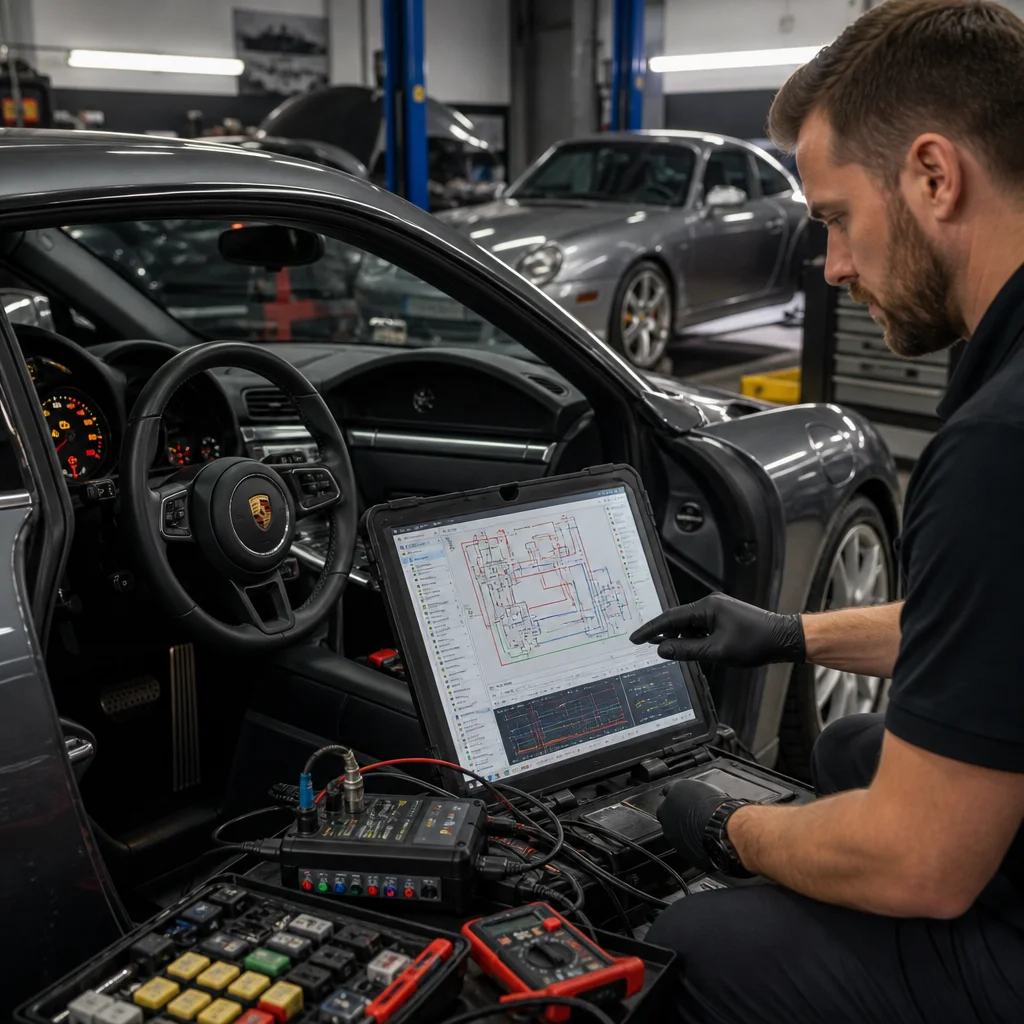
Our diagnostic approach starts with a comprehensive scan using equipment that connects directly to all of your Porsche’s control modules. We don’t just read check engine lights; we access the entire electrical architecture, pulling stored fault codes, pending codes, and freeze-frame data that reveal the precise conditions when a fault occurred.
From there, our technicians correlate what the computer is telling us with your description of the symptoms. We perform targeted electrical testing, oscilloscope analysis, and module communication verification. This multi-layered approach eliminates false positives and gets to the root cause quickly.
Action for you: Document any symptoms you notice before your appointment. Note when lights appeared, what driving conditions trigger the issue, and whether the problem is consistent or intermittent. This information accelerates our diagnosis.
Common Porsche Electrical Problems We Solve Daily
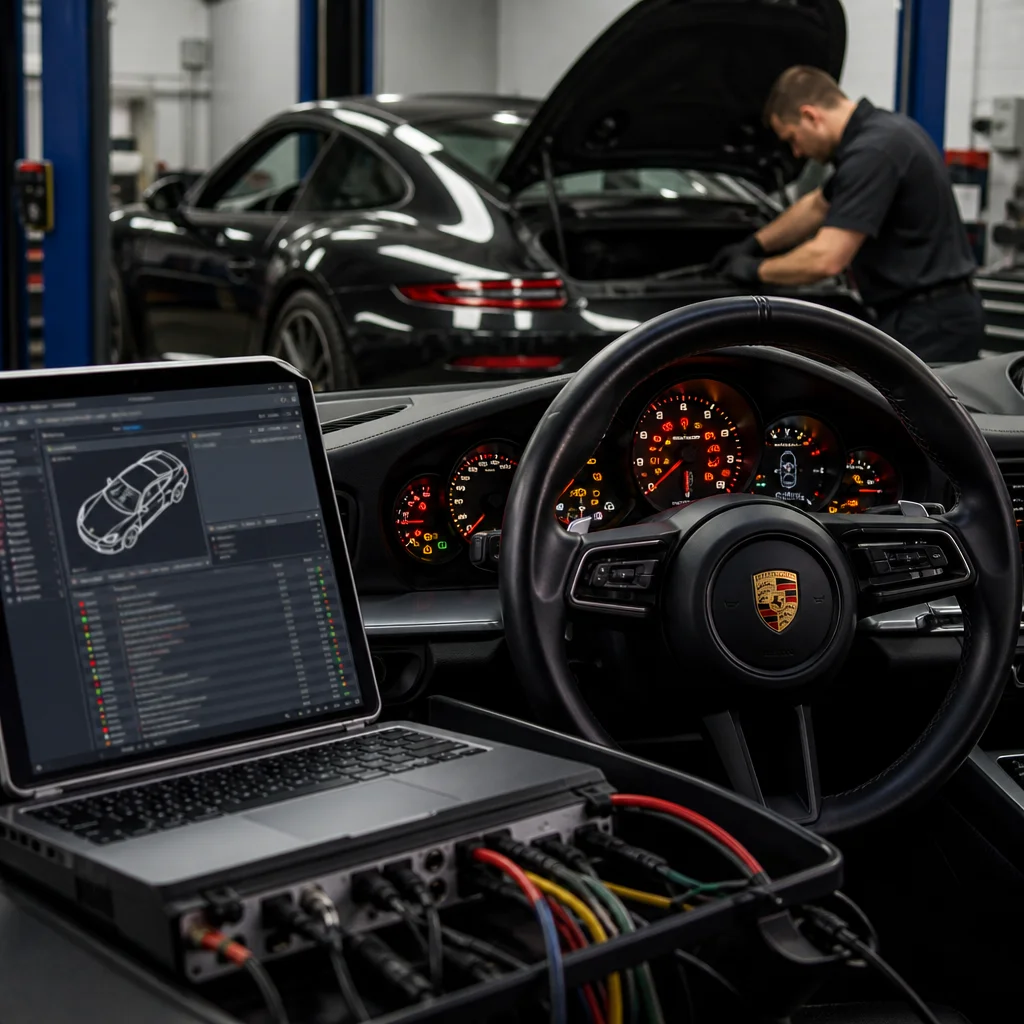
We’ve developed deep familiarity with the electrical issues that plague Porsche owners most frequently. Recognizing patterns across dozens of vehicles has taught us which problems tend to cluster together and which solutions have the highest success rate.
Battery and charging system failures rank high. Many Porsche owners mistakenly believe a dead battery indicates a bad battery itself. Often, the real culprit is a failing alternator, voltage regulator malfunction, or parasitic drain from a malfunctioning module. Without proper diagnostics, you might replace a perfectly good battery.
Gateway module failures represent another category we see regularly. These control modules act as traffic managers for your car’s electrical communication. When a gateway fails, multiple systems can malfunction simultaneously, creating bewildering symptom combinations. Proper diagnosis requires isolating the gateway module and verifying its communication status.
Sensor failures also consume a significant portion of our diagnostic workload. Porsche vehicles rely on dozens of sensors feeding data to engine control units. A single faulty sensor can trigger multiple warning lights and cause performance issues that feel unrelated.
We also address Porsche electrical gremlins that appear intermittently, which demand patience and sophisticated testing methodology to reproduce and isolate.
Advanced ECU and Module Diagnostics at EuroX
Engine control units and transmission modules in Porsche vehicles contain millions of lines of code. These aren’t simple computers; they’re sophisticated systems capable of adaptive learning, predictive adjustments, and complex decision-making. Diagnosing issues within these systems requires more than plugging in a scanner.
We perform deep ECU diagnostics that go beyond reading codes. Our process includes data stream analysis, where we monitor live parameters flowing in and out of your control modules in real-time. This reveals whether sensors are providing accurate information, whether module communication is healthy, and whether the ECU’s responses align with expected behavior.
When we suspect a module has suffered memory corruption or software issues, we can reflash the control unit with factory-specification firmware. This process restores the module to its original operational state without replacing expensive hardware. In many cases, a problematic ECU can be recovered this way, saving you thousands of dollars compared to replacement.
Our team also specializes in custom ECU remapping for performance applications. When you want your Porsche to deliver more power or enhanced responsiveness, we modify the ECU’s parameters while maintaining all safety and emissions compliance. This expertise means we deeply understand how these systems operate and can diagnose related electrical issues that other shops would miss.
The Role of OEM Specifications in Electrical Repair
Factory specifications exist for a reason. Porsche engineers have determined exact voltage parameters, current limits, timing sequences, and communication protocols that every component must follow. When we perform electrical repairs, we don’t improvise or substitute generic components. We work strictly within OEM specifications.
This commitment to manufacturer standards means:
- We source original Porsche parts or OEM-equivalent components that meet factory specifications exactly
- We verify every repair against factory service documentation and technical bulletins
- We ensure all electrical parameters fall within Porsche’s precise tolerances
- We document every repair using Porsche’s official procedures
Cutting corners on electrical work creates cascading failures down the line. A slightly substandard repair might pass initial testing but degrade over months, leading to repeated failures and customer frustration. We refuse to operate that way.
Hybrid and Electric Porsche System Expertise
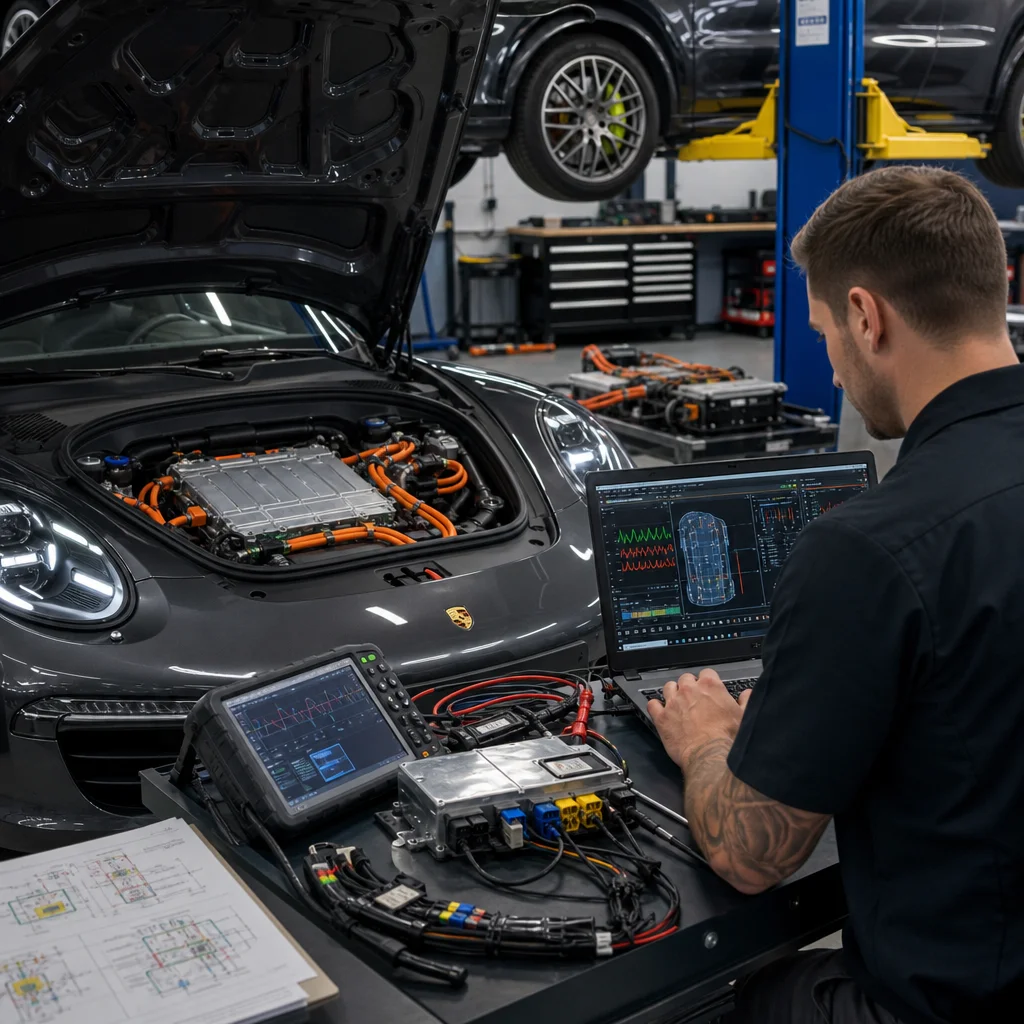
Hybrid models like the Cayenne E-Hybrid and fully electric vehicles like the Taycan introduce complexity that compounds traditional electrical troubleshooting. These powertrains integrate high-voltage battery systems, electric motor controllers, and regenerative braking circuits that operate on fundamentally different principles than gasoline engines.
Our technicians are trained specifically in hybrid and electric Porsche systems. We can diagnose battery management system failures, inverter malfunctions, and charging infrastructure issues. We’re equipped with the proper safety protocols and isolation procedures required when working with high-voltage systems. We understand the unique diagnostic codes these vehicles generate and the specialized testing required to verify their operation.
As more Porsche owners transition to hybrid and electric models, this expertise becomes increasingly valuable. We’re prepared to service these vehicles with the same precision we apply to traditional platforms.
Our Complete Diagnostic and Repair Process
When you bring your Porsche to us, here’s exactly what happens:
Initial Consultation: We listen carefully to your description of symptoms, when they occur, and their frequency.
Comprehensive Scan: We connect to all modules using dealer-level equipment and extract complete diagnostic data.
Physical Inspection: We visually examine electrical connections, harnesses, grounds, and components for corrosion, damage, or loose connections.
Targeted Testing: Based on scan results and symptoms, we perform oscilloscope analysis, voltage testing, and continuity checks on specific circuits.
Root Cause Determination: We identify the actual failure point, not just the symptom it created.
Written Estimate: We explain findings clearly, present repair options with transparent pricing, and provide timeline expectations.
Precision Repair: We execute the repair using OEM parts and factory procedures, documenting everything.
Verification Testing: After repair, we re-scan the vehicle, test all affected systems, and verify that symptoms have resolved completely.
This structured approach eliminates surprises and ensures you understand exactly what we’re doing and why.
Performance Implications of Electrical System Health
Your Porsche’s electrical system doesn’t just keep the lights on. It directly impacts engine performance, transmission response, suspension tuning, and driving dynamics. A failing sensor or malfunctioning module can rob your car of horsepower, responsiveness, and precision handling.
When an electrical component begins degrading, your Porsche’s control systems often enter fail-safe modes. These conservative operating states protect your engine but significantly reduce performance. You might notice sluggish throttle response, delayed gear shifts, or a general flatness in acceleration. Restoring full electrical health immediately restores the dynamic driving experience Porsche is engineered to deliver.
This connection between electrical health and performance is why we prioritize electrical diagnostics. Addressing these issues isn’t just about fixing warning lights; it’s about reclaiming your Porsche’s full potential.
Why Our Veteran Team Excels at Complex Troubleshooting
Our shop is veteran-owned and operated, and that background shapes how we approach complex problems. Military training emphasizes systematic thinking, attention to detail, and methodical problem-solving under pressure. These principles translate directly to advanced electrical diagnostics.
Our technicians bring specialized training from Porsche manufacturer programs combined with real-world experience diagnosing hundreds of European vehicles. This combination creates intuition that shortcuts the troubleshooting process without sacrificing accuracy. We know which questions to ask, which tests to prioritize, and which patterns typically indicate specific failures.
We also maintain our certifications and continuously update our knowledge as Porsche releases new models and technical bulletins. The automotive industry evolves quickly, and we stay current with the latest developments in Porsche engineering.
Preventing Future Electrical Issues Through Expert Maintenance
Electrical problems often develop gradually. Corrosion accumulates in connectors, battery terminals lose their tight connection, and aging grounds develop high resistance. Catching these issues early prevents catastrophic failures.
We recommend annual electrical system inspections for Porsche vehicles, particularly those over five years old. During these inspections, we examine:
- Battery health and terminal condition
- Ground connection integrity throughout the vehicle
- Alternator output and voltage regulation
- Module communication and data integrity
- Sensor operation and calibration
This preventive approach costs far less than emergency diagnostics and repair when an electrical failure strands you on the road. Think of it as insurance against unexpected breakdowns.
Schedule Your Porsche Diagnostic Appointment Today
When your Porsche is exhibiting electrical symptoms or warning lights, delay only compounds the problem. We’re located in Golden, Colorado, and equipped to provide the dealer-level diagnostic expertise your vehicle deserves.
Contact us to schedule your comprehensive Porsche electrical diagnostic appointment. We’ll provide honest assessment, transparent pricing, and the precision repairs that keep your Porsche performing at its best. Our team is ready to solve the electrical challenges that generic shops can’t handle.