Table of Contents
- Why European Vehicle Owners Choose Factory Restoration
- Understanding Performance Modifications and Their Impact
- Our Comprehensive Restoration Process
- ECU Remapping Reversal and Factory Reset Procedures
- Engine and Transmission Restoration to OEM Standards
- Diagnostic Assessment and Factory Specification Verification
- Benefits of Restoring Your European Vehicle
- Common Concerns About Modification Reversal
- Our Technical Expertise and Certification
- Selection Guide: Why EuroX Performance Leads the Industry
Why European Vehicle Owners Choose Factory Restoration
European vehicle owners invest in restoration to factory specifications for practical reasons that go beyond sentiment. When modifications accumulate over years of ownership, or when you’re preparing to sell a high-value asset, reverting to OEM standards protects your investment and warranty coverage.
We’ve seen owners discover that aggressive tuning voids manufacturer support on critical components. A performance ECU map that boosts horsepower by 40 percent also stresses the transmission, suspension geometry, and cooling systems beyond their intended limits. When something fails, dealers won’t warranty the repair because the vehicle has been modified.
Another common scenario: you’re financing a loan on a performance-modified European car, and the lender requires proof the vehicle meets factory specifications. Insurance companies increasingly scrutinize modified vehicles, sometimes denying coverage for modification-related failures. Restoring your vehicle to OEM standards removes these financial and legal complications.
Restoration also appeals to owners who originally chose performance modifications but now want reliability and longevity. The added weight and complexity of tuning takes a toll. Factory restoration delivers the balanced engineering your European manufacturer intended: smoother power delivery, predictable handling, and components designed to work together without strain.
Understanding Performance Modifications and Their Impact
Performance modifications come in layers, and each one compounds the stress on your vehicle’s systems. The most common modifications we encounter include ECU remapping, turbocharger upgrades, suspension lowering, exhaust system changes, and transmission software adjustments.
ECU remapping directly alters fuel injection timing, boost pressure, and ignition curves. A conservative tune might add 20 to 30 horsepower, while aggressive maps push vehicles well beyond manufacturer limits. The engine produces more power, but cylinder pressure rises, exhaust temperatures climb, and fuel consumption increases.
Turbocharger modifications amplify this effect. Adding a larger turbo or adjusting boost levels forces more air into the combustion chamber, requiring supporting modifications throughout the fuel system, cooling system, and intercooler design. Without full system integration, you risk bent valve stems, carbon buildup, and premature bearing wear in the turbo itself.
Transmission tuning alters shift points and throttle response curves. While performance mapping can feel sporty, it removes the margin of safety engineers built into gear ratios and clutch friction material. Extended exposure to aggressive shift logic accelerates wear on synchronizers and bearing surfaces.
Suspension and exhaust changes, though mechanical rather than electronic, force the engine and transmission to operate outside their thermal design window. A lowered suspension changes suspension geometry and increases stress on chassis welds. Freer-flowing exhaust systems reduce backpressure, requiring ECU adjustment to maintain proper fuel trim and emissions compliance.
Our Comprehensive Restoration Process
Reversing performance modifications requires methodical assessment and component-by-component restoration. We don’t simply reset the ECU and declare the work complete. Instead, we follow a structured protocol that addresses every layer of modification, verifies factory specifications at each step, and documents the results for your records.
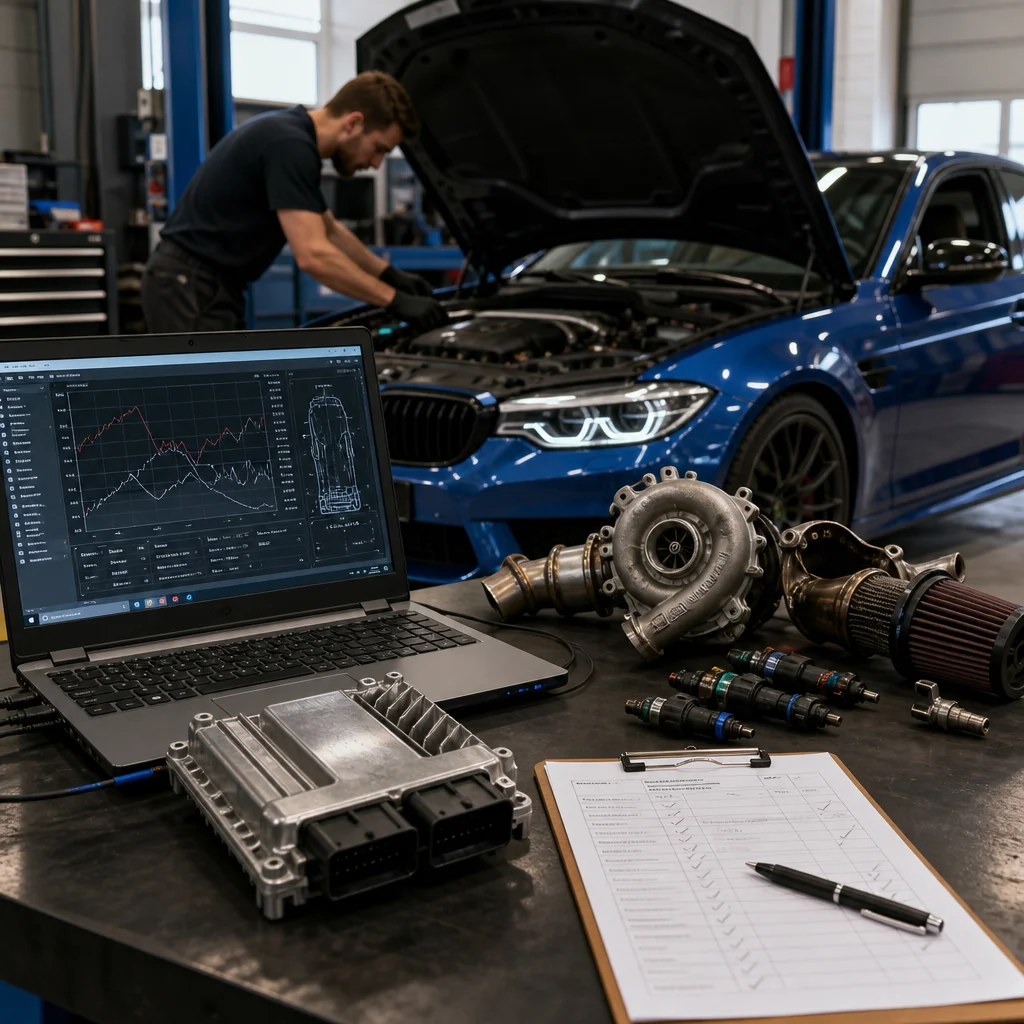
Our process begins with a complete vehicle scan using dealer-level diagnostic technology. This identifies all active and stored trouble codes, performance parameters that exceed OEM ranges, and any modifications to core vehicle systems. We create a detailed inventory of what needs to be restored.
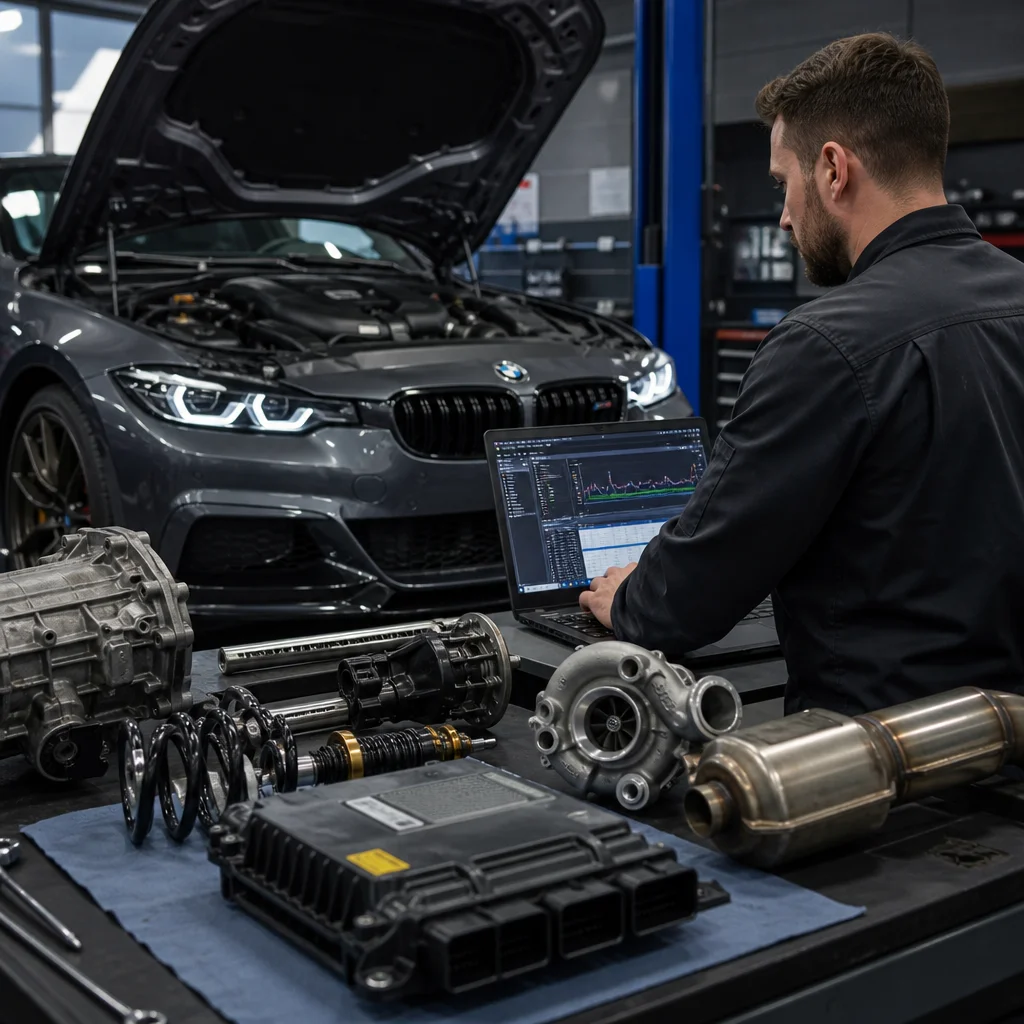
From there, we prioritize work in this sequence:
- ECU and software restoration to factory specifications
- Mechanical component inspection and replacement if needed
- Suspension geometry correction and calibration
- Cooling system verification and thermal load testing
- Hybrid and EV-specific systems (if applicable)
- Final verification against OEM specification sheets
Each phase includes targeted diagnostics to confirm factory operation before moving to the next step. We photograph and document every change so you have proof of restoration if needed for insurance, financing, or resale purposes.
ECU Remapping Reversal and Factory Reset Procedures
ECU remapping reversal is the cornerstone of performance modification removal. Modern European vehicles store factory firmware in secure memory locations, and restoring it requires the correct factory calibration file for your exact VIN, model year, and transmission type.
We maintain access to factory ECU databases through our OEM connections and dealer-level subscription services. When you bring your vehicle to us, we first extract your current ECU calibration and compare it against the authentic factory file. This shows us exactly what tuning parameters have been altered.
The reversal process involves securely erasing the modified firmware and flashing the factory calibration back into the ECU. This isn’t a simple software patch; it’s a complete replacement of the control logic that governs fuel delivery, boost control, emission system operation, and transmission shift schedules.
After flashing, we verify the installation with a complete system scan. We confirm that all learned values reset properly, fuel trim adapts to factory parameters, and adaptive transmission learning begins fresh. We also test idle stability, cold start behavior, and high-load performance to ensure the ECU operates within designed parameters.
One critical detail many shops overlook: secondary systems like transmission control modules (TCM), engine control module (ECM), and body electronics sometimes communicate across a shared network. Resetting one without addressing the others can create communication errors or limp-mode conditions. We update and verify all related modules to ensure seamless integration.
Engine and Transmission Restoration to OEM Standards
Beyond software, physical components often require inspection and replacement when modifications have accelerated wear. Our engine rebuild services include detailed assessment of pistons, rings, valves, and bearing surfaces to determine whether components can function safely at factory power levels or require replacement.
Performance tuning stresses pistons through higher combustion pressures. We measure piston crown thickness and inspect for cracks or deformation. If compression ratios have been altered through different pistons or head gasket thickness changes, we restore OEM specification pistons and gaskets during the rebuild process.
Valve stems and valve seats suffer accelerated wear under aggressive tuning. We perform magnetic particle inspection to detect microscopic cracks and measure valve stem runout to factory tolerances. Valves that fall outside acceptable ranges receive replacement with OEM components.
Transmission restoration involves similar scrutiny. Modified shift logic accelerates wear on clutch friction material, synchronizers, and bearing races. Our drive train diagnostics include pressure testing, fluid analysis, and internal inspection to assess remaining component life. Heavily modified transmissions often require partial or full rebuilds to restore reliable operation at factory power levels.
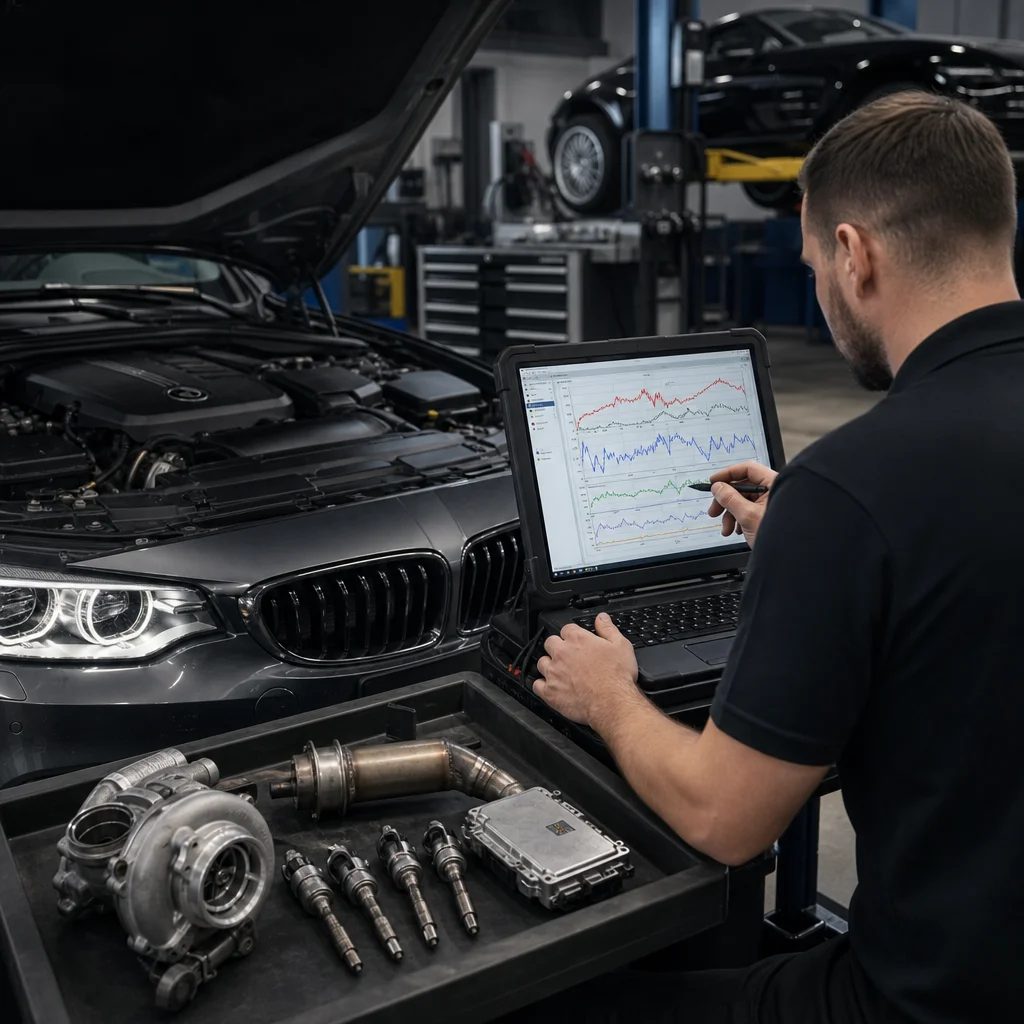
We use only OEM replacement parts during restoration. Aftermarket alternatives introduce variables that prevent us from guaranteeing factory specification operation. Your European vehicle deserves engineering precision that matches the original manufacturer intent.
Diagnostic Assessment and Factory Specification Verification
Comprehensive diagnostics anchor the entire restoration process. We don’t rely on customer reports or visual inspection alone; every claim about restoration completion is backed by measured data against OEM specification sheets.
Our diagnostic protocol includes:
- Full system scan across all control modules (engine, transmission, ABS, stability control, climate)
- Live data monitoring of fuel pressure, ignition timing, boost control, and fuel trim during accelerated operation
- Thermal imaging to confirm cooling system operation and heat distribution
- Suspension geometry measurement and four-wheel alignment verification
- Brake system pressure testing and safety verification
- Emissions baseline testing on vehicles subject to regulatory compliance
We measure critical parameters like oxygen sensor response, knock sensor sensitivity, and fuel injection duration against factory calibration curves. Any parameter outside acceptable range triggers additional investigation and correction.
For hybrid and EV systems, we verify battery management system (BMS) calibration, motor control module operation, and charging system compatibility with factory specifications. These systems require precise calibration for safe operation.
Documentation matters. We provide you with a detailed report showing before-and-after measurements, any components replaced, and confirmation that your vehicle meets OEM specifications across all systems. This report serves as proof for insurance companies, lenders, and potential buyers.
Benefits of Restoring Your European Vehicle
Restoring your vehicle to factory specifications delivers benefits that extend well beyond legal compliance. Reliability improves measurably when all components operate within their intended design window. Fuel consumption typically drops 15 to 20 percent as the ECU optimizes fuel delivery for baseline power levels rather than performance extraction.
Resale value receives significant protection. A certified factory-specification European vehicle commands stronger buyer confidence than one with unknown modification history. You can provide documentation proving restoration, which accelerates sales and improves final price.
Warranty coverage opens up on manufacturer-supported components. While existing warranty may have expired, future service visits don’t risk warranty denial due to modification-related failures. Dealers can service your vehicle without concerns about unsupported modifications voiding coverage.
Ownership experience shifts toward predictability. No more unexpected coolant temperatures, transmission shift shock, or fuel trim warnings on acceleration. The vehicle operates smoothly across all driving conditions because every system works in concert as originally engineered.
Long-term component longevity extends significantly. Suspension bushings, engine bearings, and transmission gears last considerably longer when not subjected to modification-induced stress. Your ownership costs decline as breakdown risk decreases.
Common Concerns About Modification Reversal
Owners sometimes worry that restoring factory settings will somehow damage their vehicle or void future modifications. The reality is opposite: reverting to factory specifications is the safest restoration path and returns your vehicle to a known, stable state.
Another concern involves data loss or corruption during the ECU flash process. Modern ECU programming includes multiple redundancy layers and verification steps. If the flash process encounters any error, the ECU protects itself by reverting to the previous state. Our equipment includes backup power supplies and surge protection to prevent interruptions during flashing.
Some owners ask whether factory restoration removes the “character” or performance feel of their vehicle. Factory European engines deliver substantial performance; restoring to OEM specs doesn’t mean accepting a slow vehicle. A stock BMW M440i, Porsche 911, or Audi RS delivers performance that exceeds most street-driven modifications while maintaining reliability and efficiency.
Cost concerns arise occasionally. Comprehensive restoration does require investment, particularly if mechanical components need replacement. However, the cost of restoration is substantially less than managing a warranty denial or repairing components damaged by modification stress. We’re transparent about pricing before work begins and can prioritize restoration phases if budget is a constraint.
Our Technical Expertise and Certification
We bring veteran precision and manufacturer-level expertise to every restoration project. Our diagnostic equipment matches dealer-level capabilities, including OEM scan tools, oscilloscopes, and thermal imaging systems. We maintain active subscriptions to factory ECU databases and OEM specification libraries updated for every model year.
Our technicians hold certifications from major European manufacturers and attend regular training on the latest vehicle technologies. We specialize exclusively in European and exotic vehicles, which means we understand the specific tuning vulnerabilities and restoration procedures that generic shops miss.
We maintain relationships with OEM parts suppliers and manufacturer technical support channels. When unusual modification scenarios require clarification on factory specifications, we contact manufacturer engineering resources directly. This level of access isn’t available to general-purpose repair facilities.
Our veteran-owned operation means we approach every restoration with the same precision and accountability we apply to critical systems. Your vehicle receives the attention to detail it deserves.
Selection Guide: Why EuroX Performance Leads the Industry
Choosing where to restore your European vehicle deserves careful consideration. The difference between competent restoration and comprehensive restoration often isn’t visible until months after the work is complete, when reliability and performance characteristics reveal whether all systems were properly addressed.
We distinguish ourselves through three critical advantages. First, we maintain complete factory specification databases and OEM part relationships that allow us to restore your vehicle to exact manufacturer standards, not approximate generic targets. Second, we document every step with measured data and diagnostics that verify restoration success beyond assumption. Third, we specialize exclusively in European vehicles, which means deep familiarity with modification patterns, common failure points, and restoration-specific challenges that generalist shops encounter infrequently.
Many shops can flash an ECU. Few can audit every modified system, rebuild components to exact OEM specifications, verify thermal and mechanical operation across all driving conditions, and provide documented proof that your vehicle meets factory standards. That comprehensive approach is what separates EuroX Performance from alternatives in the Golden area and beyond.
When your European vehicle matters enough to restore correctly, we bring the expertise, equipment, and commitment to precision that matches the engineering standards your vehicle was designed to meet. Contact us to discuss your modification reversal project and receive a detailed assessment of work required to return your vehicle to factory specification operation.