Table of Contents
- Why Stock ECU Settings Limit Your Vehicle's Potential
- How ECU Remapping Transforms Engine Performance
- The Difference Between DIY Tuning and Professional Remapping
- Our Certified Remapping Process for European Vehicles
- Real-World Benefits for BMW, Porsche, and Audi Owners
- Common Misconceptions About ECU Remapping Safety
- How We Protect Your Warranty During the Remapping Process
- Engine Diagnostics Before Your Remap
- Hybrid and EV ECU Optimization Services
- Performance Gains You Can Expect
- Choosing Between Stage 1 and Advanced Tuning Packages
- Schedule Your ECU Remapping Consultation
Why Stock ECU Settings Limit Your Vehicle’s Potential
Factory settings represent a compromise. Manufacturers tune engines to meet regulatory requirements, satisfy warranty obligations, and appeal to a broad customer base. The result is that your BMW, Porsche, or Audi leaves significant power on the table. ECU remapping unlocks what your vehicle was truly capable of delivering from the start.
Manufacturers calibrate engine control units with conservative parameters designed to protect their liability and maximize longevity across varied driving conditions and fuel qualities. This means your high-performance European engine operates well below its optimal efficiency and output levels.
Consider fuel timing, boost pressure, and injection parameters. Factory ECUs prioritize safety margins over performance. They account for worst-case scenarios: poor fuel quality, extreme climates, aggressive driving patterns, and minimal maintenance. For owners like you who maintain their vehicles properly and use quality fuel, these conservative restrictions waste potential.
The stock tune also limits responsiveness. Throttle response feels delayed because the ECU builds boost gradually to avoid putting stress on factory components. Acceleration plateaus before the engine reaches peak torque availability. Your transmission shifts at predetermined points that favor fuel economy over spirited driving.
What to do next: Review your vehicle’s performance specifications. Most European performance cars operate at 70-85% of their engineering capability from the factory.
How ECU Remapping Transforms Engine Performance
ECU remapping modifies the software that governs engine operations. We adjust fuel injection timing, boost pressure curves, ignition advance, and other parameters to extract maximum performance while maintaining reliability. This is not overclocking a computer; it’s recalibrating your engine to operate at its intended design capacity.
When we remap your vehicle, we’re working within the structural and thermal limits your manufacturer engineered into the engine. We simply remove the artificial restrictions the factory imposed. A 2.0-liter turbocharged engine might gain 40-50 horsepower and 60-80 pound-feet of torque through remapping alone.
The improvements extend beyond raw numbers. You’ll notice sharper throttle response, more linear power delivery across the RPM range, and improved part-throttle efficiency. The engine behaves the way performance engineers intended it to from the design phase.
Different remapping approaches target different objectives. Some focus purely on peak power output. Others balance performance with fuel economy. Still others prioritize drivability and everyday usability. Our approach matches the tune to your actual driving priorities and vehicle condition.
The Difference Between DIY Tuning and Professional Remapping
Consumer-grade tuning products promise simplicity. You download software, connect to an OBD-II port, upload a file, and walk away believing you’ve transformed your vehicle. The reality involves significant risks and limited results.
DIY tuning packages typically use generic maps created for average examples of your model. They don’t account for your specific engine’s wear patterns, fuel quality preferences, or modification history. A map optimized for a stock 335i performs very differently on a 335i with a larger turbo and upgraded injectors.
More critically, DIY solutions lack real-time monitoring and safety protocols. If something goes wrong, there’s no diagnostics, no backup plan, and potentially catastrophic engine damage. We’ve inherited vehicles where improper tuning caused boost spikes that fractured pistons or compromised cylinder seals.

Professional remapping involves complete engine analysis before any software changes. We measure actual engine behavior, verify all sensors function correctly, and confirm fuel system capacity. We create custom maps tailored to your specific vehicle rather than applying a one-size-fits-all template. If problems emerge during testing, we adjust the tune in real time rather than discovering issues after you’ve driven away.
Insurance implications matter too. Many policies specifically exclude damage resulting from DIY modifications. Professional remapping through an established service provider protects you legally and technically.
Our Certified Remapping Process for European Vehicles
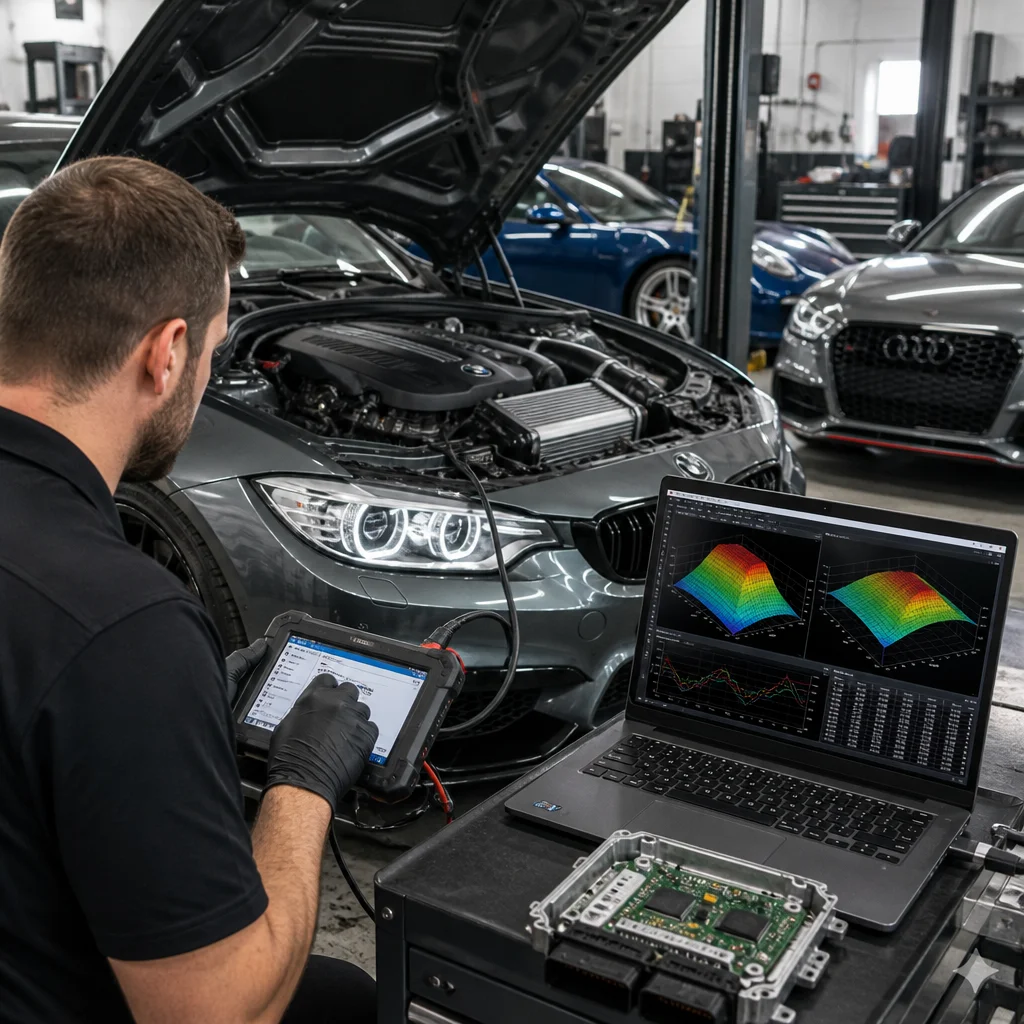
Our process begins with comprehensive engine diagnostics using dealer-level equipment. We scan all control modules, measure live sensor data, and establish baseline performance parameters. This step reveals any existing issues that must be addressed before remapping.
Next, we photograph and document your vehicle’s current state, including mileage, maintenance history, and any modifications. We discuss your performance goals, daily driving priorities, and fuel availability. A customer planning track days needs a different tune than someone prioritizing highway efficiency.
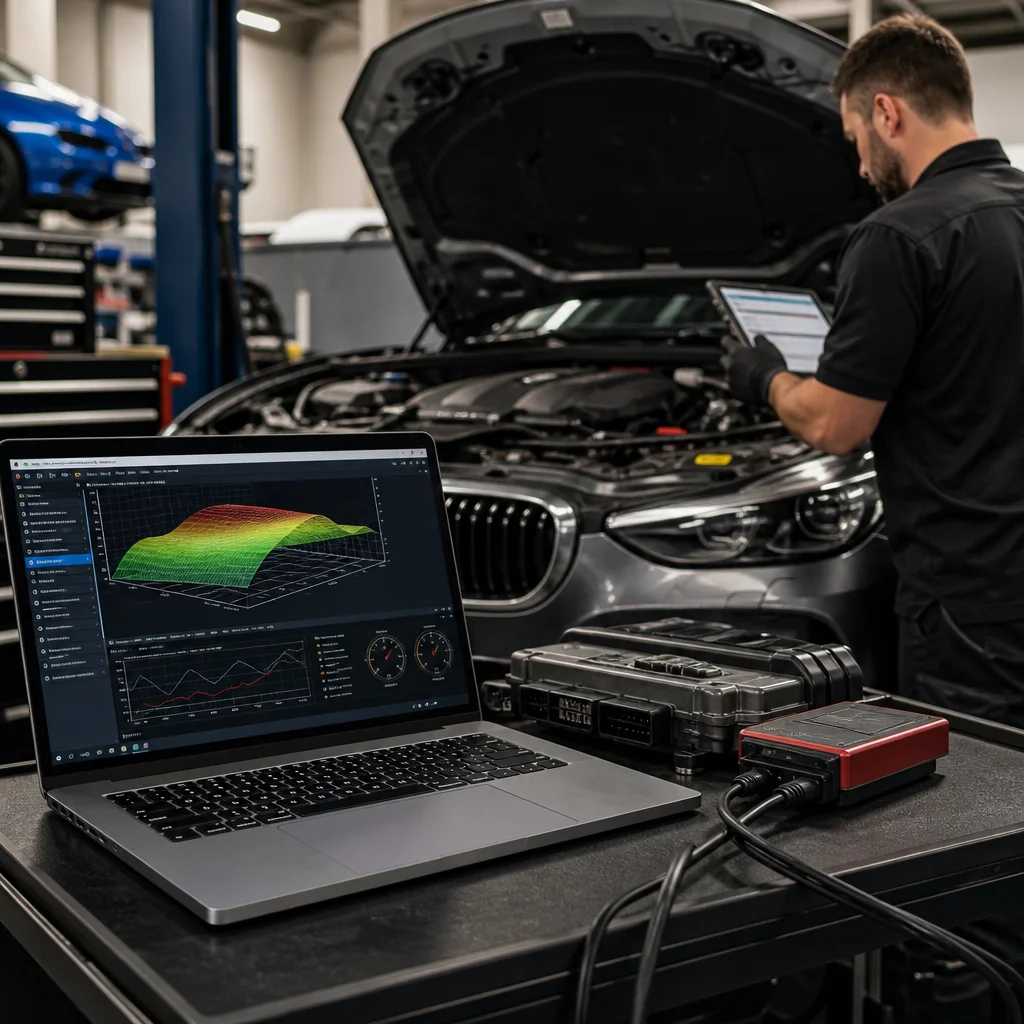
The remapping itself happens on our in-house dynamometer. We load the custom map and monitor engine behavior across the full RPM range. Real-time data tells us whether boost response aligns with expectations, whether fueling supports the power target, and whether thermal limits remain within safe parameters. We make adjustments and retest until the tune meets our specifications and your expectations.
Before you drive away, we verify the tune is stable through extended dyno runs, check for any check engine light codes, and provide documentation showing before-and-after performance metrics.
Real-World Benefits for BMW, Porsche, and Audi Owners
BMW owners discover that remapping transforms responsiveness. A remapped 340i outaccelerates many stock M-models from a rolling start. The psychological difference is profound; the car finally feels as capable as it should.
Porsche owners using our performance upgrades services find that subtle improvements compound significantly. A remapped Cayman S gains approximately 35 horsepower, but more importantly, the power delivery becomes predictable and controllable rather than dependent on boost lag.
Audi customers report transformed driving dynamics. S4 models with dual turbos benefit enormously from boost optimization, gaining 50+ horsepower while maintaining fuel efficiency during normal driving. A4 40 TFSI models achieve responsiveness that rivals previous S4 generations.
The common thread: these improvements reveal what the manufacturer’s engineers designed into these platforms. You’re not forcing the vehicle to do something it wasn’t meant to do. You’re removing the restrictions that protected the factory’s liability.
Common Misconceptions About ECU Remapping Safety
The largest misconception: remapping damages your engine. This simply isn’t true if executed properly. Professional remapping works within the engineering specifications your manufacturer established. We don’t exceed thermal limits, cylinder pressure ratings, or stress tolerances.
Another myth suggests remapping immediately breaks components. Thousands of remapped European vehicles circulate with 100,000-plus miles without issues. The engines are designed to handle the power; the factory just restricted access to it.
Some worry that remapping voids warranties entirely. This is partially true, but the extent depends on your manufacturer and specific situation. We address this thoroughly before proceeding.
A final misconception involves fuel requirements. You don’t need race fuel for most remaps. Our standard maps optimize for quality 91 or 93 octane fuel available at any premium pump. Optional high-octane variants exist for owners with access to premium fuel, but they’re not mandatory.
How We Protect Your Warranty During the Remapping Process
We operate transparently regarding warranty implications. Before any work begins, we review your specific vehicle’s warranty structure and discuss affected components.
Modern warranties cover manufacturing defects, not owner modifications. Remapping doesn’t void your warranty automatically, but it may exclude engine-related coverage if the manufacturer can prove the remap caused specific damage. The manufacturer bears the burden of that proof.
We protect you by maintaining meticulous documentation. Our complete file includes pre-remap diagnostics, dyno data, temperature monitoring, and post-remap validation. If a warranty claim arises, this documentation establishes that our work was professional and the remap didn’t cause the issue.
We also offer warranty-safe tuning approaches. Some customers prefer conservative Stage 1 remaps that stay within extremely conservative limits. Others accept broader tuning in exchange for greater performance. We help you make that choice based on your warranty coverage and risk tolerance.
For high-value vehicles, we discuss extended warranty options that cover or exclude performance modifications, allowing you to make an informed decision.
Engine Diagnostics Before Your Remap
You cannot safely remap an engine with underlying issues. A failing oxygen sensor, faulty fuel injector, or compromised boost sensor creates unpredictable behavior during remapping. We must resolve these before proceeding.
Our diagnostic protocol includes complete scan of all engine control modules, fuel system pressure testing, compression analysis, and smoke testing for vacuum leaks. We measure boost pressure accuracy, verify turbocharger responsiveness, and confirm fuel delivery rates.
This diagnostic phase typically takes 2-3 hours. It costs extra upfront, but it prevents expensive mistakes and ensures your remap performs reliably. A customer once came in for remapping, but diagnostics revealed a failing fuel pump nearing critical failure. Replacing it before remapping was straightforward; discovering it after catastrophic damage would have been devastating.
Think of diagnostics as the foundation for everything that follows. A properly prepared engine responds predictably to remapping, sustains the new tune reliably, and performs consistently for years.
Hybrid and EV ECU Optimization Services
Hybrid powertrains present unique tuning opportunities. The energy management system can be optimized to maximize electric motor involvement during acceleration, reducing engine strain and improving efficiency. We’ve successfully tuned hybrid BMWs and Audis to improve throttle response while maintaining or exceeding fuel economy ratings.
EV tuning focuses on battery management and power delivery optimization. We can adjust regenerative braking intensity, customize acceleration maps, and optimize charging profiles. EV owners often don’t realize how much their driving experience can be personalized through software adjustments.
As European automakers expand their electric lineups, our EV expertise ensures owners of the latest technologies can still achieve personalized performance characteristics unavailable from the factory.
Performance Gains You Can Expect
Realistic expectations matter. A turbocharged engine typically gains 30-50 horsepower and 50-80 pound-feet of torque with Stage 1 remapping. Naturally aspirated engines show more modest gains, often 15-25 horsepower.
These figures depend on several factors: engine displacement, existing modifications, fuel system capacity, and how aggressively you want to push. A 4.0-liter V8 has different headroom than a 2.0-liter four-cylinder.
Beyond the dyno numbers, you’ll experience throttle response improvement within the first mile of driving. That’s the most noticeable change for most owners. Power delivery feels immediate and linear rather than lazy and sudden.
Fuel economy typically improves slightly or stays neutral during combined driving. Heavy acceleration consumes more fuel, but steady-state cruising often runs more efficiently. Highway fuel economy often improves 1-2 MPG.
We provide dyno printouts showing before-and-after performance curves. You’ll see the exact horsepower and torque gains, helping you verify the remap delivered promised results.
Choosing Between Stage 1 and Advanced Tuning Packages
Stage 1 remapping represents our baseline professional tuning. It’s aggressive enough to transform how your vehicle feels, yet conservative enough to work safely with factory components and not jeopardize warranty coverage significantly.
Stage 1 suits owners who drive their cars normally but want noticeably better performance, owners with comprehensive warranty coverage, and those running factory internals without modifications.
Advanced packages account for upgraded turbos, injectors, fuel pumps, and intercoolers. We can push harder because reinforced components handle the extra stress. These tunes extract maximum performance from your specific combination of upgrades.
Choose your package based on your vehicle’s modification level, warranty situation, driving intentions, and performance targets. We’ll help assess which tier makes sense during your consultation.
Schedule Your ECU Remapping Consultation
We invite you to discuss how ECU remapping can transform your European vehicle. Our technicians review your specific model, driving priorities, and modification history to recommend the optimal approach.
Contact us at https://euroxperformance.com or call to schedule your no-pressure consultation. We’ll perform comprehensive diagnostics, explain our findings, and provide transparent pricing. You’ll understand exactly what remapping can deliver for your vehicle before committing.
Your European import deserves to perform at its engineered potential.