Table of Contents
- Why High Mileage European Vehicles Demand Specialized Tuning Knowledge
- The Performance Plateau: What Generic Shops Miss With Aging Imports
- Our Advanced Diagnostic Approach for High Mileage European Engines
- Engine and Transmission Rebuilds: Restoring Performance to Your Import
- ECU Remapping and Performance Optimization for Veteran European Vehicles
- Maintaining Dealer-Level Standards With OEM Parts and Specifications
- Hybrid and EV Service for Modern European Performance Cars
- The Long-Term Value of Precision Engineering Over Quick Fixes
- Why European Vehicle Owners Trust Our Veteran-Owned Shop
Why High Mileage European Vehicles Demand Specialized Tuning Knowledge
European performance vehicles are engineered to precision specifications that diverge significantly from domestic standards. Your BMW, Porsche, or Audi doesn’t respond to tuning the same way a domestic sedan does. High mileage compounds this complexity because wear patterns, component degradation, and system integration issues become critical variables that generic technicians often overlook.
When a European import reaches 80,000 miles or beyond, its original engineering tolerances have shifted. Valve timing drifts, fuel injection systems accumulate carbon deposits, and transmission fluid degradation affects shift calibration. Without specialized knowledge of how European manufacturers designed these systems to function across their entire lifespan, tuning efforts can actually reduce reliability or create unintended performance losses.
We understand that your imported European vehicle represents a significant investment. Maximizing its potential requires more than basic bolt-on modifications or generic ECU adjustments. It demands technicians who grasp the intricate relationships between fuel pressure, ignition timing, turbo boost curves, and transmission response on high-mileage European engines. This expertise separates precision performance work from costly mistakes.
Actionable takeaway: Before any tuning work, verify that your shop has specific experience with your vehicle’s make, model year, and current mileage range.
The Performance Plateau: What Generic Shops Miss With Aging Imports
Many owners experience a frustrating reality: their high-mileage European car feels slower or less responsive than it did at half its current mileage. Generic shops typically respond with surface-level diagnostics. They might suggest new spark plugs, a fuel system cleaning, or an aftermarket intake, expecting these modifications to restore lost performance.
This approach misses the underlying issues. At high mileage, performance degradation usually stems from:
- Carbon buildup in intake valves and fuel injectors reducing combustion efficiency
- Worn piston rings and valve seals increasing blow-by and compression loss
- Transmission shift logic drifting due to solenoid wear and fluid breakdown
- Oxygen sensor drift causing the engine computer to run richer fuel mixtures
- Turbocharger blade erosion (on turbocharged models) reducing boost pressure
A generic shop with standard diagnostic tools might identify one of these issues in isolation. Without the full picture, their recommended fix addresses only a symptom. Your car feels marginally better, costs you $800, and the fundamental problem remains. Six months later, you’re back to feeling that performance plateau.
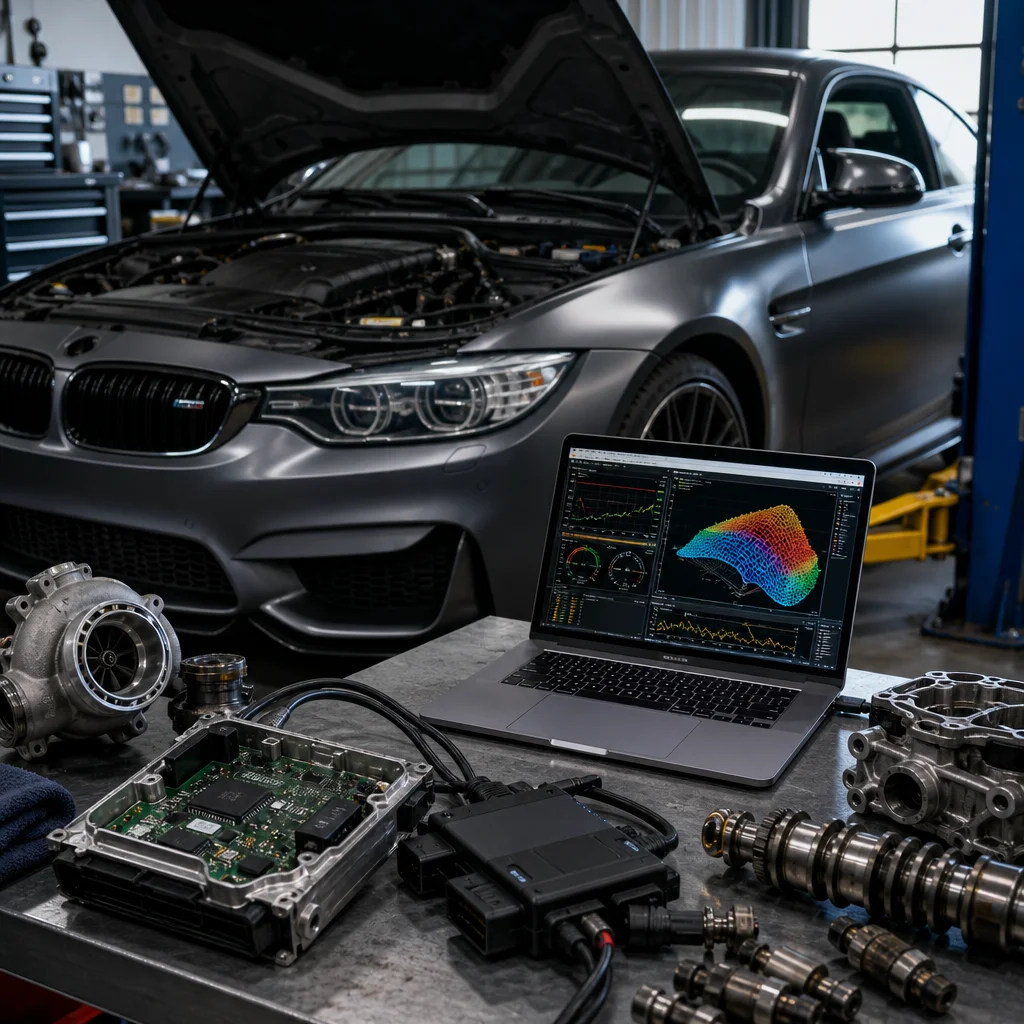
We use dealer-level diagnostic equipment to map the entire system’s behavior across engine load, rpm range, and operating temperature. This reveals which components are actually constraining your engine’s output and which modifications will provide genuine gains.
Our Advanced Diagnostic Approach for High Mileage European Engines
Our diagnostic methodology goes beyond fault codes. We perform dynamic testing that simulates real-world driving conditions while monitoring dozens of sensor inputs simultaneously. Here’s what this reveals for a high-mileage European engine:
- Combustion efficiency mapping: We measure fuel delivery, ignition timing, and actual combustion pressure to identify where efficiency is lost
- Compression testing: This tells us whether piston rings and valve seals still seal effectively
- Fuel system pressure and response: We verify that fuel injectors deliver the correct spray pattern and volume across all engine speeds
- Turbo system analysis: For turbocharged vehicles, we measure actual boost pressure, turbo response lag, and wastegate function under load
This data-driven approach means we never recommend a $5,000 engine rebuild when a $1,200 fuel injector cleaning and ECU recalibration would restore 95% of lost performance. Conversely, when internal engine wear genuinely requires rebuilding, we can show you exactly why.
Your diagnostic results become the foundation for every performance modification we recommend. You’re not guessing whether changes will help. You’re making informed decisions based on what your specific engine is actually doing.
Engine and Transmission Rebuilds: Restoring Performance to Your Import
High-mileage European vehicles sometimes require more than tuning adjustments. When compression testing reveals worn rings, when valve seat recession develops, or when transmission solenoids become unreliable, engine rebuild services restore both reliability and performance simultaneously.
We follow manufacturer specifications precisely. This means using OEM bearing tolerances, honing cylinders to exact dimensions, and setting ring gaps according to your engine’s design parameters. A rebuilt engine isn’t simply reassembled. It’s engineered to operate within the thermal and pressure ranges your vehicle’s management systems expect.
For transmissions, we rebuild them to dealer specifications, replacing wear-prone components like solenoids, seals, and friction materials. This is critical because a modern European transmission’s performance directly impacts how the engine’s tuning parameters perform. A sloppy transmission rebuild will nullify even excellent engine tuning work.
Many owners believe rebuilding an engine means choosing between expensive dealer work or risky independent shortcuts. We provide a middle path: precision work that meets manufacturer standards without the dealer price premium. Our technicians have spent years learning European assembly techniques, dimensional accuracy requirements, and quality verification methods.
ECU Remapping and Performance Optimization for Veteran European Vehicles
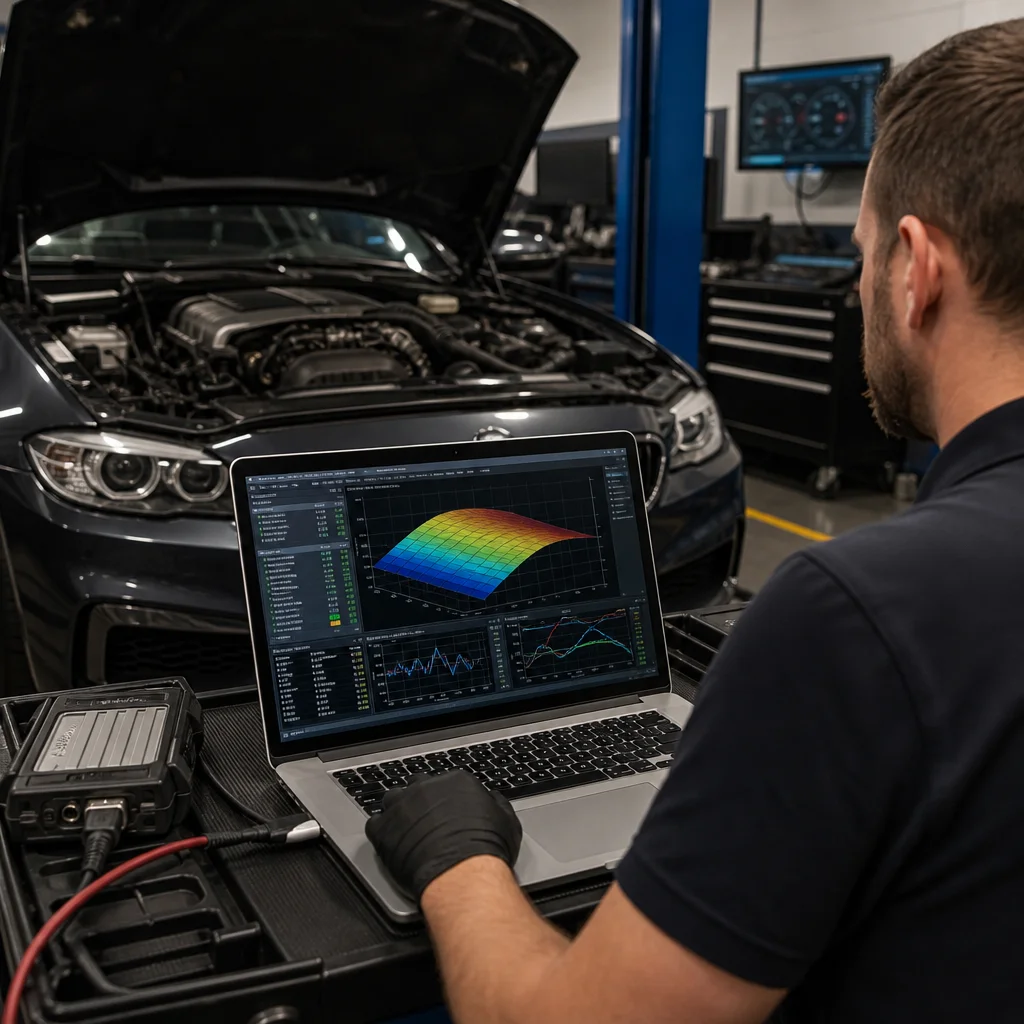
ECU remapping is often misunderstood as simply “turning up the boost” or increasing fuel pressure. Professional remapping on high-mileage European engines requires far more subtlety.
We analyze your engine’s current calibration data, compare it against factory specifications for your model year, and identify how mileage and component wear have shifted optimal parameters. Then we carefully adjust the fuel curve, ignition timing, and boost targets based on your engine’s actual capabilities.
For a 90,000-mile turbocharged engine, this might mean conservative boost increases paired with mid-range timing advances where combustion efficiency remains highest. We build in safety margins that respect your engine’s wear condition rather than maximizing output at the cost of reliability.
The remapping also optimizes transmission shift points and pressure profiles. On many European cars, the transmission computer and engine computer communicate constantly. Proper tuning coordinates these systems so the engine delivers power smoothly through gear changes rather than fighting against outdated transmission response logic.
This targeted approach means real-world gains: 15-25 additional horsepower and noticeable throttle response improvement without sacrificing reliability or longevity.
Maintaining Dealer-Level Standards With OEM Parts and Specifications
Here’s where we differ fundamentally from many performance shops: we use OEM parts or equivalent quality components that meet manufacturer specifications. We never compromise on part selection to reduce costs.
When we rebuild your engine, every bearing, seal, and gasket meets the original equipment manufacturer’s dimensional and material specifications. When we service your cooling system, we use the specific coolant formulation your manufacturer designed for your engine’s metallurgy. This consistency matters because European engineers designed every component to work within precise parameters.
Aftermarket “performance” parts sometimes bypass this engineering. They might promise better flow or lighter weight, but they often conflict with the detailed calibration your engine’s computer performs during cold start, warm-up, and load transitions. We prioritize reliability and verified performance gains over trendy modifications that create unexpected issues.
Hybrid and EV Service for Modern European Performance Cars
Modern European performance vehicles increasingly incorporate hybrid systems or full electric powertrains. Porsche, BMW, Audi, and Mercedes all offer high-performance hybrid or EV models that demand specialized service knowledge.
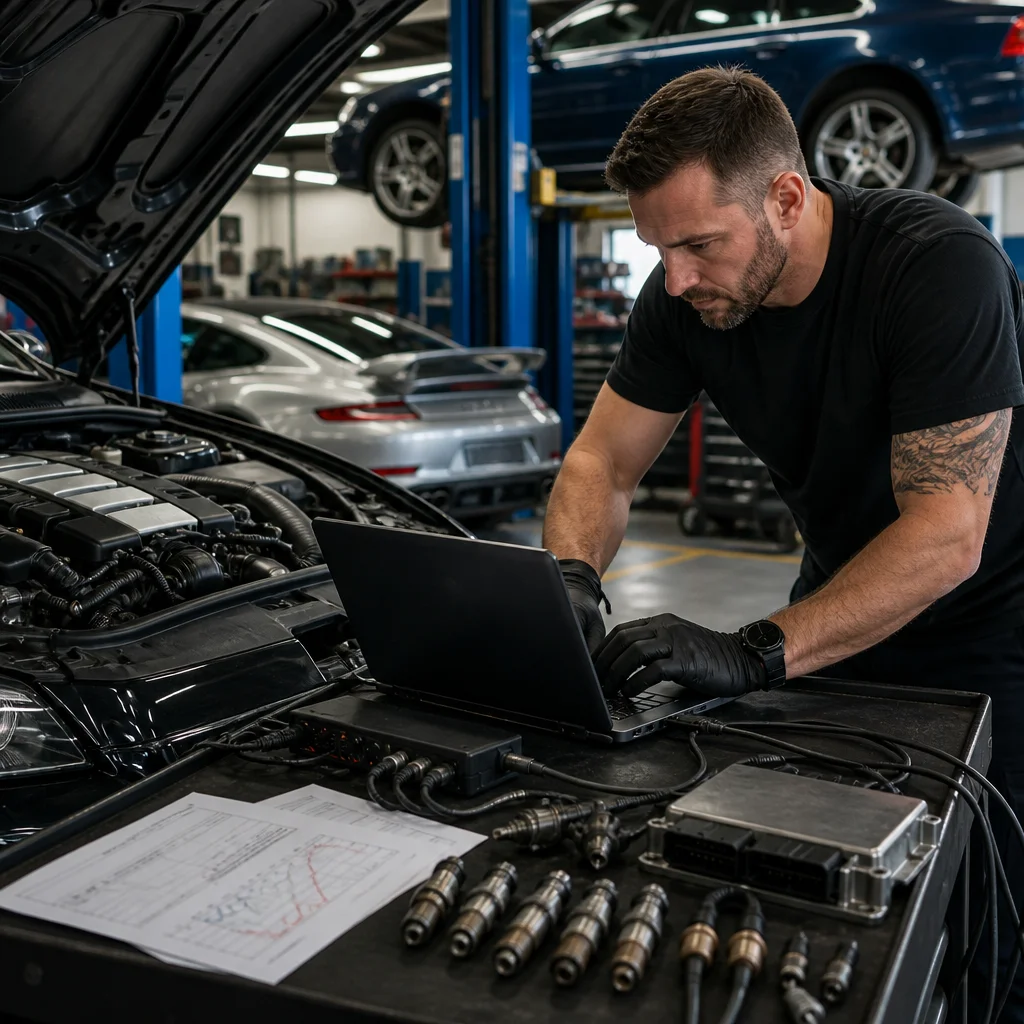
We maintain dealer-level capabilities for hybrid and EV diagnostics, battery management system programming, and electric motor performance verification. A hybrid performance vehicle requires understanding how energy recuperation interacts with braking feel, how the transition between electric and combustion power affects drivability, and how high-voltage battery conditioning preserves long-term performance.
For owners tuning hybrid systems, we ensure that any modifications work harmoniously with regenerative braking and power-blending logic rather than fighting against them. This creates a more refined driving experience than generic tuning approaches.
The Long-Term Value of Precision Engineering Over Quick Fixes
Quick fixes feel satisfying initially. A cheap tune-up shop remaps your ECU in an afternoon. Your car runs better immediately. You feel like you got a great deal.
Then, six months later, your transmission feels sluggish. The check engine light appears. Your fuel economy plummets. The initial savings evaporate when you’re facing unexpected repairs.
Precision engineering costs more upfront because it requires time: thorough diagnostics, careful planning, quality components, and meticulous execution. But this investment prevents the compounding problems that cheap work creates. Your rebuilt engine lasts another 100,000 miles reliably. Your ECU remapping maintains consistent performance and fuel efficiency. Your transmission feels responsive because it was calibrated to work perfectly with your engine’s tuning.
Over the vehicle’s remaining lifespan, precision work costs less than repeated cheap repairs and reliability issues.
Why European Vehicle Owners Trust Our Veteran-Owned Shop
We’re veteran-owned and operated, which means we approach your vehicle with the same commitment to precision and reliability we brought to military service. Your high-mileage European import isn’t a quick revenue opportunity. It’s a vehicle you chose for performance and quality, and we’re committed to honoring that choice.
We combine deep European vehicle expertise with dealer-level diagnostic technology. This combination is rare. Most shops have one or the other. We maintain both because your vehicle deserves technicians who understand European engineering philosophies and have tools that reveal exactly what’s happening inside your engine.
When you bring your import to us, you’re getting honest diagnostics, realistic assessments of what work is actually necessary, and performance improvements that respect your vehicle’s engineering. We’re here to help you maximize your European import’s potential, not just sell the most expensive service we can imagine.
Ready to transform your high-mileage European vehicle’s performance? Contact us for a comprehensive diagnostic evaluation. We’ll show you exactly where your engine stands and which performance improvements will deliver the greatest benefit for your specific vehicle.