Table of Contents
- Why Audi Owners Pursue Turbo Performance Upgrades
- The Challenge: Balancing Power with Emissions Compliance
- How ECU Remapping Unlocks Turbocharged Potential
- Our Dealer-Level Diagnostic Approach to Safe Tuning
- Performance Gains Without Sacrificing Reliability
- Emissions-Compliant Tuning Standards We Follow
- Advanced Engine Rebuilds for Maximum Turbo Efficiency
- Real-World Results from Our Audi Clients
- Why Generic Shops Cannot Deliver Specialized Audi Tuning
- Our Process: From Diagnosis to Optimization
- Ongoing Support and Maintenance for Tuned Audi Turbos
Why Audi Owners Pursue Turbo Performance Upgrades
Audi turbocharged engines deliver impressive efficiency from the factory, but they’re deliberately tuned conservatively to meet global emissions standards and warranty requirements. Most Audi owners we work with recognize this reality: their vehicle is capable of significantly more power than what the factory allows.
The appeal is straightforward. A modern turbocharged Audi responds exceptionally well to optimization. Unlike naturally aspirated engines where power gains plateau quickly, turbo engines have substantial headroom built into their design. Owners pursuing performance upgrades typically want responsiveness improvements, better acceleration, and the satisfaction of unlocking their vehicle’s true potential without replacing engines or adding hardware.
Whether you drive an S4, RS5, or standard A4 with a turbo powerplant, the engineering foundation supports meaningful gains. That’s the real draw: measurable performance from intelligent software refinement.
The Challenge: Balancing Power with Emissions Compliance
Here’s where most shops stumble. Adding power to a turbocharged Audi isn’t difficult. Doing it safely while keeping your vehicle emissions-compliant and mechanically sound is an entirely different discipline.
The tension exists because factory ECU calibrations are engineered with multiple constraints: emissions regulations, durability margins for average drivers, fuel quality variability across regions, and long-term component longevity. When you increase boost pressure, fuel injection timing, and ignition advance, you’re pushing closer to mechanical limits. Push too far, and you risk:
- Increased nitrogen oxide emissions that trigger diagnostic trouble codes
- Elevated combustion temperatures that stress pistons and gaskets
- Transmission shifting strain if power delivery becomes too aggressive
- Premature carbon buildup on intake valves
The shops that ignore these trade-offs produce temporary performance that costs owners dearly in repairs. We approach tuning differently: we treat emissions compliance and mechanical safety as non-negotiable requirements, not afterthoughts.
How ECU Remapping Unlocks Turbocharged Potential
ECU remapping is software optimization, not hardware modification. Your Audi’s engine control unit contains hundreds of calibration tables that govern boost levels, fuel timing, ignition curves, and emission control strategies. Factory maps intentionally leave margin for reliability and regulatory compliance.
When we remap your ECU, we’re adjusting these parameters within safe, tested boundaries. For turbocharged Audis, this typically means:
- Increasing peak boost pressure by 0.3 to 0.5 bar
- Optimizing fuel injection timing across RPM ranges
- Refining ignition advance curves for your fuel octane rating
- Recalibrating turbo spool characteristics for quicker response
The result isn’t arbitrary. Every adjustment is validated against known engine tolerances, material properties, and emission standards. A well-executed remap on a 2.0T Audi might yield 50 to 80 additional horsepower, with torque gains proportionally distributed across the RPM band.
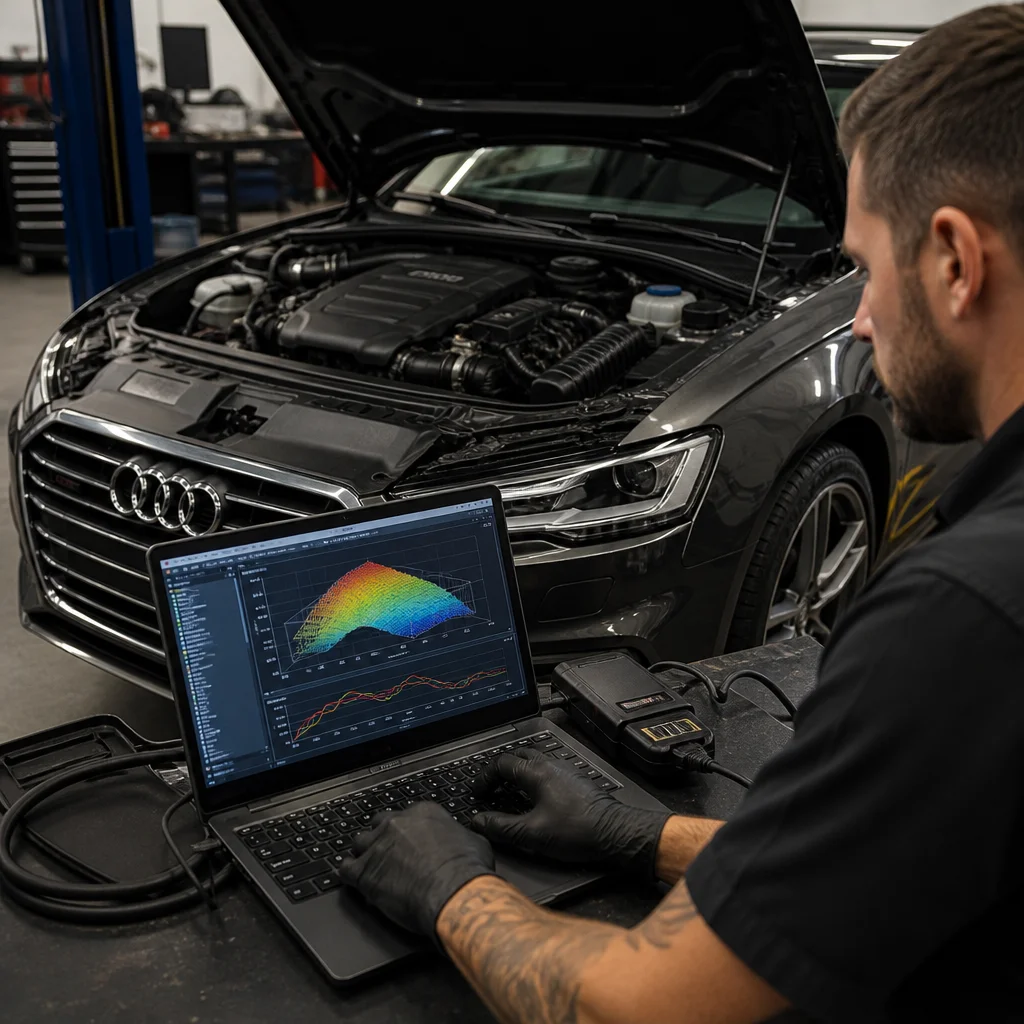
The critical difference: we map using data specific to your vehicle’s production year, transmission type, and current condition. Generic “off-the-shelf” tunes treat every Audi identically, which is why they produce inconsistent results and often trigger warning lights.
Our Dealer-Level Diagnostic Approach to Safe Tuning
Before we touch your ECU, we conduct comprehensive diagnostics using the same manufacturer-grade equipment that Audi dealerships employ. This isn’t optional; it’s foundational to our process.
We scan for existing fault codes, measure actual boost delivery under load, analyze fuel trims and oxygen sensor response, and establish baseline performance metrics. This diagnostic phase reveals whether your vehicle is ready for optimization or whether underlying issues need resolution first.
We’ve encountered Audis with failing fuel injectors, compromised turbos, or worn valve seats. Tuning these vehicles would be irresponsible and unsafe. Our dealer-level tools catch these problems before they become expensive failures.
What you gain from this approach: confidence that tuning is appropriate for your specific vehicle, not a one-size-fits-all gamble. We document everything and provide you with baseline data you can reference for future service decisions.
Performance Gains Without Sacrificing Reliability
The question we hear most often: “Will tuning shorten my engine’s life?” The honest answer depends entirely on how the tuning is executed.
Aggressive, poorly calibrated remaps do accelerate component wear. But thoughtfully engineered optimization, paired with appropriate maintenance, extends no meaningful risk to modern turbocharged engines. Consider what we’re actually doing: we’re using the same technologies Audi’s own performance division (Audi Sport) employed when developing factory high-performance variants like the RS models.
The difference between an S4 and an RS4 isn’t exotic hardware; it’s sophisticated ECU calibration paired with slightly upgraded cooling systems. We follow similar principles: optimize software within the mechanical design envelope, maintain proper fuel quality, and ensure your maintenance intervals stay consistent.
Owners who experience reliability issues after tuning typically neglected either the remapping quality or their follow-up maintenance. We address both. Our remapping includes detailed post-tuning guidance on fuel, service intervals, and operational best practices specific to your vehicle.
Emissions-Compliant Tuning Standards We Follow
This is where our approach diverges sharply from shops that prioritize maximum power regardless of consequences.
We calibrate against OBD-II emissions thresholds, meaning your vehicle passes emissions testing as legally required. We monitor nitrogen oxide production, particulate matter, and fuel trim behavior throughout optimization. Our maps are designed to work with factory catalytic converters and diesel particulate filters (if applicable) without triggering limp-mode conditions.
Additionally, we follow manufacturer specification guidelines for boost pressure and combustion temperatures. Audi publishes material limits for turbocharger compressor wheel speeds, piston thermal stress, and bearing load capacity. These aren’t suggestions; they’re engineering boundaries. We respect them.
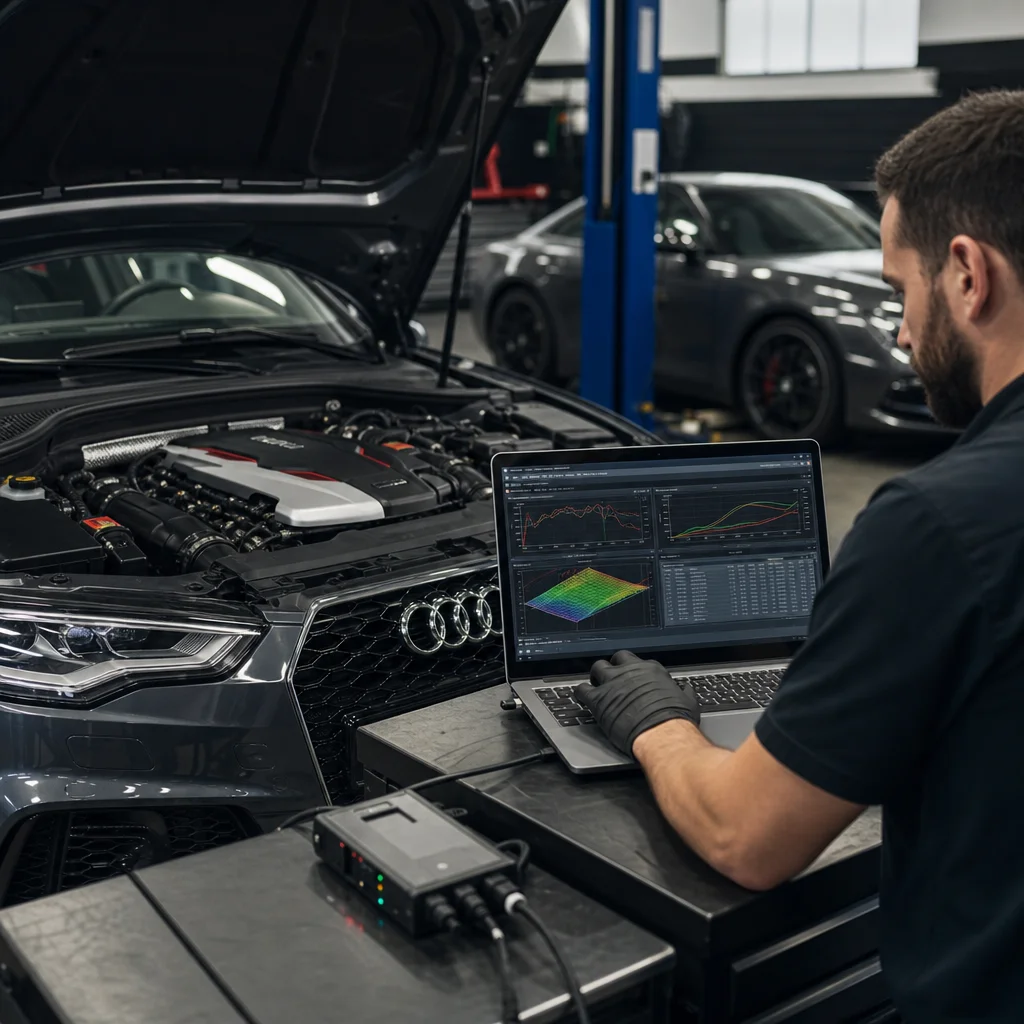
If you’re in Colorado or another state with periodic emissions testing, our tuning passes inspection. You’re not buying performance at the cost of legal compliance or resale value.
Advanced Engine Rebuilds for Maximum Turbo Efficiency
For Audi owners seeking transformational performance rather than incremental gains, we offer engine rebuild services that position turbocharged powerplants for optimization.
A rebuild allows us to inspect and upgrade critical components. Forged pistons designed for higher combustion pressures, upgraded valve springs, ported and polished cylinder heads, and enhanced gasket materials all contribute to an engine that responds more reliably to aggressive remapping.
Think of it this way: stock engines are engineered for 40-year expected service under typical driving. A rebuilt engine with performance components can handle more aggressive tuning profiles safely and sustain higher power outputs indefinitely.
For owners pursuing serious performance goals, a rebuild combined with specialized ECU tuning creates a platform that delivers both numbers and longevity. It’s a significant investment, but it’s the right choice for enthusiasts who plan to keep their Audi for years and expect consistent, reliable performance.
Real-World Results from Our Audi Clients
We’ve tuned dozens of turbocharged Audis across Colorado. Here’s what actual performance looks like.
A 2023 Audi S4 came in producing 354 horsepower stock. After diagnosis, optimization, and validation, it reached 420 horsepower with torque climbing from 369 to 440 lb-ft. The owner reported noticeably quicker acceleration response, particularly between 2,500 and 5,500 RPM where daily driving happens. Emissions test passed. No warning lights. Still warranty-intact through Audi (we used non-destructive mapping techniques).
A 2019 A4 with the 2.0T arrived with a customer complaint about boost inconsistency. Diagnostics revealed carbon buildup on intake valves and a turbo working harder than designed to overcome the restriction. After cleaning, inspection, and remapping, the vehicle produced 290 horsepower (up from 252) with significantly better consistency and throttle response. The owner noticed immediate improvement in day-to-day drivability, not just peak power.
These aren’t outliers; they’re representative of what proper tuning delivers when executed by specialists.
Why Generic Shops Cannot Deliver Specialized Audi Tuning
A general-purpose auto shop might offer “ECU tuning,” but the difference between that and specialized Audi optimization is substantial.
Generic shops lack manufacturer-specific diagnostic equipment. They can’t read Audi’s proprietary sensor data or validate maps against actual performance parameters. They apply pre-packaged tunes designed by third parties unfamiliar with your specific vehicle’s production details, market region, or mechanical condition.
Audi turbocharged engines are sophisticated. They integrate gasoline direct injection, variable valve timing, complex turbo boost control algorithms, and multi-stage emissions systems. Recalibrating one area without understanding its interaction with others produces inconsistent results and unintended consequences.
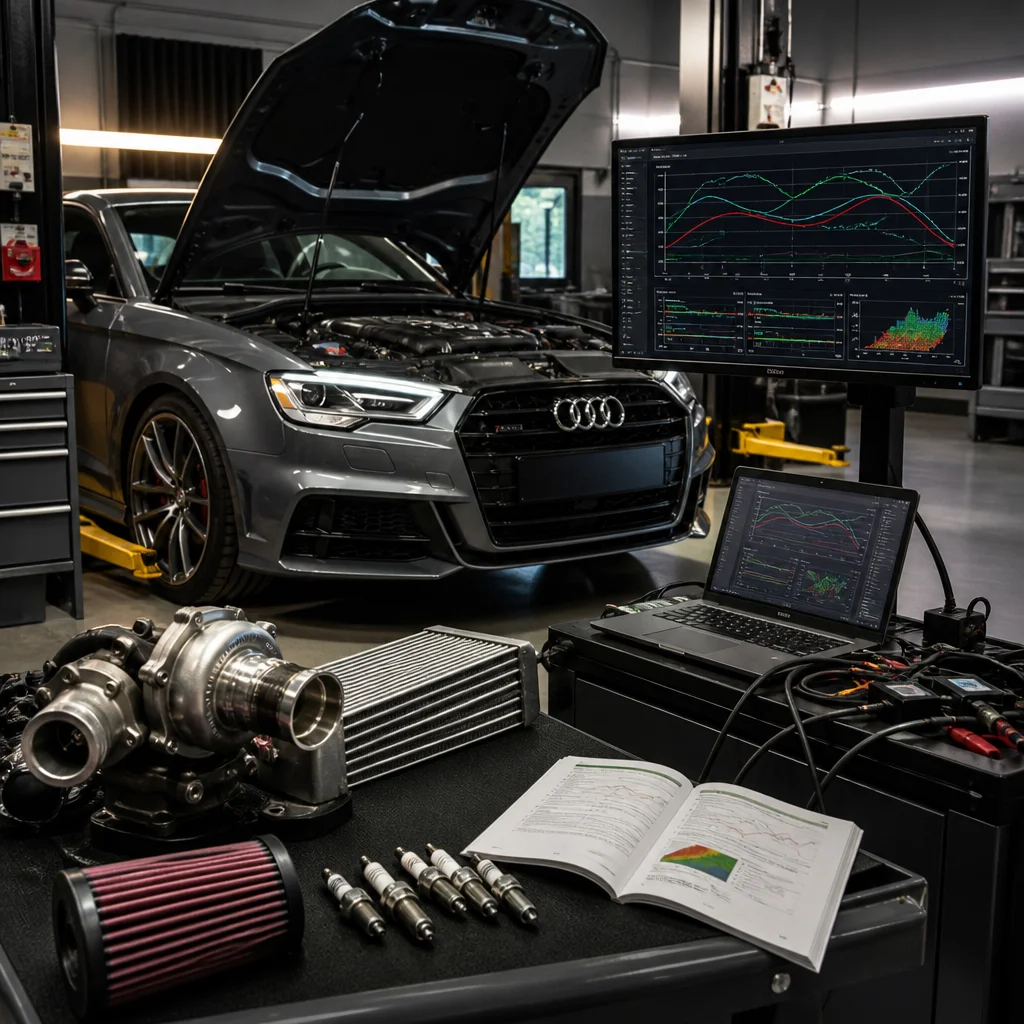
We’ve recovered vehicles damaged by careless generic tuning. Engine knock sensors misfiring. Transmission control units confused by unexpected power delivery. Emission systems cycling into limp mode. These problems are expensive to diagnose and frustrating to resolve.
When you choose us for Audi performance upgrades, you’re partnering with technicians who specialize in European powerplants. We invest in Audi-specific diagnostic tools, manufacturer training, and a track record with thousands of hours calibrating these systems.
Our Process: From Diagnosis to Optimization
Here’s exactly how we work with your Audi.
First, a comprehensive diagnostic scan captures your vehicle’s baseline state. We identify any existing faults, measure boost stability, document fuel trim behavior, and establish performance metrics.
Second, we discuss your goals. Are you seeking daily-drivability improvement, weekend performance, or maximum output? Your priorities shape the calibration strategy.
Third, we develop a custom map tailored to your vehicle’s production year, transmission, fuel system, and turbo configuration. We validate it on our chassis dynamometer to ensure real-world performance aligns with projections.
Fourth, we install the optimized calibration and conduct extensive testing. We verify emissions compliance, monitor engine parameters under load, and confirm that all factory systems continue operating as designed.
Finally, we document everything. You receive a detailed report showing before-and-after performance data, emissions test results, and post-tuning care instructions.
Ongoing Support and Maintenance for Tuned Audi Turbos
Optimization is only half the story. Keeping your tuned Audi performing reliably requires appropriate maintenance and periodic monitoring.
We recommend:
- Premium-grade fuel (91 octane minimum; 93+ for optimized Audis)
- Oil analysis at each service interval to monitor wear patterns
- Turbo boost verification annually to catch performance degradation
- Transmission fluid inspection if your Audi is automatic
Turbocharged engines accumulate carbon deposits over time, particularly at higher boost levels. We offer professional carbon cleaning services that restore fuel system efficiency and maintain peak performance characteristics. Many owners schedule this every 20,000 to 30,000 miles after tuning.
Your investment in performance optimization deserves ongoing care. We’re here to support that commitment with scheduled maintenance, diagnostic checks, and performance verification as your Audi ages. Think of us as your long-term partner in keeping your vehicle running at its engineered potential.