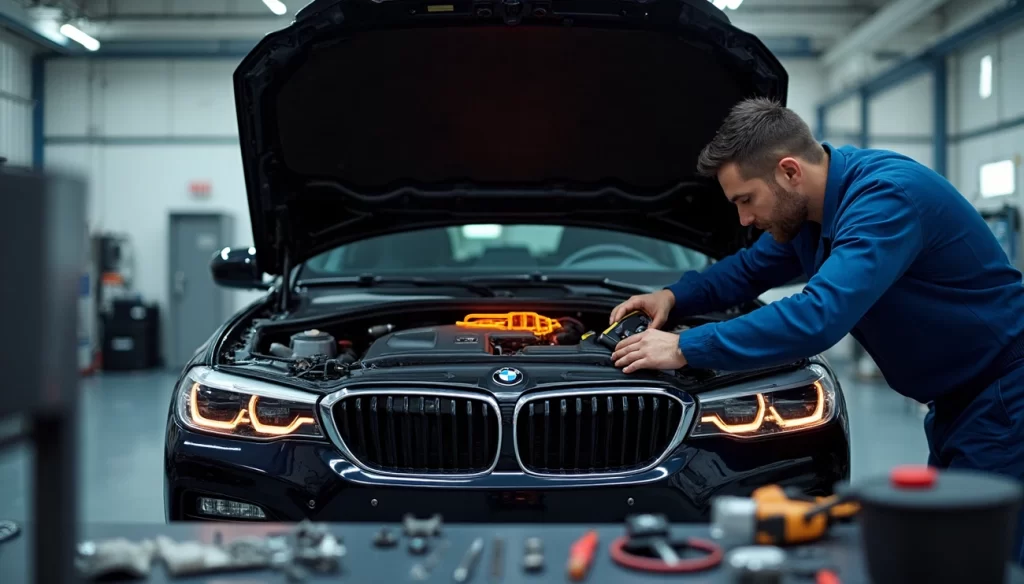
A steady Service Engine Soon light usually means an emissions-related fault has been stored. If your car runs normally, you can generally drive gently to a shop for diagnosis. A flashing light signals a misfire that can damage the catalytic converter. Stop driving as soon as you can safely pull over.
On most European cars, Service Engine Soon means the same thing as Check Engine. For drivers in Golden and Arvada, a light that appears on a freezing morning needs the same attention as one that appears in summer.
Cold weather can expose a fault. It does not make the warning harmless.
Is Service Engine Soon the Same Light as Check Engine?
Usually, yes. OBD-II, the federal onboard diagnostics standard, requires emissions monitoring and a Malfunction Indicator Lamp. Manufacturers may label that lamp “Check Engine” or “Service Engine Soon.” The wording does not determine the severity.
On a BMW, Audi, Mercedes-Benz or Porsche, check whether the lamp is steady or flashing, then look for accompanying warnings. A reduced-power message changes the decision about driving even if the engine light stays steady.
Maintenance Reminder or Fault? Read the Cluster First
A service countdown usually calls for scheduled maintenance. An engine-shaped warning reports a detected fault. Before booking either service, identify which message your car displays:
- Look for a wrench icon or “service due” message with a distance or date. That generally indicates scheduled maintenance.
- Look for an amber engine-shaped symbol, sometimes labeled Service Engine Soon. That is the emissions warning discussed here.
- Check the owner’s manual for your model year. It identifies the symbols and the action each requires.
A maintenance reminder does not explain rough running or a flashing engine light. Treat those symptoms separately, even if scheduled service is also due.
Why a Steady Light Shows Up on a Cold Morning
Late October brings the first hard overnight freezes to Golden, and cold starts then expose faults that are less apparent once the engine warms up. The engine computer monitors warm-up behavior, so a warning that appears only on freezing mornings still needs diagnosis.
The thermostat and coolant sensor
The engine computer uses coolant temperature readings to judge whether the engine warms up as expected. A thermostat stuck partly open can keep the coolant too cool and trigger a fault, especially in cold weather. Testing should distinguish a thermostat problem from an inaccurate temperature sensor before either part is replaced.
Oxygen sensors on a cold start
The engine uses a richer fuel mixture during a cold start, and oxygen sensors must reach operating temperature before their readings can guide mixture corrections. A slow sensor or a sensor-heater fault can become apparent during this period. An oxygen sensor code identifies something to test, not automatic proof that the sensor needs replacement.
How Golden’s Altitude Changes What the Engine Computer Sees
Golden sits at approximately 5,675 feet, where thinner air affects engine operation. The engine computer accounts for changing air density, and diagnosis must consider altitude when interpreting airflow and oxygen sensor data.
Drivers traveling between Lakewood and Evergreen also encounter changes in elevation and temperature. Record where the light first appeared, particularly if it followed a climb into the foothills. That history helps a technician reproduce the conditions rather than test only at a warm idle.
Fuel trims at altitude
Fuel trims are the engine computer’s corrections to the fuel mixture. Unusual corrections can point toward an intake leak or inaccurate sensor readings, but altitude alone does not identify the failed part. A technician needs to compare those readings with operating conditions and manufacturer specifications.
The fuel cap after a cold snap
If your vehicle has a conventional fuel cap, check that it is seated as the owner’s manual specifies and inspect the seal for damage. A leaking cap allows fuel vapor to escape, which the evaporative emissions system can detect.
Cold weather can expose a marginal seal. After correcting a loose cap, the light may take several drive cycles to clear. If it stays on, do not assume tightening the cap resolved the fault.
When Is It Safe to Keep Driving With the Light On?
Check both the lamp and the way the car runs. A steady warning does not override signs of overheating or a strong fuel smell.
Steady light, normal running
If the engine runs normally without power loss, rough idle or fuel smell, it is usually reasonable to drive gently to a shop soon. Avoid long highway trips and towing a trailer until the fault has been checked. Do not wait for a second symptom before arranging diagnosis.
Flashing light, stop now
A flashing light indicates an active misfire that can damage the catalytic converter. Pull over safely, shut the engine off and arrange a tow rather than continuing to test whether it improves.
Signs That Mean You Should Call for a Tow
Stop driving if the engine shakes, loses substantial power, overheats or produces a fuel smell. A reduced-power or turbocharger warning alongside the engine light also warrants greater caution than an isolated steady lamp.
If you cannot tell whether the vehicle is safe to move, describe the symptoms to the shop or roadside assistance provider before driving farther.
What to Check Before You Book a Diagnosis
Record the circumstances before clearing anything. A fault that occurs only during a freezing start can be harder to trace after the engine has warmed up.
- Write down when the light appeared and the outside temperature.
- Describe any change in how the engine runs, such as a rough idle.
- Note any fuel smell. If you smell fuel, stop driving rather than continuing these checks.
- Record whether you recently refueled or removed the fuel cap.
- With the engine off and cool, look for obvious cracks in accessible intake or evaporative hoses. Do not remove parts to investigate; a visual check cannot rule out a small leak.
- Leave the codes stored. Do not disconnect the battery to extinguish the warning.
Clearing codes does not repair the fault and can remove information useful for diagnosis. Disconnecting the battery may also erase learned adaptations and reset emissions readiness monitors, which can delay an emissions test.
Parts-Store Scan or Full Diagnosis, and What Each Tells You
A parts-store code scan can identify the stored trouble code. It cannot, by itself, establish the cause. Replacing the component named in a code without testing it is guessing.
A proper diagnosis combines fault codes with live sensor data and physical checks. European-specific diagnostic equipment also provides access that a basic generic reader may lack. The useful question is what the technician measured and how that evidence supports the repair.
| What you want to know | Parts-store code read | Full diagnosis |
|---|---|---|
| Scope of work | Retrieves stored codes | Tests the system identified by the codes |
| Which code is stored | Usually emissions-related codes | Relevant codes across accessible modules |
| Live sensor data | Depends on the reader and service | Used to evaluate operating conditions |
| European module data | May have limited access | Manufacturer-capable tools provide broader access |
| Evidence for replacing a part | A code alone is insufficient | Measurements and inspection support the repair decision |
At EuroX Performance in Golden, our ASE-certified technicians use dealer-level diagnostic tools for European and exotic vehicles. We are veteran-owned and operated, with OEM parts among our repair offerings. Review our check engine light diagnostics in Golden, CO, or request a quote online.
For diagnosis, call (303) 562-1800 or submit your vehicle details through the contact page. Include whether the light flashes and any changes in engine operation.
Frequently asked questions
Can a loose gas cap trip the Service Engine Soon light at high elevation?
Yes. A loose or damaged cap can allow fuel vapor to escape and trigger an evaporative emissions fault at any elevation. Check that the cap is seated correctly and its seal is intact. The light may take several drive cycles to clear after the leak is corrected.
What happens if I keep driving with a steady amber light?
The risk depends on the underlying fault. If the car runs normally, a gentle drive to a shop is generally reasonable, but continued driving without diagnosis can allow some faults to cause further damage. Stop if the light flashes, the engine runs rough, you smell fuel or the temperature rises abnormally.
Will disconnecting the battery turn off the light for good?
No. Disconnecting the battery may temporarily extinguish the warning, but it does not repair the cause. It can also erase useful diagnostic information and reset emissions readiness monitors.
How do I tell a maintenance reminder from a real fault?
A service countdown or wrench icon generally indicates scheduled maintenance; an engine-shaped warning indicates a detected fault. Check your owner’s manual because displays vary by model and year. If both appear, completing routine maintenance does not necessarily resolve the engine warning.
Is a free parts-store code scan enough to fix the light?
A code scan is a useful starting point, but it does not confirm which part failed. Proper diagnosis checks live data and tests the relevant components before recommending replacement. Bring any scan results to your diagnostic appointment rather than buying the part named in the code.