Table of Contents
- Why Stage 2 Tuning Matters for European Performance Owners
- Understanding Stage 2 Tuning: What You're Really Getting
- Stage 2 BMW Tuning: Costs and Timelines
- Stage 2 Audi Tuning: Costs and Timelines
- Diagnostic Requirements and Precision Engineering Differences
- Our Dealer-Level Advantage for Accurate Pricing and Scheduling
- OEM Parts vs Aftermarket: How We Protect Your Investment
- Real-World Timeline Expectations from Our Workshop
- Why Specialized Expertise Directly Impacts Your Final Cost
- The EuroX Performance Difference: Why We're Your Clear Choice
Why Stage 2 Tuning Matters for European Performance Owners
Stage 2 tuning represents the sweet spot between modest power gains and real-world reliability. Unlike bolt-on modifications that deliver marginal improvements, Stage 2 work fundamentally changes how your engine breathes, combusts, and delivers power. For BMW and Audi owners, this translates to meaningful horsepower and torque increases while maintaining the structural integrity of your vehicle.
The investment matters because Stage 2 isn’t about chasing numbers on a dyno sheet. It’s about unlocking what the OEM engineering team actually designed into your platform but deliberately limited for warranty, emissions, and consumer liability reasons. A 2023 BMW M440i or B9 Audi S4 owner who invests in proper Stage 2 work will experience tangible acceleration improvement, sharper throttle response, and the confidence that comes from working with precision engineering rather than guesswork.
What separates a quality Stage 2 build from a risky one is the diagnostic foundation. This is where most generic tuners fail and where we differentiate ourselves through dealer-level equipment and manufacturer expertise.
Understanding Stage 2 Tuning: What You’re Really Getting
Stage 2 typically combines ECU remapping with targeted mechanical upgrades. You’re not just uploading new software; you’re adding supporting modifications that allow the engine to safely handle increased fuel and boost pressure.
For turbocharged engines, Stage 2 usually includes:
- ECU tuning for optimized fuel mapping and boost curves
- Upgraded intake systems for unrestricted airflow
- Enhanced intercooler systems to manage charge temperatures
- Transmission tuning to handle increased torque delivery
- Catalyst-back exhaust for improved scavenging
The mechanical components aren’t optional extras. When we increase boost pressure on a BMW or adjust fuel timing on an Audi, the supporting systems must be engineered to work together. A botched intake paired with aggressive ECU tuning creates heat problems and potential engine stress. This integration is precisely where precision engineering matters.
Many shops charge based on a generic formula. We charge based on the actual work your specific platform requires because no two builds are identical, even within the same model year.
Stage 2 BMW Tuning: Costs and Timelines
BMW Stage 2 tuning typically ranges from $1,200 to $2,400 depending on the platform. A B58 engine (found in newer M440i, 340i, and 540i models) sits at the lower end because the software is well-understood and aftermarket support is mature. Older N63 twin-turbo engines cost more because they require deeper diagnostic work and custom calibration.
Timeline expectations for BMW Stage 2:
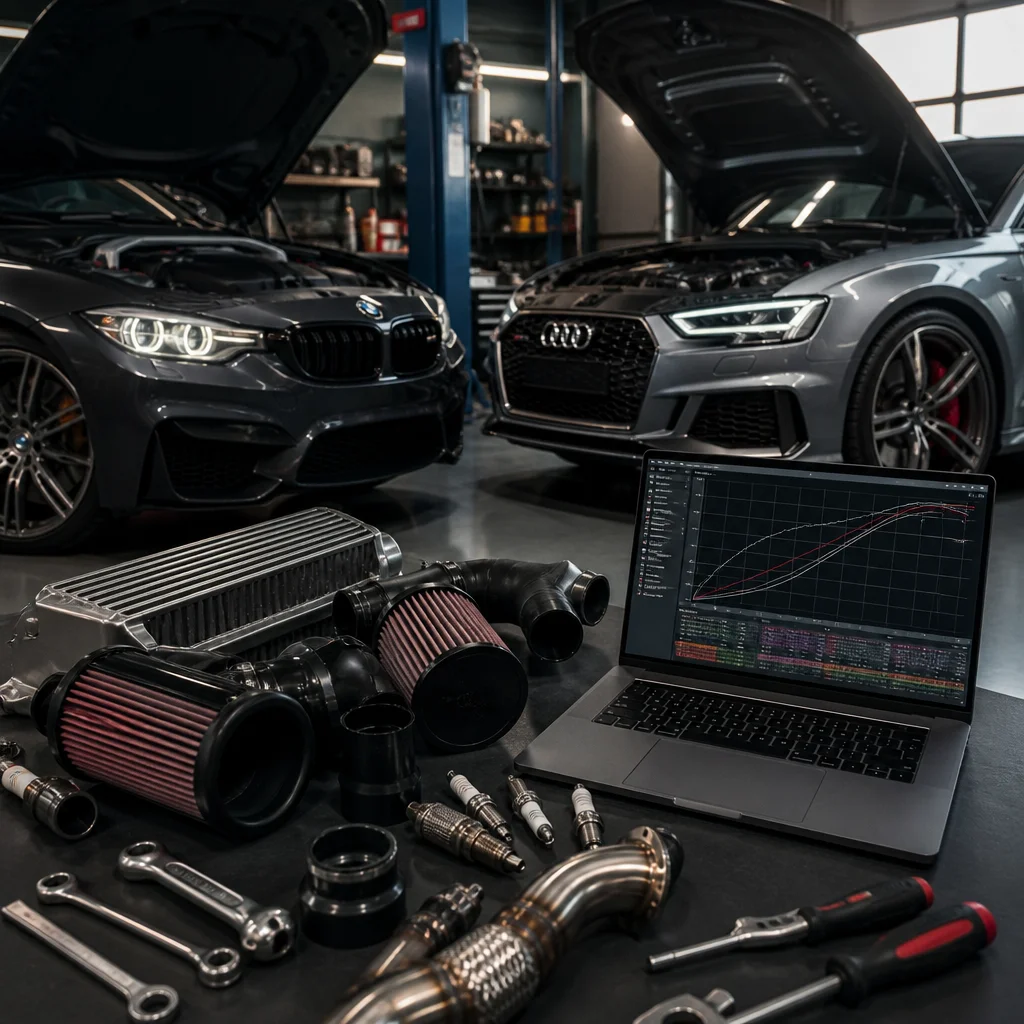
- Initial diagnostics and consultation: 1-2 hours (complimentary at our shop)
- ECU remapping and testing: 3-5 hours
- Supporting mechanical upgrades: 2-8 hours depending on scope
- Post-tuning verification and dyno confirmation: 2-3 hours
Most owners see their BMWs back in service within 2-3 business days if mechanical work is straightforward. Older models or those with pre-existing issues extend to 4-5 days.
The cost difference between a basic remap and a comprehensive Stage 2 reflects real labor. We’re not just flashing files; we’re validating every system integration point and documenting baseline performance before and after modification.
Stage 2 Audi Tuning: Costs and Timelines
Audi Stage 2 tuning typically ranges from $1,400 to $2,600 depending on your model. B9 platform Audis (2017+) have more standardized tuning pathways and cost less than older B8 generation cars. RS models and S-line variants often require additional diagnostics because they come with more complex baseline calibrations.
Timeline expectations for Audi Stage 2:
- Initial diagnostics and consultation: 1-2 hours
- ECU remapping and baseline validation: 4-6 hours
- Intake and exhaust integration: 2-6 hours
- Transmission tuning and torque verification: 2-3 hours
- Final dyno testing and calibration refinement: 2-3 hours
Audi timelines typically run slightly longer than BMWs because Audi’s multi-stage turbo systems and dual-clutch transmissions demand more careful calibration sequencing. A careless approach risks transmission limp-mode or turbo surge, which is why we don’t rush this work.
Your S4 or S5 will spend 3-4 business days in our shop for thorough Stage 2 work. We could shorten that to 48 hours, but you’d be sacrificing the validation and testing that protects your 6-figure investment.
Diagnostic Requirements and Precision Engineering Differences
This is where most tuning shops cut corners and where quality separates from liability.
Before we touch your ECU, we run comprehensive diagnostics that reveal baseline fuel trims, boost pressure response curves, transmission shift characteristics, and thermal management patterns. We’re looking for hidden issues that cheap tuning could amplify. A vehicle with marginal fuel injector performance might handle factory settings fine but fail catastrophically under aggressive Stage 2 mapping.
Our dealer-level diagnostic equipment gives us access to real-time data streams that generic code readers cannot access. We see what Bosch and Audi/BMW engineers see, which means we calibrate knowing exactly what margin of safety exists on your specific vehicle.
BMW and Audi engines differ fundamentally in their factory tuning philosophy. BMW tends toward conservative boost curves with aggressive timing, while Audi typically uses higher boost with more conservative timing. This means the tuning approach, cost allocation, and timeline differ between brands even within the same horsepower target.
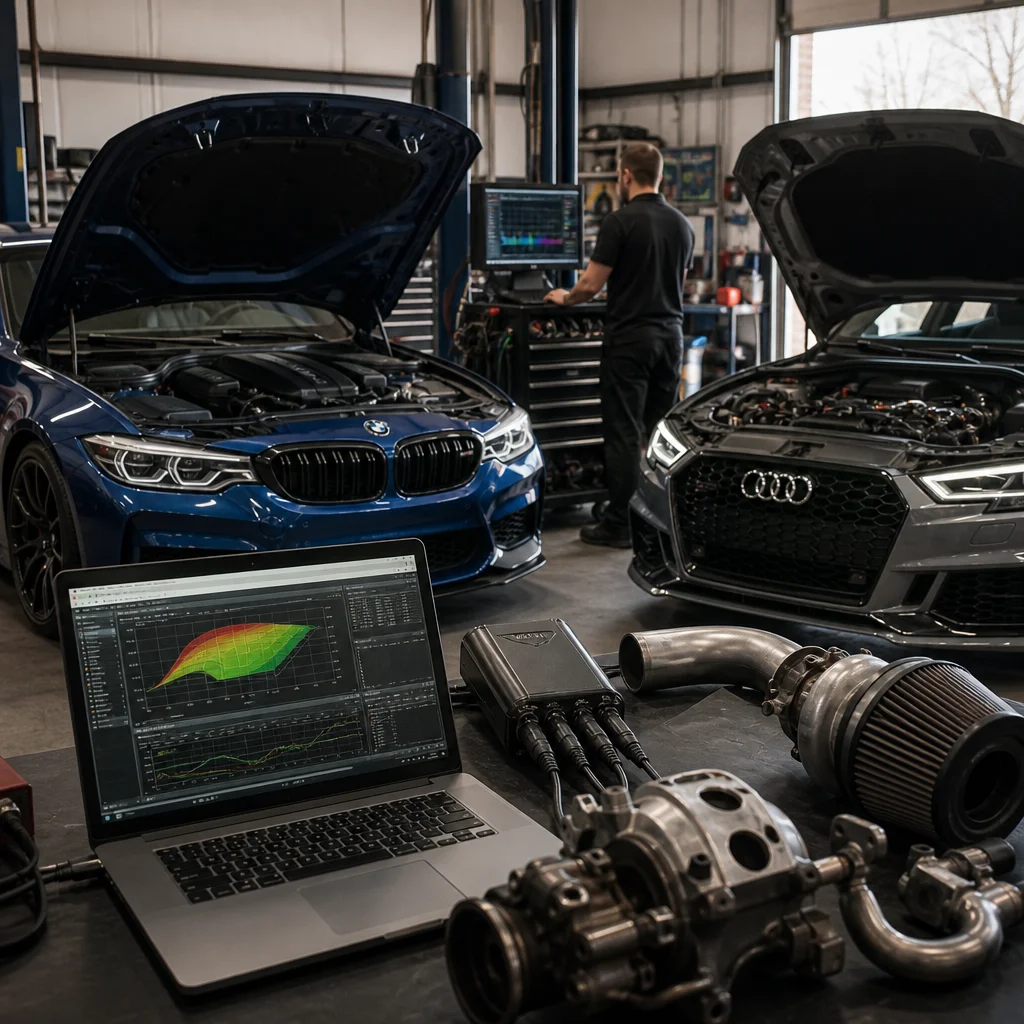
Precision engineering also means validation testing. After Stage 2 installation, we dyno-test your vehicle to confirm power delivery matches the calibration design. We’re not guessing; we’re measuring.
Our Dealer-Level Advantage for Accurate Pricing and Scheduling
Generic shops quote Stage 2 tuning with blanket pricing: “BMW Stage 2 is $1,500, Audi Stage 2 is $1,600.” This approach guarantees either overcharging simple vehicles or undercharging complex ones, with zero accountability.
We provide detailed estimates after thorough diagnostics because your car’s condition, modification history, and performance goals directly affect what we’ll actually do and how long it takes. A bone-stock vehicle requires different validation steps than a car with previous modifications or potential hidden issues.
Our scheduling accuracy comes from realistic labor standards based on actual shop data. We track every diagnostic finding and every hour invested, which means when we quote 3 business days, you’re getting an estimate grounded in genuine experience, not hope.
When we say your vehicle needs specific work, we have diagnostic data to show why. You’re not paying for guesses; you’re paying for precision.
OEM Parts vs Aftermarket: How We Protect Your Investment
The intake and exhaust components for Stage 2 work come in two categories: OEM and aftermarket. The choice directly impacts cost, durability, and warranty implications.
OEM-specification parts maintain manufacturer compatibility and often preserve factory warranty coverage on unmodified systems. An OEM intake manifold for your Audi S4 costs more than an aftermarket carbon unit, but it eliminates risk of fitment issues or compatibility problems down the road.
Aftermarket performance components offer cost savings and often superior engineering for specific performance goals. A quality carbon intake typically flows better than factory plastic designs. However, quality varies dramatically, and cheap aftermarket work becomes expensive liability.
We recommend OEM-specification components as the foundation because we’re protecting your long-term ownership experience, not maximizing short-term margin. When you invest $50,000 into a BMW M440i, spending an extra $300 on OEM-spec intake components isn’t just worth it; it’s mandatory.
This approach explains why our Stage 2 tuning costs more than discount shops. We’re building systems designed to perform reliably for 50,000+ additional miles, not just pass a dyno test.
Real-World Timeline Expectations from Our Workshop
Timelines slip when shops underestimate work scope or encounter unexpected issues. We manage expectations by building buffer time into schedules based on our actual historical data.
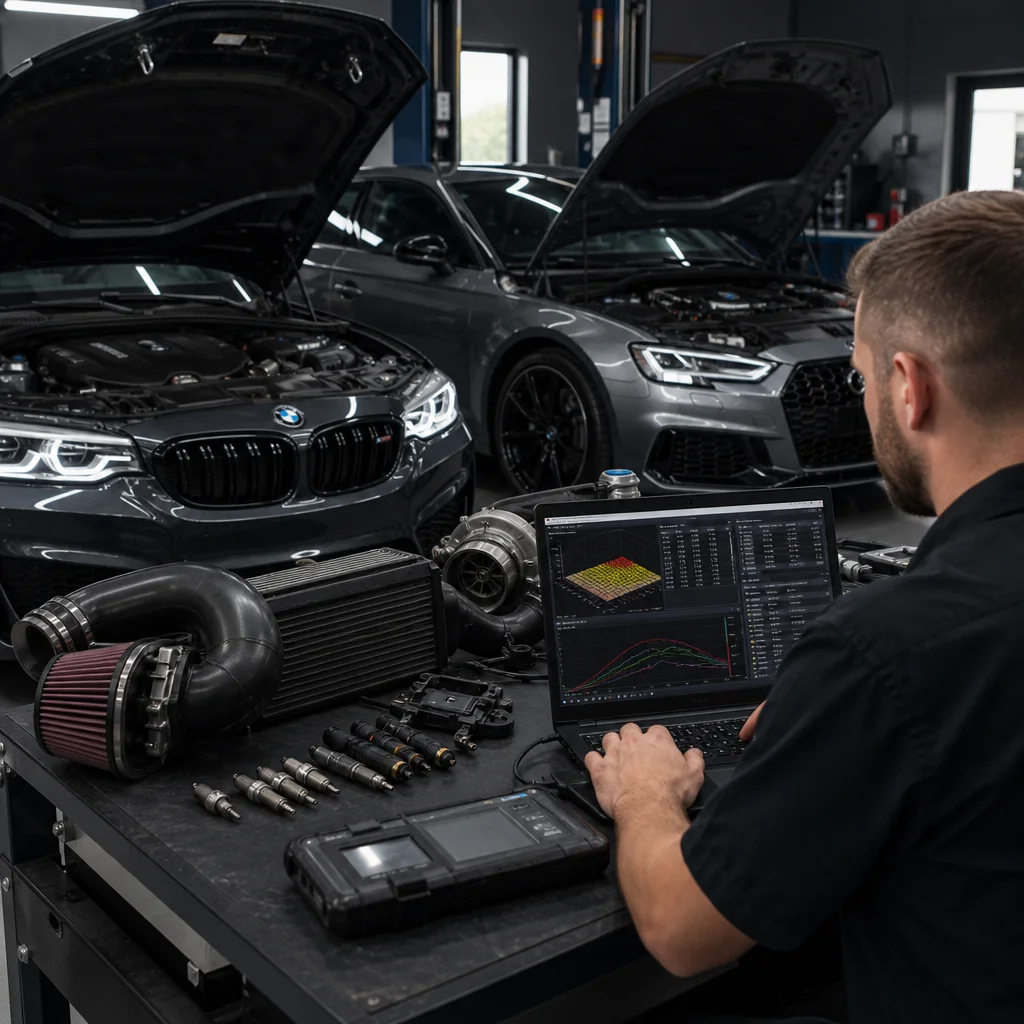
A straightforward Stage 2 B58 BMW tunes in 2 business days. Add a pre-existing fuel system concern, and that extends to 3 days. A complex B9 Audi S4 with dual-clutch transmission tuning routinely requires 4 business days because we’re calibrating multiple interconnected systems.
We schedule Stage 2 work with full transparency about what happens behind the scenes. You’re not waiting for a dyno slot; you’re waiting while we methodically validate every system integration point. This takes time, and we don’t apologize for it.
Our workshop also maintains schedule flexibility because we’ve learned that rushing European performance work costs more in callbacks and troubleshooting than it ever saves in scheduling efficiency. Your tuning is completed right, not fast.
Why Specialized Expertise Directly Impacts Your Final Cost
A generalist shop with basic OBD2 knowledge can flash ECU files. A specialist shop understands why your specific vehicle requires specific calibration adjustments.
Our team holds manufacturer certifications, has rebuilt hundreds of European engines, and maintains relationships with OEM engineers. When we encounter an unusual fuel trim response or unexpected boost curve behavior, we know whether it’s normal for your platform or a sign of underlying issues.
This expertise commands premium pricing because it prevents expensive mistakes. A badly tuned transmission can cost $4,000+ to repair. A poorly calibrated boost curve can damage a turbocharger ($3,500+). Our diagnostic rigor and calibration precision protect you from these catastrophic failures.
Specialized expertise also means we complete work faster because we’re not troubleshooting on your dime. We know what to look for, how to fix it, and what validation steps prevent recurrence. Generic shops spend hours guessing; specialists spend minutes confirming.
The EuroX Performance Difference: Why We’re Your Clear Choice
We’re not asking you to shop around for Stage 2 tuning because that comparison misses the point. Cheap shops will quote lower prices, but they’re gambling with your vehicle. Premium specialists will deliver results, but they’re not all equal in diagnostic rigor or calibration expertise.
Our veteran-owned operation exists specifically because we refuse to compromise on European performance engineering. We invest in dealer-level diagnostic technology, maintain OEM technical relationships, and employ technicians with genuine certification in BMW and Audi systems. We provide written warranties on our tuning work because we’re confident in our calibrations.
When you bring your BMW or Audi to EuroX Performance for Stage 2 tuning, you’re getting precision engineering grounded in manufacturer knowledge, validated with real-time diagnostics, and backed by our commitment to your long-term ownership satisfaction. Your investment is protected not by discount pricing but by uncompromising technical standards.
We’re ready to discuss your specific Stage 2 goals and provide a detailed estimate based on your vehicle’s actual needs. Contact us today to schedule your comprehensive diagnostic consultation.
For further reading: Precision drivetrain diagnostics.