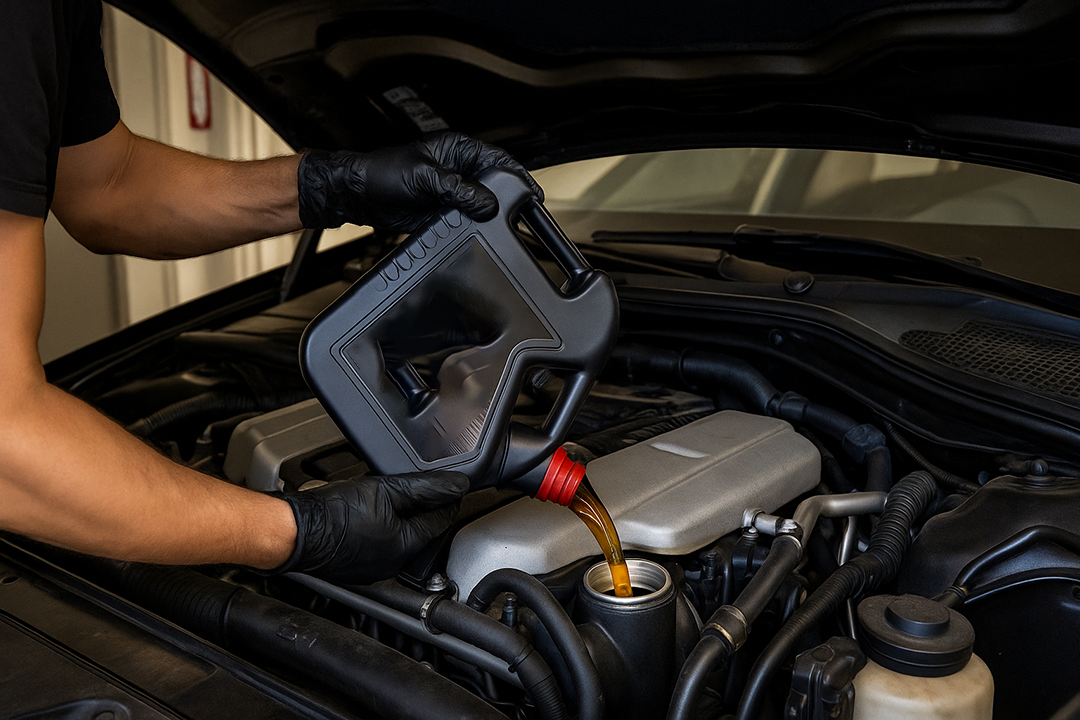
An Audi oil change requires full-synthetic motor oil carrying an explicit Volkswagen approval code, such as VW 502 00, VW 504 00, or VW 508 00, paired with an OEM synthetic fleece cartridge filter. Generic quick-lube bulk oils lack the high-temperature shear stability needed to protect Audi turbochargers, especially at Colorado elevations where sustained boost and winter cold starts accelerate thermal breakdown.
Servicing an Audi is not simply draining old fluid and pumping generic 5W-30 from a shop drum. Turbocharged German engines run tight internal tolerances, direct injection, and high exhaust gas temperatures that cook standard lubricants. These five steps protect your turbocharger and keep your engine from burning oil along the Front Range.
Check Your Under-Hood Label to Decode VW 502 00, 504 00, and 508 00 Specs
Before lifting the car or pulling a drain plug, check the factory emissions placard under the hood or on the radiator core support. Assuming all 2.0T or 3.0T engines take the same fluid is a common mistake that leads to internal wear.
- Locate the factory placard: Pop the hood and read the emissions sticker. Audi prints the specific engine code alongside the required factory fluid standard.
- Cross-reference the Volkswagen technical standard: Modern Audi engines use one of three main specifications: VW 502 00, VW 504 00, or VW 508 00. Each requires different additive chemistry and viscosity targets.
- Check the oil bottle label: The container must explicitly state the approval under its manufacturer specification list. A label that simply claims the oil is recommended for European cars has not passed Volkswagen factory testing.
The differences between these approvals matter. Older Audi powerplants often specify VW 502 00, a high-ash formulation typically found in 5W-40 oils. Mid-generation engines moved toward VW 504 00, a lower-ash 5W-30 designed to preserve direct-injection valves and catalytic converters. Newer engines often mandate VW 508 00, a specialized 0W-20 blend dyed blue-green with distinct chemical markers. Pouring heavy 5W-40 into an engine built for VW 508 00 slows oil delivery to valvetrain journals during cold mornings. Pouring generic 0W-20 into an older performance engine will thin the oil film under load. Understanding these exact tolerances is the foundation of Audi 2.0T oil consumption fixes that actually work.
Verify High-Temperature Shear Stability for Mountain Turbocharger Protection
Golden sits at 5,675 feet. Driving west means immediately climbing steep grades along I-70 through Mount Vernon Canyon. In thin mountain air, your turbocharger works continuously to compress less dense air, spinning well past 100,000 RPM. This drives oil temperatures inside the turbocharger cartridge to extreme levels. You need an engine oil with sufficient High-Temperature High-Shear (HTHS) viscosity.
HTHS measures how well a lubricant resists mechanical thinning at 150 degrees Celsius under heavy mechanical load. Standards like VW 502 00 and VW 504 00 require a minimum HTHS rating of 3.5 mPa·s. Standard off-the-shelf bulk 5W-30 oils sold at domestic oil change shops often sit below 3.0 mPa·s. When non-spec oil meets sustained boost up mountain passes, the viscosity modifiers break apart. The protective barrier thins, risking contact between the turbo shaft and its journal bearings.
Shutting off the engine in Evergreen or Summit County leaves that thinned oil sitting against a hot turbocharger housing. Inferior fluids break down and bake into hard carbon grit, a failure known as oil coking. On your next startup, that abrasive grit scratches the turbo shaft and bearings. Non-spec additives also struggle with direct-injection blow-by gases. Carbon builds up behind low-tension piston rings, causing them to stick in their lands until the engine begins burning oil rapidly. We explain that pattern in our guide on Audi S4 oil consumption and what to do about it.
Demand an OEM Synthetic Fleece Filter and Inspect the Housing Seal
Certified synthetic motor oil cannot do its job when paired with a cheap paper filter. Most modern Audi engines use an inverted cartridge filter element housed in a canister on top of the block. Quick-lube shops routinely use low-cost paper elements to keep material costs down. On a precision German engine, that shortcut creates serious risks.
| Feature | OEM Synthetic Fleece Filter | Generic Cellulose Paper Filter |
|---|---|---|
| Media Construction | Multi-layered synthetic microglass fibers | Pressed wood-pulp cellulose paper |
| Pressure Resistance | Maintains structural shape under high oil pump pressure | Prone to pleat collapse under high flow |
| Cold-Start Flow | Flows freely when oil is thick and cold | High flow resistance can force bypass valve open |
| O-Ring Material | Heat-resistant Viton elastomer | Basic nitrile rubber prone to hardening |
| Holding Capacity | Traps fine particulate down to 10–15 microns | Fills quickly, allowing bypass of unfiltered oil |
Sub-freezing mornings in Jefferson County thicken engine oil overnight. When you start the engine, the oil pump surges pressure to feed the galleys. Paper filter pleats can crush under this sudden pressure differential. When pleats collapse, the filter bypass valve opens, sending unfiltered oil and debris straight to your camshafts and bearings. Circulating contaminants speed up sludge buildup, which we break down in understanding oil sludge and why it is a silent killer.
The canister O-ring matters just as much. Factory-grade filter kits supply heat-resistant Viton rubber seals engineered for repeated thermal cycles. Cheap aftermarket kits rely on basic nitrile seals that turn brittle after a few thousand miles. During a rapid freeze, a hardened seal shrinks and sprays pressurized oil over your engine bay.
Shorten Oil Change Intervals for Front Range Elevation and Winter Driving
Factory maintenance schedules often list a 10,000-mile or 12-month service interval. That number works for mild highway commuting at sea level, but it does not fit the severe driving conditions along the Front Range. Guidance from vehicle valuation resource Kelley Blue Book notes that extreme operating temperatures, mountain grades, and frequent stop-and-go driving increase thermal stress on engine oil, requiring shorter service intervals.
To keep an Audi engine running cleanly past 100,000 miles in Colorado, follow these guidelines:
- Target 5,000 to 7,500 miles: Do not run European synthetic oil past 7,500 miles if you climb mountain corridors or commute daily on C-470. High-elevation driving depletes detergent and anti-wear additives faster than level cruising.
- Watch for cold-start fuel dilution: Short winter trips across Golden, Arvada, or Lakewood keep the engine from reaching steady operating temperature. Raw fuel washes past the piston rings, dilutes the oil in the pan, and lowers its viscosity.
- Protect hydraulic timing chain tensioners: Audi engines depend on steady oil pressure to tension the timing chains. Oxidized, contaminated oil gums up tensioner check valves, causing morning chain rattle and eventual guide damage. We inspect these components through our timing chain diagnostics and replacement services.
- Check your digital display monthly: Many modern Audi models lack a dipstick and measure oil through the instrument cluster. Check the digital gauge every few weeks instead of waiting for the low-oil alert to pop up.
Follow Strict Evacuation Procedures and Reset the Digital Oil Monitor
Servicing an Audi takes methodical work to prevent stripped pans, incorrect fluid volumes, and confused computer monitors. Quick-lube operators working on volume regularly skip these steps.
- Extract or drain the crankcase completely: Many Audi engines are engineered for top-side vacuum extraction through the dipstick tube. If draining from the pan, discard the single-use crush washer or plastic composite drain plug every service. Reusing a crushed washer on an aluminum pan is a dependable way to strip threads and cause steady leaks.
- Torque the filter housing to spec: Plastic filter caps are stamped with an exact torque spec, usually 25 Nm. Over-tightening with an impact gun or heavy hand tools cracks the plastic housing, leading to sudden oil loss on the road.
- Measure the fill quantity precisely: Audi crankcases hold between 5.5 and 9.0 quarts depending on engine configuration. Add fluid gradually and give it time to settle. Overfilling causes the rotating crankshaft to whip air into the oil, which drops oil pressure and damages catalytic converters.
- Reset the adaptation channels: Clearing the maintenance alert takes more than a basic instrument cluster reset. Technicians reset the basic MMI screen and use specialized diagnostic tools to clear cluster adaptation channels, keeping tracking systems accurate.
If your car is due for factory-compliant fluid service, you can learn more about our European oil change services in Golden.
Where to Go in Golden for Certified Audi Oil Service
Drive-through quick-lube shops and discount tire centers are built for speed, not precision. They work from communal bulk barrels, use basic paper filters, and rarely train their staff on German engineering. The result is often stripped pan threads, broken engine cover tabs, collapsed filters, and the wrong oil spec in your engine.
EuroX Performance is a veteran-owned and operated import auto repair specialist in Golden, Colorado. Our ASE-certified technicians focus on European and exotic platforms. We carry synthetic fluids that meet VW 502 00, 504 00, and 508 00 approvals, install OEM synthetic fleece filter elements, and inspect belts and cooling lines while the car is on the rack. We avoid guesswork by using dealer-level diagnostic scanners to verify fluid levels and reset factory adaptation channels correctly.
To schedule your Audi oil service before winter weather arrives in the Foothills, submit a request on our contact page or call our team at (303) 562-1800.
Frequently Asked Questions
Where is the best place to get your oil changed in Golden?
An independent European specialty shop like EuroX Performance is the safest choice for an Audi. Unlike generic quick-lube centers using bulk barrels, our ASE-certified technicians install OEM synthetic fleece filters, use oils certified to Volkswagen factory standards, and reset digital service intervals using dealer-level tools.
Can I put generic synthetic 5W-30 in my Audi?
No, standard off-the-shelf 5W-30 oils lack the high-temperature shear stability and specific additive packages demanded by Volkswagen approvals like VW 502 00, 504 00, or 508 00. Running generic fluid causes oil breakdown under turbocharger heat, which leads to stuck piston rings and turbo bearing wear.
Why does my turbocharged Audi burn oil after a quick-lube oil change?
Generic shop oils break down rapidly when exposed to the extreme operating temperatures inside an Audi turbocharger. The fluid thins, shears out of grade, and bakes behind the low-tension piston rings. Once those rings stick, oil slips into the combustion chamber and burns off during normal driving.
How often should you change Audi oil when driving Colorado mountain passes?
Audi factory manuals often state a 10,000-mile interval, but mountain climbs on I-70 and freezing winter commutes qualify as severe service. Front Range drivers should change engine oil and the OEM filter every 5,000 to 7,500 miles to protect turbo bearings and avoid hydraulic timing chain tensioner failures.
Why are Audi oil changes more expensive than standard oil changes?
Audi engines require 5.5 to 9.0 quarts of certified European synthetic fluid, an OEM synthetic fleece cartridge filter with high-grade Viton O-rings, and new drain hardware. Technicians also remove underbody aero trays, check oil levels electronically through the MMI, and reset onboard computer channels using diagnostic scanners.