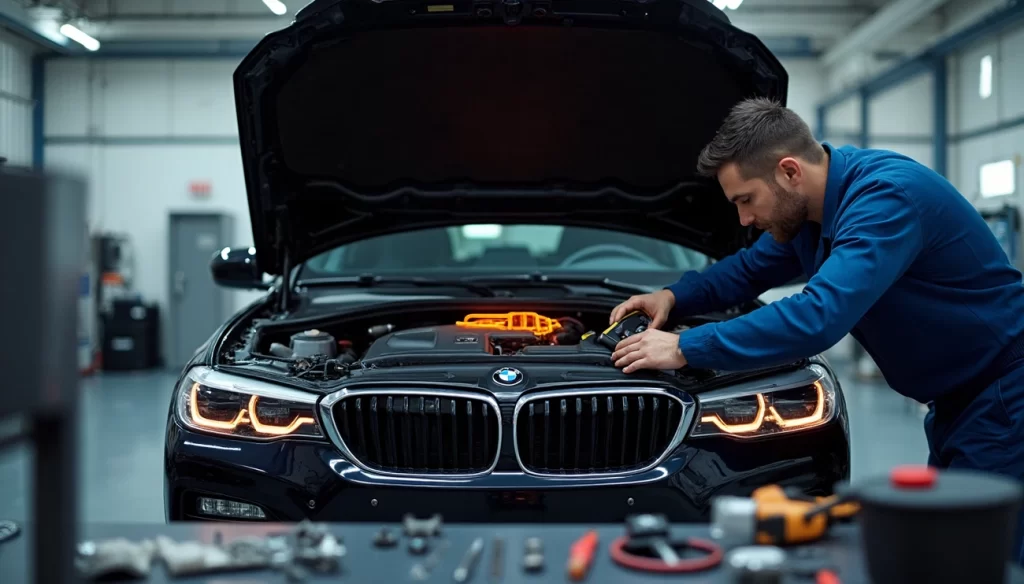
A sharp metallic rattle lasting two to three seconds during a cold morning start means the hydraulic tensioner bled down overnight, leaving the timing chain slack until oil pressure stabilizes. On European engines, this momentary startup clatter signals that the chain has elongated or the composite guides have begun failing, which commonly happens between 80,000 and 120,000 miles. Waiting for a dashboard warning light is a mistake. When live camshaft phase deviation exceeds four degrees or tensioner teeth reach maximum extension, replacing the timing kit immediately prevents pistons from colliding with valves.
You start your Audi or BMW parked outside in an Arvada driveway on a frosty October morning, and for two seconds, an aggressive metallic clatter echoes against the siding before smoothing into an ordinary idle. That brief sound is an early mechanical warning. Chains jump sprocket teeth during cold cranking when thick oil drag and starter torque hit an unprimed, slack assembly together.
Does Your Engine Rattle for a Few Seconds on Cold Start
A cold-start engine rattle happens because modern European powerplants use oil-fed hydraulic tensioners to maintain steady pressure against composite guide rails. While your vehicle sits parked overnight in dropping autumn temperatures, oil bleeds out of the tensioner body back into the oil pan. When you crank the ignition, the timing chain operates unassisted until the oil pump achieves sufficient operating pressure to recharge the tensioner piston.
If the chain and guides are within factory operational tolerances, mechanical ratcheting pawls inside the tensioner hold baseline tension. That mechanical hold keeps the system quiet even without oil pressure. Once internal link pins wear, the mechanical tensioner extends past its calibrated baseline. The loose chain whips against the guide rails and aluminum timing covers for the first few engine rotations, creating a harsh slapping noise that suddenly vanishes.
Why the Rattle Disappears After Three Seconds
The noise disappears quickly because fluid dynamics take over. Modern timing tensioners depend entirely on clean, pressurized oil delivery from the engine lubrication circuit. Within three seconds of ignition, oil floods the upper timing cassettes, pumping up the hydraulic piston and forcing the plastic tensioner shoe tight against the chain. The slack disappears, the slapping stops, and the engine idles smoothly. The underlying elongation remains. Hydraulic pressure simply masks the symptom while you drive, leaving the chain vulnerable to jumping teeth during the next cold start.
Distinguishing Timing Slap from Hydraulic Lifter Tick
Valvetrain noise sounds distinctly different from timing chain clatter. A collapsed hydraulic lifter produces a rapid, light tapping focused at the top of the valve cover. In contrast, timing chain slack creates an irregular, heavy metallic slapping or grinding sound from behind the front timing covers or against the rear firewall cassette. Scheduling an oil change in Golden, CO using OEM-specification synthetic fluids helps technicians verify oil condition, inspect magnetic drain plugs for metallic grit, and isolate lifter noise from timing assembly slack.
Why Mountain Temperatures Unmask Chain Slack in Autumn
At our shop elevation of roughly 5,675 feet in Golden, Colorado, the first freezing nights of late autumn alter engine fluid behavior. Cold temperatures increase base oil viscosity. When morning temperatures drop along the Foothills, thick engine oil takes several extra seconds to navigate narrow passages, bypass check valves, and pressurize upper timing tensioners. An elongated chain that stayed quiet during mild summer mornings will slap loudly against plastic guides in October and November.
Elevation and Cold Viscosity Drag at 5,675 Feet
High-altitude environments amplify startup drag. When freezing Foothills air meets heavy cold oil, starter torque strains against sluggish valvetrain friction.
That initial startup slap is the exact mechanical window where chains jump teeth. Starter torque hits slack links before pressurized oil reaches the upper cassettes. If your chain already has slight elongation, cold mountain mornings expose it fast.
Why Thickening Oil Additives Accelerate Chain Damage
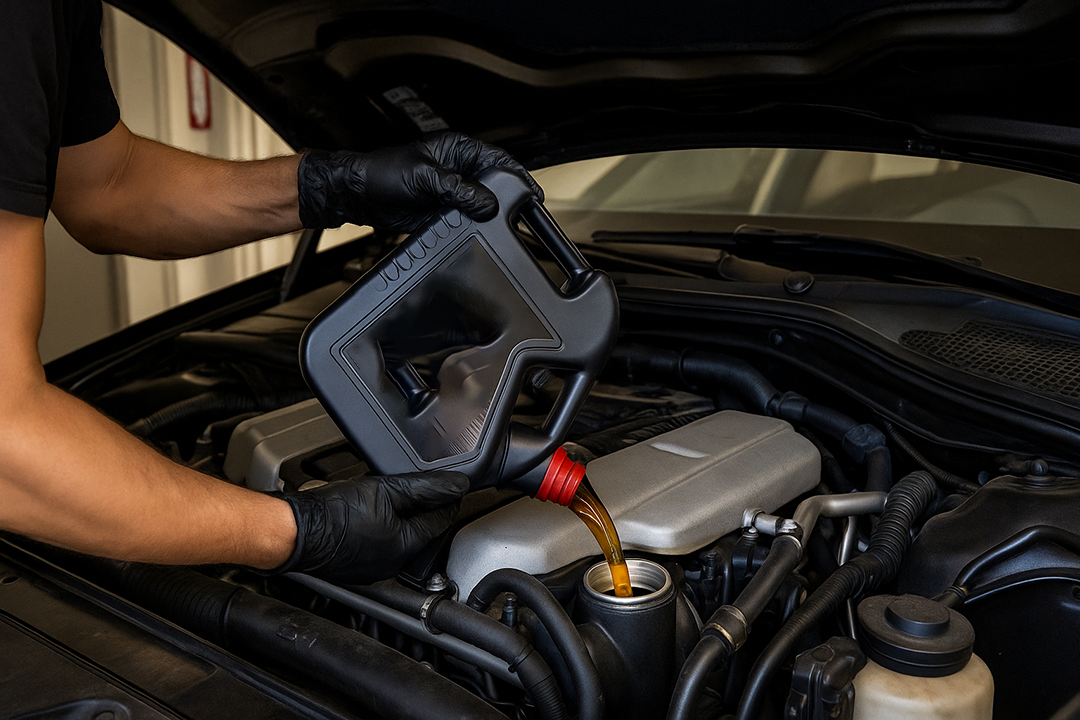
Pouring heavy oil additives or aftermarket stabilizers into your crankcase to silence morning startup rattle is a dangerous mistake. Thickening additives impair cold fluid mobility, delaying oil flow to overhead cam bearings, variable valve timing solenoids, and hydraulic tensioners. While heavy additives might dull engine noise once warmed up, they prolong oil starvation during cold starts. Looking at how driving habits and climate impact oil changes confirms that severe mountain driving demands manufacturer-approved multi-viscosity synthetic oils rather than aftermarket thickeners that starve tensioning systems.
What Camshaft Phase Angles Reveal Before a Warning Light
Waiting for a yellow check engine light on your instrument cluster before inspecting your timing system is a gamble. Engine control modules monitor synchronization between crankshaft position sensors and camshaft position sensors. Factory calibration thresholds permit substantial timing drift before generating a stored diagnostic trouble code, such as P0016 or P0017 for crank and cam correlation faults. By the time the computer illuminates the light, the chain is often stretched close to failure.
Accurate mechanical assessment requires evaluating the vehicle with factory-level diagnostic software, such as Ross-Tech VCDS for Audi and Volkswagen models, or BMW ISTA. Certified technicians evaluate live adaptation values under measuring blocks to observe real-time phase deviation angles while the engine idles at full operating temperature.
| Camshaft Phase Angle Deviation | Diagnostic System Reading | Mechanical Status & Action Required |
|---|---|---|
| 0.0° to -2.5° | Within factory specification | Normal assembly operation; tensioner maintains adequate mechanical travel reserve. |
| -2.6° to -3.9° | Moderate wear detected | Measurable chain link wear; monitor adaptation values at every scheduled service interval. |
| -4.0° to -4.9° | Critical threshold exceeded | Immediate mechanical replacement mandatory; hydraulic tensioner at risk of unseating. |
| -5.0° or greater | Severe timing correlation fault | DTC stored; imminent tooth jumping; do not crank engine to prevent valve damage. |
Reading Live Adaptation Values in VCDS and ISTA
Diagnostic computers communicate directly with the ECM to read camshaft adaptation values, indexed under Group 093 in VCDS for Audi platforms. When components wear down, the camshafts retard in physical relation to the crankshaft. Rather than disassembling valve covers or front accessories for an initial inspection, connecting dealer-grade scanning hardware reveals the exact degrees of timing drift in minutes.
The Four-Degree Threshold for Mechanical Intervention
Across most modern German engines, a phase deviation angle of negative four degrees represents the threshold for mechanical intervention. Once camshaft adaptation reaches or exceeds negative four degrees, the mechanical tensioner has exhausted its calibrated travel margin. If a diagnostic session at our Golden facility reveals phase drift entering negative four degrees during check engine light services, we recommend immediate mechanical timing kit replacement, even if the engine feels responsive on the highway.
How to Inspect Tensioner Extension and Composite Guides
Physical mechanical inspection confirms component integrity when computer diagnostics show borderline numbers. European engines do not use metal tracks. They route steel chains around sprockets using extruded nylon composite guide rails. Severe thermal cycling combined with degraded engine oil causes these plastic rails to turn brittle, leading to fractures under high load.
- Access the Lower Timing Inspection Port: On engines like the Volkswagen and Audi 2.0 TSI, remove the front passenger wheel and wheel well splash shielding to reach the lower steel or aluminum timing cover.
- Extract the Rubber Access Plug: Pry out the circular rubber inspection plug positioned over the hydraulic chain tensioner cylinder without scoring the sealing surface.
- Mirror and Borescope Alignment: Insert an inspection mirror or illuminated digital borescope directly into the service cavity facing the ratcheting piston.
- Count Tensioner Ratchet Teeth: Updated tensioners feature visible machined teeth along the extension piston. Count the exposed ribs protruding past the cylinder housing.
- Evaluate Physical Safety Limits: If the tensioner shows six or more exposed extension teeth, or four or more rings on older styles, the chain has reached full service stretch. Complete timing replacement is required regardless of how quietly the engine idles.
Checking Ratcheting Teeth on Lower Inspection Plugs
Physical inspection prevents surprises. Even if phase adaptation angles read within a borderline tolerance, an inspection plug check may show a tensioner pushed to its physical limit. Older tensioner designs used weak internal retaining clips that can fail suddenly upon startup, allowing the piston to retract entirely when oil pressure drops overnight. Identifying which generation of tensioner sits inside your engine is critical for preventing sudden timing failure.
Nylon Guide Embrittlement and Oil Pan Contamination
When brittle nylon timing rails fracture, the damage rarely stays confined to excess chain play. Shattered plastic guide segments fall straight down into the lower oil sump. These rigid plastic chunks migrate toward the oil pickup tube screen, lodging tightly against the mesh. As detailed across common Audi maintenance issues, a blocked oil pickup screen starves the oil pump, triggering severe oil pressure drops that ruin engine bearings within minutes.
What Happens When an Interference Engine Skips Time
Almost all modern high-compression European gasoline and diesel engines built by Porsche, BMW, Mercedes-Benz, Audi, and Volkswagen are interference engines. In an interference design, the sweep of the piston at top dead center shares the exact same physical cylinder space as the fully extended intake and exhaust valves at alternating moments. The timing chain ensures these moving parts never occupy that space at the same time.
When an elongated timing chain skips two or three sprocket teeth during a cold start, synchronization collapses instantly. Piston crowns moving upward collide directly with open stainless steel valves at high speed. Valve stems bend immediately, valve heads snap off into the combustion chambers, and metal fragments punch through piston crowns and score cylinder walls.
| Service Scope | Mechanical Components Addressed | Typical Cost Profile | Downtime |
|---|---|---|---|
| Preventative Timing Kit Service | New timing chains, updated hydraulic tensioners, composite guide rails, gaskets, crank seal, fresh OEM oil & filter | Standard preventative maintenance investment | 1 to 2 business days |
| Cylinder Head Rebuild (Valve Collision) | Cylinder head removal, new intake/exhaust valves, valve guides, head gasket, machining, full timing kit | 3x to 4x standard timing service cost | 1 to 2 weeks |
| Complete Engine Overhaul or Replacement | Full powertrain removal, replacement short block or long block, transfers, machining, fluid flush, new timing kit | 5x to 8x preventative service cost | 2 to 3 weeks |
Piston-to-Valve Clearance Under Starter Torque
Many drivers assume timing jumps occur only while driving hard at high RPM on mountain passes like Floyd Hill. In reality, the most frequent point of failure is right when the starter motor engages against an unprimed engine. The starter motor delivers an instantaneous shock load to the crankshaft sprocket. If the hydraulic tensioner is slack and the chain is elongated, that sudden rotational force causes the chain to climb up and skip across the camshaft sprocket teeth before oil pressure builds.
Preventative Timing Kit Replacement vs Catastrophic Rebuild Costs
Investing in preventative timing kit replacement protects your engine from total structural damage. Letting a loose chain slap until it snaps or jumps shifts your repair from straightforward maintenance into full European engine rebuild services or complete replacement using our engine replacement services in Golden. A preventative service keeps the original engine intact and protects your investment.
Front Timing Cover or Engine-Out Replacement
Timing chain service varies significantly depending on engine layout. European vehicle platforms dictate very different labor procedures depending on whether the timing components sit at the front of the vehicle or flush against the passenger compartment firewall.
- Drivetrain Evaluation and Access Clearance: For engines with front-mounted chains, such as longitudinal VW and Audi 2.0T or BMW N20 and N55 engines, technicians slide the radiator support into a forward service position. For engines featuring rear-mounted timing cassettes, such as Audi 3.0T or 4.2L platforms, the entire engine, transmission, and subframe assembly must drop out of the chassis.
- Precision Engine Locking Tool Installation: Technicians rotate the engine to top dead center on cylinder one and secure hardened steel camshaft and crankshaft locking fixtures. Universal clamping tools must never be used on high-tolerance European sprockets.
- Teardown and Debris Evacuation: Technicians remove the upper and lower timing covers. If guide rails fractured, the lower oil pan is unbolted to clean the sump, clear the oil pickup tube screen, and inspect rod journals for debris.
- Complete Component Renewal: The primary chain, secondary balance shaft chains, intermediate oil pump chains, updated hydraulic tensioners, and high-density polymer guide rails are fully removed and replaced as a matched set.
- Sprocket Alignment and Torque-to-Yield Fastener Torquing: New OEM sprockets and variable valve timing phasers are secured using new factory torque-to-yield stretch bolts, torqued to precise angle specifications using digital angle-torque wrenches.
- Manual Rotation and Timing Verification: Technicians release mechanical tensioner locking pins to activate spring loading, rotate the engine manually through two full revolutions at the crankshaft bolt, and reinstall locking fixtures to confirm zero mechanical timing deviation.
In-Chassis Front Access vs Rear Firewall Cassettes
Front-mounted timing chains can be serviced in-chassis by removing the front radiator carrier assembly, cooling fans, and accessory drive pulleys. Rear-mounted timing systems place the timing drive inches away from the vehicle firewall. Servicing rear-timing architectures requires dropping the subframe, engine, and transmission together on a specialized hydraulic lift table. Once the powertrain is out of the chassis, accessing the rear timing covers becomes straightforward.
The Necessity of Replacing Guides, Tensioners, and Sprockets as a System
A frequent mistake in cut-rate auto repair is installing a new chain over worn sprockets while leaving aged plastic guide rails inside the timing cover. Worn sprocket teeth develop hooked wear patterns that accelerate wear on brand-new chain links. Aged plastic guide rails that have endured years of thermal stress can shatter if forced to absorb the higher tension of a fresh chain. A lasting repair requires replacing every chain, tensioner, rail, sprocket, crank seal, and cover gasket simultaneously. If you hear a brief metallic morning slap or your scanner indicates drifting cam angles, schedule professional timing chain services in Golden, CO with EuroX Performance or call (303) 562-1800 to inspect the assembly before teeth jump.
Frequently Asked Questions
Can you drive a European car with a cold start timing chain rattle?
No, you should avoid driving with a cold-start rattle because starter torque against a slack chain is the exact moment chains jump sprocket teeth. Even if the sound quiets down after a few seconds, the rattle confirms that the mechanical tensioner has exhausted its travel reserve. Driving in that condition risks sudden piston-to-valve contact on any cold start.
How many miles does a timing chain typically last on European engines?
Timing chains on European engines typically require replacement between 80,000 and 120,000 miles. Frequent short trips, extended oil change intervals, and cold mountain weather accelerate link pin wear while making plastic composite guide rails brittle over time.
How do mechanics check for timing chain stretch without taking the engine apart?
Technicians use dealer-level diagnostic scan tools like VCDS or ISTA to evaluate live camshaft adaptation values and measure phase deviation angles while the engine idles. On engines equipped with an inspection port, mechanics also remove the rubber plug to count the number of extended ratcheting teeth protruding from the hydraulic tensioner piston.
Can oil additives fix a cold-start timing chain rattle?
No, aftermarket oil additives cannot fix physical chain elongation or worn mechanical tensioners. Thickening additives actually slow oil delivery to hydraulic tensioners during freezing starts, which prolongs chain slap and speeds up guide failure.
What is the difference between timing chain rattle and hydraulic lifter tick?
A timing chain rattle produces a heavy, irregular metallic slapping sound originating behind the timing covers that fades once oil pressure builds. Hydraulic lifter tick produces a rapid, light, steady tapping localized at the top of the valve cover that persists and tracks directly with engine speed.