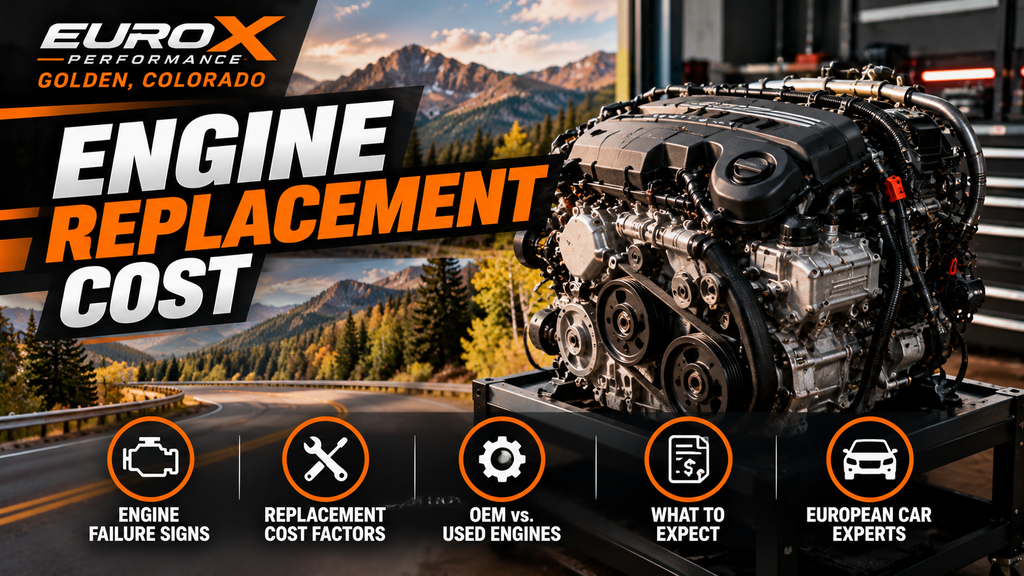
An engine replacement cost typically ranges from $5,000 to $9,000 installed for a quality factory remanufactured long block on a European vehicle. While brand-new dealer OEM crate engines for platforms like Audi or BMW reach $9,000 to over $16,000, remanufacturing restores original factory tolerances at roughly half the parts expense. If the total repair estimate stays below 50% of the vehicle’s fair market value, repowering a sound German chassis is almost always the smartest financial move in 2026.
A catastrophic failure from oil starvation, a spun rod bearing, or a snapped timing chain sounds definitive. Yet the rest of the car is rarely finished. Modern European sedans and SUVs feature rigid safety cages and rust-resistant bodies built to endure hundreds of thousands of miles. The critical decision is choosing the right replacement tier, respecting actual European labor realities, and refusing the shortcuts that destroy fresh motors on startup.
How Much Does an Engine Replacement Cost in 2026?
According to a 2026 price guide published by DMV JDM Depot, national engine replacement totals average $4,000 to $7,000 across standard passenger cars. European platforms command higher totals because their tighter factory tolerances demand specialized workshop tooling. Your total investment depends on the replacement platform you choose.
| Replacement Type | Typical Cost (Parts & Labor) | Warranty Coverage | Risk Level | Best For |
|---|---|---|---|---|
| New OEM Crate Engine | $9,000 to $16,000+ | 2 to 3 Years / Unlimited Miles | Extremely Low | Late-model, high-value luxury or exotic platforms |
| Factory Remanufactured Long Block | $5,000 to $9,000 | 3 to 5 Years / Up to 100k Miles | Low | Daily drivers, long-term ownership, best financial balance |
| Professional Custom Rebuild | $3,500 to $6,000 | 12 Months / 12,000 Miles | Moderate | Vehicles with intact blocks needing top-end machining |
| Used Salvage Motor | $2,500 to $5,000 | 30 to 90 Days (Parts Only) | High | Older commuter cars nearing end-of-life |
New OEM Crate Engines
A brand-new crate motor comes directly from the factory assembly line with zero operating hours. Parts alone average $5,000 to $9,000 for standard four-cylinder or six-cylinder configurations, while high-output twin-turbo V8 variants exceed $14,000 before labor. This path fits owners protecting the resale value of a late-model performance car where preserving original factory provenance matters.
Factory Remanufactured Long Blocks
As outlined in an engine guide by Kelley Blue Book, a remanufactured engine undergoes complete industrial teardown, machine reconditioning of the core block, and total renewal of internal wear components. Remanufactured units routinely deliver over 100,000 miles of reliable service at about half the price of crate motors. Our engine replacement services rely on these units because they offer the cleanest balance of mechanical longevity and warranty coverage for Foothills drivers.
Salvage Yard and Used Motors
A used motor from an auto recycler costs $600 to $2,500 for the bare core. Still, junkyard engines remain a serious gamble for Colorado motorists facing high-load commutes along I-70. An unverified unit carries unknown oil change intervals, brittle valve stem seals, and stretched chains. When a salvage yard engine drops a valve after 60 days, the recycler may supply another used motor, but you get stuck paying the entire shop labor bill again. If your original engine block has not thrown a rod through the casting, an authorized engine rebuild is a far more predictable path.
Why Long Blocks Outperform Short Blocks on European Vehicles
You may encounter repair shops quoting lower estimates built around a short block. A short block includes just the lower crankcase and rotating assembly. A long block arrives as a complete unit with the cylinder head and valvetrain pre-timed at the factory. In the European repair trade, a short block is almost always a false economy.
The Valvetrain Transfer Penalty
Ordering a short block means technicians must strip the valvetrain off your damaged motor, clean every part, and rebuild it onto the new lower assembly. That delicate machine work adds 8 to 12 billable hours. The extra labor quickly cancels any savings on the short block casting, leaving you with an invoice identical to a complete long block.
Debris Contamination in Camshaft Journals
When an engine suffers a rod bearing failure, pulverized metal circulates through every pressurized passage. Those microscopic flakes embed into the aluminum camshaft journals and variable timing solenoids. Bolting that contaminated cylinder head onto a virgin short block is destructive. Within minutes of running, trapped metal flakes wash down into your new bearings and scour the crankshaft journals. Installing a complete long block with clean valvetrain hardware protects your capital.
What Really Drives European Shop Labor to 20 Hours
General automotive guides claim an engine swap requires 8 to 12 labor hours. That timeline applies to an older domestic truck, not a tightly packaged German vehicle. According to automotive finance repair data from Synchrony Automotive, luxury and complex European engine replacements routinely span 15 to 20 book hours. Any estimate quoting under 12 hours for an all-wheel-drive import is cutting corners or preparing a supplemental bill.
Front Lock Carrier Service Position
Modern Audi, BMW, and Volkswagen bays do not allow technicians to pull an engine straight up and out.
Technicians must first disassemble the entire front clip. That means uncoupling the bumper cover, disconnecting radar modules, draining coolant lines, and swinging the air conditioning condenser aside without venting refrigerant. Only then can the front core support slide forward into the factory service position so technicians can reach the bellhousing bolts safely.
All-Wheel-Drive Subframes and Mechatronics
Most European cars along the Front Range rely on all-wheel-drive systems like Audi quattro, BMW xDrive, or Mercedes-Benz 4MATIC to handle steep mountain grades. Dropping these engines requires unbolting steering racks, popping front CV axles, and lowering the front subframe. Technicians must also disconnect delicate transmission wiring without bending pins. Through our drivetrain repair services, technicians inspect differential seals, transfer case alignments, and driveshaft guibo joints during this step so the driveline reassembles without vibration.
Mandatory Ancillary Parts to Replace During an Engine Swap
Replacing an engine without renewing aged wear items in the bay is mechanical negligence. An empty engine compartment provides wide-open access to components that otherwise require thousands of dollars in labor to reach later. Replacing them while the chassis sits bare takes minimal time and prevents immediate warranty headaches.
Turbocharger Feed Lines and Oil Coolers
If your previous engine failed from bearing seizure or oil starvation, you must replace the external oil cooler and turbocharger feed lines. Flushing cannot dislodge metal filings embedded inside an oil cooler’s micro-passages. Reusing an old cooler sends trapped glitter directly into your fresh engine. Furthermore, oil starvation damages turbo shaft bearings; pairing an old, oil-starved turbo with a fresh motor risks sending broken turbine pieces straight into your intake valves.
Hydraulic Engine Mounts and Rear Main Seals
Modern German vehicles rely on fluid-damped hydraulic motor mounts to isolate cabin vibration. By 80,000 miles, these rubber bladders tear and leak their fluid. Bolting a new motor onto collapsed mounts causes harsh idling and strains exhaust flex pipes. The rear main crankshaft seal sits right behind the flywheel. Installing a fresh seal while the engine hangs from a hoist costs pennies in labor, saving you from paying to pull the transmission six months later.
Water Pumps and Plastic Cooling Crossovers
European manufacturers favor composite plastics for thermostat housings and rear coolant crossover pipes. Subjected to repeated heat cycling and freezing Rocky Mountain winters, these plastic parts turn brittle. Renewing the water pump assembly and rear coolant flanges before sliding the engine into place eliminates sudden coolant dumps. Our guide on European coolant leak repair costs illustrates how fast cooling system repairs mount when tackled piece by piece.
Why Direct Injection and Immobilizers Demand ECU Coding
Dropping an engine into a European car is no longer just a wrenching job. Direct-injection systems run fuel rail pressures over 2,000 PSI, requiring surgical calibration from the engine control module. Mechanical installation is merely three-quarters of the project; dealer-grade diagnostics must marry the hardware to the car.
Each high-pressure direct injector carries a unique alphanumeric flow-rate code etched into its body. During reassembly, technicians run factory-level software through our automotive electrical services to register every injector code to its specific cylinder slot. Skipping injector adaptation causes uneven fuel trim distribution, hard misfires, catalytic converter melting, and cylinder wash that ruins new rings.
The engine control unit is also tethered to the vehicle immobilizer, transmission computer, and electronic steering lock. When a new engine block and fresh sensors enter the loop, the modules require a digital security handshake to sync. Without dedicated diagnostic software to authorize this communication, the starter will spin while the vehicle locks out ignition.
Is Replacing an Engine Smarter Than Buying Another Car in 2026?
Deciding between a $7,000 engine installation and a dealership showroom comes down to straightforward math. Vehicle replacement costs remain high, and borrowing terms add substantial drag on household finances.
According to the October 2026 Survey of Consumer Finances from the Federal Reserve Board, 8.6% of American families now carry debt service payments exceeding 40% of their income. Securing a hefty auto loan at current interest rates tethers you to significant monthly financing fees. Repowering a vehicle you already own eliminates that debt burden while retaining a car whose maintenance record and body condition you already know.
The 50 Percent Fair Market Value Guideline
A practical rule of thumb applies here: if the complete engine replacement estimate totals less than 50% of the vehicle’s fair market value, keeping the car makes financial sense. Take a 2017 BMW X5 or Audi Q5 worth $18,000 to $22,000. Spending $7,500 on a remanufactured long block backed by warranty represents roughly 35% to 40% of its market value. You gain years of reliable operation for a fraction of the capital needed to buy an unfamiliar used vehicle.
Avoiding Elevated Auto Loan Interest Rates
Buying another used luxury car means gambling on how the previous driver treated maintenance intervals, such as ignoring a stretched timing chain. Beyond the purchase price, you must pay registration fees, dealer documentation charges, and local vehicle taxes. Investing that money into a remanufactured engine restores your vehicle without tying you to monthly finance payments.
Warranty Options and Professional Installation in Golden
Every engine replacement at EuroX Performance is handled by ASE-certified technicians adhering to strict factory technical specifications. We do not gamble on unverified salvage yard units with 30-day coverage. We install precision remanufactured long blocks supported by dependable multi-year warranty options, protecting your vehicle whether you commute on C-470 or head up Clear Creek Canyon.
Cold weather demands specific engine installation procedures along the Front Range. As autumn temperatures dip below freezing in Golden and Evergreen, new cooling systems require thorough vacuum filling. European coolant loops contain multi-zone heater cores and auxiliary radiators. Any trapped air pocket creates hot spots that can warp an aluminum cylinder head before the thermostat cycles. We fill systems with European-spec coolant mixed to precise 50/50 freeze ratings.
Before turning the key, our technicians prime oil pressure across the engine galleys without spark or fuel, preventing dry bearing friction on initial fire-up. We also set a clear break-in protocol: for the first 500 to 1,000 miles, Foothills motorists should vary engine speed and avoid wide-open throttle climbs up I-70 so piston rings seat against the cylinder walls. If your vehicle has experienced mechanical failure, contact EuroX Performance to discuss diagnostic options and review our engine replacement warranty solutions.
Frequently Asked Questions
How much does a European engine replacement cost in 2026?
A complete European engine replacement typically costs between $5,000 and $9,000 for a factory remanufactured long block, including parts, labor, and necessary fluids. Brand-new dealer OEM crate engines range from $9,000 to over $16,000 installed, depending on whether the car runs a standard four-cylinder engine or an intricate twin-turbo powertrain.
What is the difference between an OEM crate engine and a remanufactured long block?
An OEM crate engine is built entirely new on the factory assembly line with zero operating hours. A remanufactured long block utilizes a fully inspected, cleaned, and precision-machined original core block fitted with brand-new internal wear components, delivering original factory tolerances at roughly half the parts expense.
How many labor hours are required to replace a European car engine?
European engine replacements book between 15 and 20 billable labor hours. Technicians must slide the front bumper and core support into service position, unbolt all-wheel-drive subframes, and disconnect delicate transmission harnesses, a technical process that cannot be rushed without risking electrical faults or fluid leaks.
Why does my European engine replacement require ECU coding?
Direct-injection European engines require technicians to program individual injector flow-rate calibration numbers into the engine control unit to ensure balanced cylinder combustion. The factory engine electronics also need an immobilizer alignment handshake to authorize ignition and prevent anti-theft startup lockout.
Is it worth replacing an engine or buying another vehicle in 2026?
Replacing an engine makes practical sense if total repair costs stay below 50% of the vehicle’s fair market value. With high auto loan interest rates and elevated replacement vehicle prices, installing a warranty-backed remanufactured engine restores dependable transportation without locking you into years of new financing payments.