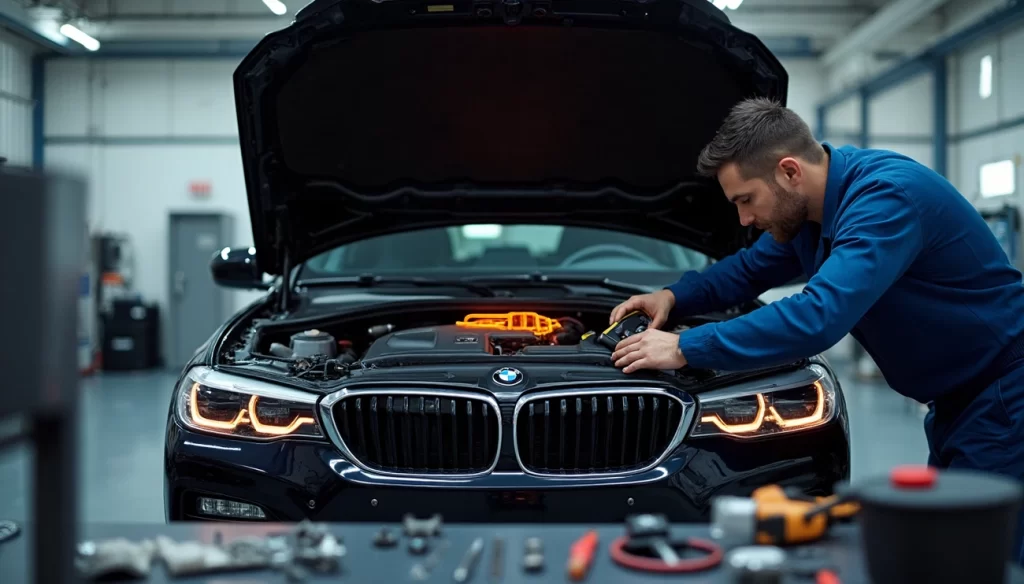
Repairing a coolant leak on a European vehicle in 2026 typically costs between $350 and $1,800, depending on whether the fault is an accessible expansion tank or a buried electric water pump. Across the Front Range, October temperature swings cause aging composite plastics to contract and weep fluid overnight. Professional pressure-decay testing pinpoints these micro-fractures before overheating damages your engine.
Walking into your garage on a crisp October morning in Golden to discover a sweet-smelling puddle beneath your front bumper is unsettling. When an amber dashboard alert signals that your car is low on coolant, continuing to drive risks severe internal damage. High-compression European alloy engines have minimal tolerance for thermal spikes, and what begins as a minor overnight seep can quickly leave your car overheating on the climb up Clear Creek Canyon. Understanding the true coolant leak repair cost means looking past generic estimates and examining the precision engineering under your hood.
2026 European Coolant Leak Repair Costs by Component
National automotive aggregators often cite generic cooling system repairs between $150 and $1,200. However, those numbers reflect basic domestic and Asian platforms with open engine bays, standard rubber hoses, and stamped metal thermostat necks. European marques like BMW, Audi, Mercedes-Benz, Porsche, and Volkswagen rely on glass-fiber reinforced composite plastics, integrated electronic thermal management modules, and tightly packaged engine compartments that demand specialized disassembly.
| Component / Service | Typical Parts Cost (OEM) | Labor Hours | Total 2026 Estimated Range |
|---|---|---|---|
| Pressurized Expansion Tank | $95 – $240 | 1.0 – 1.5 hrs | $250 – $480 |
| Upper / Lower Quick-Connect Radiator Hoses | $80 – $220 | 1.0 – 2.0 hrs | $240 – $550 |
| Rear Cylinder Head Coolant Flange | $65 – $130 | 3.0 – 5.0 hrs | $550 – $950 |
| Map-Controlled Thermostat Assembly | $180 – $420 | 2.0 – 3.5 hrs | $500 – $980 |
| Computerized Electric Water Pump & Hardware | $450 – $850 | 3.0 – 4.5 hrs | $950 – $1,650 |
| Full Water Pump & Thermostat Overhaul Module | $650 – $1,150 | 4.0 – 6.0 hrs | $1,300 – $2,100 |
| All-Aluminum Radiator Core Replacement | $320 – $750 | 3.5 – 5.5 hrs | $850 – $1,650 |
| Internal Head Gasket Failure (Severe Overheating) | $400 – $900 | 15.0 – 25.0 hrs | $2,800 – $5,500+ |
Component Cost Breakdown and Typical Shop Hours
On European vehicles, component prices reflect strict material standards. OEM expansion tanks feature internal level sensors and pressure-rated structural baffles, while thermostat housings integrate electronic heating elements to regulate operating temperatures on demand. While a simple plastic fitting may carry an accessible price tag, the labor required to reach it dictates the final invoice. When neglected leaks cause complete head gasket failure or block distortion, costs escalate into full engine replacement services.
Understanding the European Labor Distribution
The biggest pricing surprise for European owners is the ratio of parts to labor. On a transverse engine layout found in many Audi and Volkswagen models, a rear cylinder head coolant flange is an inexpensive composite part. Yet, replacing it requires removing the airbox, battery tray, high-pressure fuel lines, and secondary wiring harnesses simply to access the rear of the cylinder head. You are paying for hours of surgical mechanical labor to ensure surrounding sensors, vacuum lines, and harness clips remain completely intact.
Why Autumn Temperature Drops Trigger Coolant Leaks in Golden
Every October across the Colorado Front Range, daytime temperatures in the 60s plunge into sub-freezing territory overnight. A 30- to 40-degree swing within twelve hours places significant thermal stress on your engine bay. Materials expand when hot and contract when cold, but different materials do so at drastically different rates.
Thermal Expansion Differentials on Alloy Blocks
Modern German engines pair cast aluminum or magnesium alloy blocks with glass-fiber reinforced polyamide plastic cooling connections. Aluminum contracts moderately as it cools, but heat-aged composite plastics contract substantially faster. After five to eight years of engine heat cycles, the plastic flanges lose their original plasticity and internal O-rings harden into rigid, flattened rubber. During an October freeze in Golden, the plastic flange shrinks away from the alloy block, relaxing clamping pressure on the cold O-ring. Coolant weeps out onto the floor overnight, only for the leak to mysteriously vanish the next morning once the engine warms to 200 degrees and expands the seal shut. However, the underlying issue remains; if you notice fluid pooled beneath the transmission bellhousing, our guide on VW Golf rear engine coolant leaks details how this exact failure develops.
Ultrasonic Weld Micro-Fractures in Pressurized Expansion Tanks
European cooling systems operate under substantial static pressures, routinely running between 1.4 and 2.0 bar (20 to 29 psi) to elevate boiling thresholds for maximum combustion efficiency. Expansion tanks are molded in two separate halves joined together by an ultrasonic weld seam along the middle perimeter. Years of hot, pressurized cycling make this plastic brittle. When cold mountain air hits an aged tank, the sudden thermal shock causes the seam to develop microscopic stress fractures. In typical European expansion tank cracks, these fissures initially weep faint traces of white or crusty pink residue before splitting entirely under highway load.
Electric Water Pumps Compared to Thermostats and Expansion Tanks
Diagnosing and repairing cooling faults requires isolating completely different component architectures. Replacing an expansion tank takes minimal shop time, while electric water pumps and thermal management modules represent complex electronic repairs.
Computerized Electric Water Pumps and Vacuum Bleeding
Traditional domestic water pumps rely on a mechanical impeller driven by the serpentine belt. German marques like BMW and Porsche frequently utilize computerized electric water pumps powered by internal brushless electric motors and dedicated microprocessor control boards. These smart pumps adjust coolant flow independently of engine RPM, speeding up to cool hot turbochargers after you shut the engine off. When internal electronics fail or the plastic impeller housing cracks, replacement involves programming, specialized hardware, and an automated electronic scan-tool bleeding sequence. We explore these unique mechanical demands in our analysis of BMW electric water pump failures.
Integrated Map-Controlled Thermostat Housings
Thermostats in modern European vehicles are rarely standalone wax-pellet valves hidden under a two-bolt neck. Instead, they are housed within complex composite thermal management modules that use internal electric heaters commanded by the engine control module. If your car is running cold or overheating on steep grades, the housing itself has likely degraded internally. Identifying the warning signs of a failing European thermostat early protects the engine from chronic under-temperature carbon fouling or catastrophic heat spikes.
Pressurized Coolant Expansion Tanks
In contrast to simple overflow catch cans on domestic trucks, European expansion tanks are an active, fully pressurized part of the cooling circuit. They incorporate internal multi-chamber baffles, integrated low-coolant reed sensors, and calibrated relief-valve caps. Replacing a weathered expansion tank is relatively straightforward, but installing unbranded aftermarket tanks often results in split seams within a single season due to inferior polymer grades.
Why Chemical Stop-Leak Products Ruin European Engines
When faced with a cooling system quote, some drivers consider buying a bottle of pour-in chemical radiator sealant from an auto parts store. In a modern European engine, this is an expensive mistake.
Chemical stop-leak products function by suspending micro-fibers, sodium silicate, or metallic particles in a liquid carrier. When these compounds encounter air at a crack, they cure into a solid crust. Experienced mechanics warn in community repair discussions that stop-leak additives carry a severe risk of clogging narrow internal coolant passages. European heat exchangers, turbocharger coolant supply pipes, and cabin heater cores rely on ultra-thin micro-channels barely wider than a pinhead. Pour-in sealants quickly pack these passages solid.
The cabin heater stops blowing warm air, the engine oil cooler gets starved of flow, and internal hot spots form across the cylinder head. What would have been a straightforward plastic connector repair turns into a costly teardown requiring dashboard removal to replace the heater core, alongside a full cooling system flush or engine repairs.
How Pressure-Decay Diagnostics Pinpoint Hidden Hairline Leaks
Guessing where a European cooling leak originates by simply opening the hood is ineffective. Modern engine bays are tightly encapsulated, and aerodynamic composite belly pans catch weeping coolant, running it backward along the subframe before dropping it onto your garage floor feet away from the actual leak point. Pinpointing faults requires an orderly diagnostic procedure.
- Aerodynamic Splash Shield Removal: Technicians place the vehicle on a hydraulic lift to remove the full-length underbody shielding. This eliminates false trails and reveals whether coolant is weeping from the front radiator end tanks, the oil filter housing, or the back of the cylinder head.
- Calibrated Cold Pressure-Decay Testing: A professional cooling system diagnosis labor estimate is valued between $61 and $90 according to national repair index data from September 2026. Using calibrated bay adapters, the technician inspects the pressure cap first and pressurizes the cold system to the exact specification stamped on your reservoir cap (typically 1.4 to 2.0 bar). Monitoring the pressure gauge over a decay window verifies the drop rate. If pressure drops without an external puddle, it points to an internal fault, such as an oil-cooler heat exchanger leak or head gasket issue.
- High-Intensity Ultraviolet Dye Inspection: If the pressure decays externally, high-intensity UV dye circulated through the system illuminates under an inspection flashlight. This immediately isolates hairline stress cracks in composite plastic necks, weeping quick-connect clips, or water pump mechanical shaft seal seepage hidden behind drive belts.
- Altitude Boiling Point Compensation: In Golden, elevation sits at roughly 5,675 feet above sea level. Due to reduced atmospheric pressure, the boiling point of pure water drops from 212 degrees Fahrenheit down to roughly 202 degrees. A tight, pressurized cap and fresh 50/50 European-spec coolant are required to keep operating fluid from boiling into localized steam pockets. Steam pockets do not transfer heat, which causes rapid head warping during sustained uphill acceleration up I-70.
If your amber coolant light has appeared, or you have detected a sweet odor from your vents, schedule an appointment for check engine light diagnostics and a pressure test. Our ASE-certified technicians at EuroX Performance use OEM parts and dealer-grade diagnostic tools to keep your vehicle performing reliably. Call (303) 562-1800 or submit an inquiry through our contact page to resolve your cooling issues before winter weather sets in.
Frequently Asked Questions
How much does it cost to fix a coolant leak on a European car?
Most European coolant leak repairs in 2026 cost between $350 and $1,800. Straightforward repairs like replacing a cracked expansion tank or upper radiator hose range from $250 to $550, while buried electric water pumps, oil filter housing assemblies, and rear cylinder head coolant flanges require extensive labor that pushes totals to $950 to $1,800 or more.
Can I drive my European car with an amber low-coolant warning?
No, you should safely pull over and shut the vehicle off as soon as possible. High-compression European alloy engines have tight manufacturing tolerances, and localized boiling can warp aluminum cylinder heads or compromise head gaskets within minutes of running low on fluid.
Why does my European car only leak coolant overnight in cold weather?
Autumn temperature swings along the Colorado Front Range routinely exceed 30 to 40 degrees between afternoon and early morning. Heat-aged glass-fiber composite plastic flanges contract faster than the aluminum engine block they bolt to, shrinking hardened internal rubber O-rings and allowing fluid to seep past the cold seal until the engine warms back up.
Does chemical stop-leak work for European cooling system leaks?
No, chemical sealants should never be added to a modern European cooling system. The fibrous sealing agents coagulate inside the narrow micro-channels of European heater cores, turbocharger coolant lines, and oil coolers, causing widespread clogs and leading to thousands of dollars in secondary cooling system damage.
What is involved in a professional cooling system pressure-decay test?
A technician inspects the reservoir pressure cap and connects a calibrated tester to pressurize the cold system to factory operating specifications, usually between 1.4 and 2.0 bar. By monitoring gauge decay alongside ultraviolet leak-detection dye and a UV flashlight, the technician locates hairline cracks in composite housings and failing seals hidden behind aerodynamic belly pans.