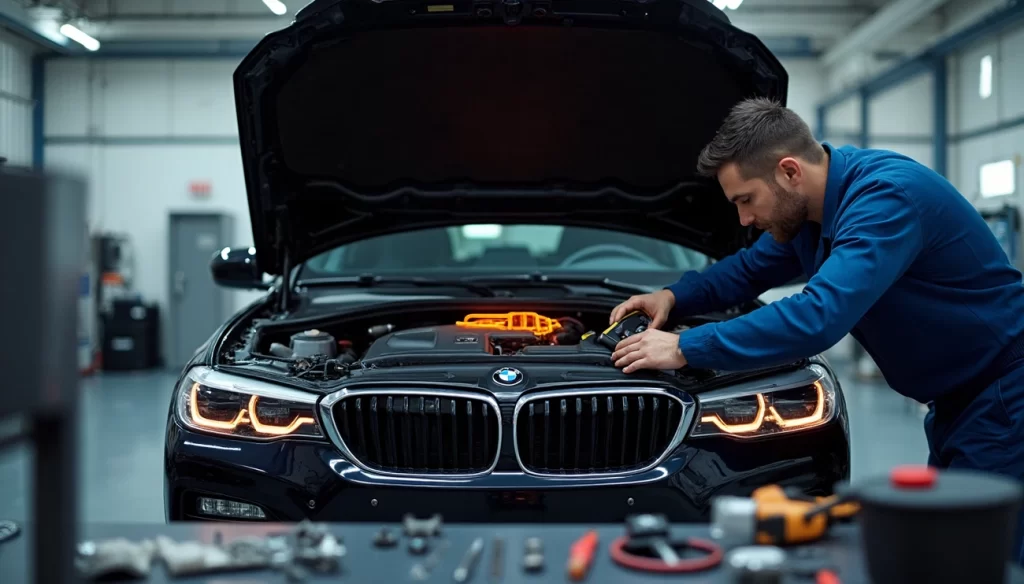
When a 25-degree October morning in Golden or Evergreen results in a sluggish engine crank and a cascade of instrument cluster warnings, cold-thickened oil and depleted chemical capacity have exposed a degraded battery. Modern European vehicles demand specialized auto electric service because their microprocessors actively regulate alternator output based on battery age and Absorbed Glass Mat (AGM) chemistry. Simply dropping in an unprogrammed retail battery causes the alternator to overcharge the new unit, triggering electrical faults and premature battery death within months.
European vehicles rely on complex network architectures where steady voltage is mandatory. When temperatures drop along the Front Range, electrical systems undergo extreme physical and chemical stress. Treating a modern BMW, Audi, Mercedes-Benz, or Porsche like a domestic car from thirty years ago by performing a simple hardware swap creates cascading system errors. Understanding how cold weather affects these vehicles and why digital calibration is required protects both your starter motor and your onboard computers.
Why Do European Car Batteries Fail Suddenly When Temperatures Drop?
A battery that starts your car effortlessly on a mild September afternoon can leave you stranded in an unheated mountain driveway on the first freezing morning in October. This abrupt failure is rarely an overnight defect; rather, the sudden temperature drop exposes chemical degradation that developed quietly over the summer months.
Sub-Freezing Foothills Nights and Chemical Output
Automotive lead-acid and AGM batteries rely on liquid or gel-suspended electrolytes to facilitate chemical reactions between lead plates. As ambient temperatures drop into the 20s across the Foothills, these chemical reactions slow dramatically. At 32 degrees Fahrenheit, a vehicle battery loses roughly 20 to 35 percent of its electrical capacity; at zero degrees, that capacity drops by half. If internal plates are already compromised by sulfation or high summer heat degradation, the battery cannot release enough amperage to satisfy initial ignition demands. When that sudden voltage crash occurs, the instrument cluster often illuminates a battery light or triggers false diagnostic trouble codes. If you see that warning pop up on your dash, learn what it means when your battery light comes on before the car leaves you immobilized.
Increased Cranking Resistance from Thickened Cold Oil
While the battery loses available chemical output, the mechanical load placed on it doubles. Engine oil thickens significantly as temperatures plummet overnight in Golden and Evergreen. Pumping cold, viscous synthetic oil through tight European bearing clearances requires massive rotational torque from the starter motor. The starter draws substantially higher cold-cranking amps (CCA) to turn the crankshaft over at necessary starting speeds. When an aging battery with reduced output attempts to spin a stiff, resistant engine, system voltage collapses below the operating threshold of sensitive control units, producing a slow, agonizing crank or rapid starter solenoid clicking.
What Happens If You Do Not Program a New European Car Battery?
Replacing the battery in a modern European platform is no longer a simple mechanical task. Advanced platforms from Audi, BMW, Mercedes-Benz, Porsche, and Volkswagen incorporate microprocessors that constantly monitor and adjust charging profiles. Failing to update these control modules turns a routine car battery replacement service into an expensive electrical failure.
How Intelligent Battery Sensors Track Aging Cells
Modern German vehicles feature an Intelligent Battery Sensor (IBS) mounted directly on the negative terminal. This microprocessor-controlled sensor continuously calculates voltage, internal resistance, current throughput, and operating temperature. As lead plates age and internal resistance increases, the vehicle’s Battery Management System (BMS) compensates by raising alternator output voltage. By pushing a higher charging current into the aging battery, the vehicle ensures that older cells continue to hold sufficient charge to operate complex safety networks, comfort convenience modules, and advanced driver assistance systems (ADAS), which modern vehicle electrical architectures require steady system voltage to run reliably.
The Damage of Running an Aggressive Charging Profile on New Plates
When you install a fresh battery without registering it via dealer-level diagnostic equipment, the BMS has no way of knowing the plates are new. The engine control module continues applying the aggressive, high-voltage charging profile designed for the worn-out unit. This excessive charge boils the fresh electrolyte, warps internal plates, and can destroy a brand-new AGM battery within six to twelve months. Digital registration resets the learned adaptation values, instructing the alternator to deliver a gentle, baseline charging curve appropriate for brand-new cells. At EuroX Performance, our certified technicians perform factory-level coding during every automotive electrical service in Golden, CO to protect your investment.
Can You Put a Regular Flooded Battery in an AGM European Vehicle?
When faced with replacement costs, vehicle owners occasionally ask whether a less expensive conventional flooded lead-acid battery can be substituted for an Absorbed Glass Mat unit. In a modern European automobile, the answer is an absolute no. Doing so creates immediate operational hazards and accelerates battery breakdown.
| Feature / Specification | Standard Flooded Lead-Acid | Absorbed Glass Mat (AGM) |
|---|---|---|
| Internal Electrolyte State | Liquid acid free-floating around lead plates | Electrolyte suspended in fiberglass mat separators |
| Cycle Life & Durability | Standard cycling; degrades under repeated deep draw | Up to 3x higher cycle life; designed for deep discharge |
| Recharge Acceptance Rate | Slower charge intake; prone to surface charge buildup | Rapid energy absorption from regenerative charging |
| Vibration & Tilt Resistance | Vulnerable to plate shedding and liquid acid leaks | Spill-proof, sealed, and highly vibration resistant |
| Start-Stop Compatibility | Unsuitable; causes premature plate sulfation | Mandatory factory specification for micro-hybrid systems |
Internal Chemistry Differences Between Flooded and AGM Batteries
Standard flooded batteries submerge lead plates in liquid sulfuric acid. When subjected to the aggressive charge-discharge cycles common in modern cars, liquid acid stratifies, and the plates shed active material, settling as sludge at the bottom of the casing. AGM batteries eliminate free-floating liquid entirely by compressing the electrolyte within micro-fiberglass fleece mats. This construction lowers internal resistance, allows far faster energy transfer, and withstands harsh mountain vibration along Clear Creek Canyon or the I-70 corridor without physical plate damage.
Deep-Cycle Micro-Hybrid Demands and Premature Plate Degradation
European start-stop systems and regenerative braking architectures place deep-cycle demands on the electrical system. When your engine shuts down at a red light on 6th Avenue in Golden, the battery alone carries the load of the high-output cabin blower motor, navigation processors, daytime running lights, and seat heaters. Once the light turns green, the alternator immediately floods the battery with a high-amperage burst of regenerative charging. Conventional flooded plates cannot absorb high current rapidly and will quickly overheat, degrade, and trigger secondary diagnostic trouble codes across the vehicle’s network.
Why Does a Simple Multimeter Voltage Test Miss Critical Winter Faults?
Testing a battery at rest with a handheld multimeter is one of the most common diagnostic pitfalls in European car care. A reading of 12.5 or 12.6 volts can make a battery look healthy on the surface while it sits on the verge of complete operational collapse.
- Static Surface Voltage: A handheld multimeter checks potential energy without an active load. Even a badly sulfated battery with almost no remaining cranking capacity can show 12.6 volts across its terminals until an actual load is applied.
- Dynamic Conductance and Internal Resistance: Proper diagnostic testing measures conductance by sending a high-frequency AC signal through the battery. This tests internal plate integrity, surface area, and resistance to prove whether the unit can deliver cold-cranking amperage under load.
- Alternator Diode Ripple Voltage: Testing must include monitoring AC ripple from the alternator diodes. A leaky diode allows alternating current into the vehicle’s direct-current network, creating electronic interference and slowly draining the battery while driving.
- Intermittent Communication Network Errors: When system voltage droops during ignition cranking, microprocessors lose communication. Scanning modules using dedicated equipment reveals whether low voltage has stored historic communication faults across the transmission or anti-lock brake systems.
Static Surface Voltage vs Dynamic Conductance Testing
Static surface voltage only measures chemical potential at rest. Dynamic conductance testing simulates real-world stress by evaluating the physical structure of the internal plates. Industry maintenance guidelines note that vehicle batteries should be professionally evaluated after 3 years of service and routinely replaced by year 5. If conductance testing reveals elevated internal resistance, that battery will drop below required operating voltage the moment cold weather hits the Foothills, no matter what a standard multimeter displays.
Automated Comfort Circuit Power-Shedding Under Voltage Drops
When European power management modules detect battery reserve dropping below safety margins, they preserve starting power through automated power-shedding. The vehicle systematically shuts down high-draw convenience circuits, such as steering wheel heaters, rear window defrosters, and auxiliary seat warmers, without displaying a primary battery fault. Drivers frequently mistake this power preservation for faulty switches or broken heating elements. If your luxury vehicle is randomly disabling cabin comfort features or flashing strange warnings, our certified technicians can run complete check engine light diagnostics in Golden, CO to pinpoint the low-voltage root cause.
How Do Technicians Track Down Parasitic Battery Drains in Modern Cars?
When a European vehicle suffers from recurring overnight discharge, simply installing a new battery is costly guesswork. The vehicle may be suffering from a parasitic drain: an onboard computer or convenience module that fails to shut down after the vehicle is locked, slowly drawing down the battery while parked.
- Latching Latches and Simulating Sleep Mode: The technician connects an external lab-grade power supply, manually trips the door and hood latches so the vehicle can be locked with access panels open, and allows the platform to enter its deep sleep cycle, which can take up to 45 minutes on modern Audi or BMW platforms.
- Monitoring Closed-Circuit Current Draw: A digital multimeter or inductive amp clamp is placed in series to measure quiescent current draw. A healthy modern vehicle should draw fewer than 40 to 50 milliamps once fully asleep. If current draw stays at 200 to 800 milliamps, a module is awake.
- Measuring Millivolt Drop Across Fuses: Rather than pulling fuses, which wakes up sleeping computer modules and resets the bus network, technicians measure microscopic millivolt drops across the exposed test points of each fuse to calculate exact current draw using Ohm’s Law.
- Isolating the Active Bus Circuit: Once the active fuse is identified, technicians trace the circuit to locate the specific control module, damaged sensor, or pinched wiring harness preventing the vehicle from entering its low-power state.
Isolating Sleepless Modules Along the CAN Bus Network
Modern luxury vehicles rely on high-speed Controller Area Network (CAN) and Local Interconnect Network (LIN) data buses. If a single control module, such as an aftermarket dash cam, a telematics unit, an exterior door handle sensor, or an infotainment controller, remains active, it broadcasts signals across the entire data bus. This keeps neighboring control units awake, turning a minor module glitch into an overnight parasitic drain that flattens an AGM battery during cold weather. Finding these issues requires methodical testing rather than random parts swapping.
Under-Hood Jump-Starting Terminals to Protect Sensitive Control Units
If you experience a dead battery in an unheated mountain driveway, avoid connecting jumper cables directly to the battery terminals in the trunk or spare tire well. Modern European vehicles route battery power through delicate Pyrotechnic Battery Disconnect switches and Intelligent Battery Sensors that can be destroyed by an electrical spike. Always use the dedicated positive jump terminal and chassis ground post located under the hood. Connecting jumper cables backwards or causing an accidental short circuit carries devastating consequences for onboard computers, which is why safe handling procedures and proper polarity are non-negotiable.
Where Should Foothills Drivers Go for Certified Auto Electric Service?
Harsh high-altitude winters across Golden, Lakewood, Arvada, Wheat Ridge, and Evergreen demand uncompromised electrical health. Combining freezing Foothills temperatures, steep mountain grades, and short, accessory-heavy commutes prevents the alternator from fully replenishing the massive electrical deficit created during cold starts. That persistent state of partial charge accelerates plate sulfation, making timely car battery service a necessity.
Dealer-Level Diagnostic Scanners and Factory Coding
Servicing European electrical systems requires specialized tools that quick-lube shops and general tire stores do not carry. EuroX Performance utilizes dealer-level diagnostic scanners to interface directly with BMW ISTA, Audi/VW ODIS, Mercedes-Benz XENTRY, and Porsche PIWIS software platforms. Our ASE-certified technicians do not simply drop a retail battery into your vehicle; we verify alternator diode ripple, evaluate starter motor draw, check ground straps for micro-corrosion, install exact OEM-spec AGM batteries, and complete digital BMS registration according to factory specifications.
Scheduling Preventative Fall Electrical Diagnostics in Golden
Expecting an original battery to survive past its fourth or fifth winter without systematic testing is a gamble that leaves many Foothills drivers stranded in sub-freezing weather. Preventative testing confirms your battery’s cold-cranking capacity before the deep winter freezes arrive. To have your charging system tested, your vehicle scanned for dormant electrical faults, and an OEM-grade AGM battery properly registered, submit a quote request on our contact page or call our team at (303) 562-1800 to schedule your appointment.
Frequently Asked Questions
Why does my European car require battery registration after replacement?
The vehicle’s Battery Management System automatically raises alternator charging output as the battery ages to compensate for rising internal resistance. If a new battery is installed without digital registration, the system continues applying that aggressive, high-voltage charging profile, which quickly boils the fresh electrolyte and drastically shortens the new battery’s service life.
Can I replace an AGM battery with a standard flooded battery to save money?
No. European vehicles equipped with start-stop technology, regenerative braking systems, and sophisticated electronics impose heavy deep-cycle demands that conventional flooded batteries are not built to withstand. Installing a standard flooded battery will cause rapid plate degradation, internal acid stratification, and premature failure within months.
Why did my car battery fail on the very first sub-freezing morning?
Freezing overnight temperatures slow the internal chemical reactions of a battery, reducing its cranking capacity by up to 50 percent in extreme cold. At the same time, cold, thick engine oil creates immense mechanical resistance against the starter motor, exposing preexisting plate wear that went unnoticed during warm summer driving.
How do technicians pinpoint an overnight parasitic battery drain?
Technicians allow the vehicle to enter its complete low-power sleep state and monitor quiescent current draw using specialized equipment. By measuring millivolt drops across fuses without pulling them, technicians identify exactly which computer module or circuit on the CAN bus network is failing to go to sleep.
Is it safe to jump-start a European car directly at the battery terminals?
Connecting jumper cables directly to battery terminals in the trunk or spare tire well is dangerous and risks sending voltage spikes through the Intelligent Battery Sensor and sensitive onboard computers. European vehicles are engineered with dedicated positive jump terminals and chassis ground lugs located under the hood specifically for safe emergency starting.