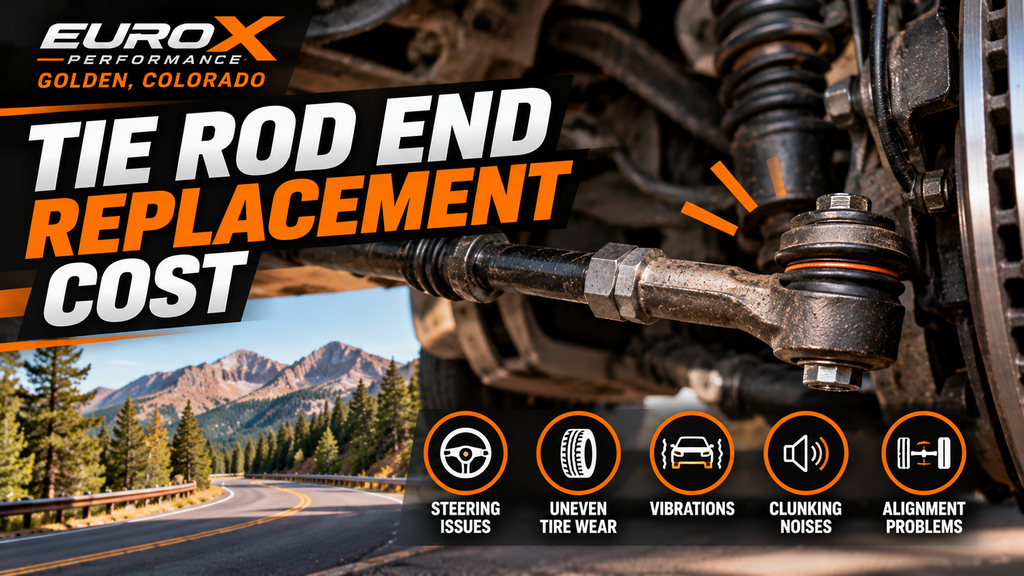
Replacing an outer tie rod end typically costs $100 to $250 per side, while an inner tie rod runs $200 to $450 per side because accessing it requires working inside the steering rack bellows. Replacing all four tie rod joints across both sides totals $650 to $1,200, including a mandatory computerized wheel alignment. When worn front linkages rattle over rough pavement on West Colfax or US-6, tie rod ends and stabilizer sway bar links are the usual culprits.
Foothills driving punishes front suspensions. Between sharp thermal swings, washboard dirt roads leading into Jefferson County canyons, and de-icing chemicals on highway corridors, steering linkages take direct abuse. Delaying these repairs compromises directional stability on snow-packed roads and destroys expensive tires in short order.
How Much Does Tie Rod and Sway Bar Replacement Cost in 2026?
Front-end steering and suspension linkage costs depend on which joint has failed and the labor required to reach it. Outer tie rod ends thread into the steering knuckle and are straightforward to service. Inner tie rods thread directly into the steering rack gear beneath protective rubber bellows boots. According to benchmark repair data published by RepairPal in September 2026, a standard tie rod service averages between $258 and $300 across standard passenger cars. Multi-link European platforms require specialized inner-rack tools and precise factory torque sequences that push labor higher.
| Component Replaced | Parts Cost (Per Side) | Labor Cost (Per Side) | Total Installed Cost (Per Side) |
|---|---|---|---|
| Outer Tie Rod End | $40 – $130 | $60 – $120 | $100 – $250 |
| Inner Tie Rod Assembly | $80 – $200 | $120 – $250 | $200 – $450 |
| Sway Bar End Link | $35 – $110 | $55 – $115 | $90 – $225 |
| Both Inners & Both Outers (Complete Front Set) | $240 – $600 (Total) | $310 – $500 (Total) | $650 – $1,200 (Includes Alignment) |
Outer Versus Inner Tie Rod Pricing
An outer tie rod end operates externally, exposed to direct road spray. Replacing one requires 30 to 60 minutes of labor per side using a mechanical ball joint separator. In contrast, an inner tie rod end sits enclosed inside the steering rack boot. Technicians must remove the boot clamps, slide back the bellows without tearing the polymer, and deploy specialized inner tie rod tools to unthread the ball housing directly from the rack gear. This avoids placing destructive rotational force on the rack pinion teeth. That extra step doubles the labor time.
Adding Sway Bar End Links to Front-End Labor
Sway bar links connect the stabilizer bar directly to the strut assembly or lower control arm. They share load paths and diagnostic teardown time with your steering linkages. A typical sway bar replacement runs $90 to $225 per side for parts and labor. When a car is already on a lift with wheels removed to service loose tie rods, overlapping labor makes replacing worn sway bar links economical. You avoid paying for duplicate teardown labor later.
Why Computerized Four-Wheel Alignment Is Mandatory
Every time a technician loosens a tie rod jam nut or threads a new ball stud into a steering assembly, dynamic toe angle shifts. A computerized wheel alignment adds $75 to $120 to your invoice. Skipping it ruins tires fast. Research from the Tire Industry Association shows that a toe misalignment of just 1/16 inch scrubs front tires an extra 4 feet per mile driven. For an owner driving 15,000 miles a year, that slight misalignment subjects the tread to roughly 4,200 miles of abrasive sideways wear. If you suspect your steering geometry is compromised, schedule our professional suspension repair in Golden, CO to inspect your linkages before tire cords show.
How to Tell if a Knocking Sound Is a Tie Rod or a Sway Bar Link
Diagnosing front-end noises requires separating lateral steering slop from vertical chassis roll. Both components feature sealed ball-and-socket joints that rattle when internal clearances open up. Yet they respond to entirely different road inputs.
The 9-and-3 O’Clock Tire Shake Test
The standard test for steering linkage play requires lifting the vehicle so the front suspension hangs unloaded. Grasp the tire firmly at the 9 o’clock and 3 o’clock positions and rock the assembly side to side. Any noticeable free play at the outer ball stud confirms the tie rod is worn. By contrast, rocking the tire at 12 o’clock and 6 o’clock tests for vertical movement, which points to a failing wheel bearing or a lower control arm ball joint.
Body Roll and Vertical Clunking Over Speed Bumps
Worn sway bar end links generate distinct noises. Instead of a vibration felt through the steering wheel, a failing sway bar link produces a light metallic clatter or dull thud over washboard surfaces and parking lot speed bumps. The stabilizer bar does not steer the car. Its job is to resist lateral body lean by transferring upward force across the chassis. When an end link develops slop, the bar clatters inside the loosened ball socket during normal vertical wheel travel.
Steering Vagueness Versus Chassis Sway
Driving sensations reveal the source as well. A failing tie rod presents as dead play on-center. You turn the steering wheel an inch before the car reacts, often accompanied by wandering along highway ruts. A broken or loose sway bar link does not cause steering wander. Instead, it introduces heavy body lean. The car pitches excessively when cornering or braking into downhill mountain curves.
Why Colorado Road Chemicals and Potholes Destroy Ball Joint Boots
Suspension assemblies in the Denver West and Foothills regions take severe environmental beatings. Wide temperature swings trigger freeze-thaw cycles that fracture asphalt along I-70, Clear Creek Canyon, and C-470. Striking sharp pothole edges at speed drives high shock loads through the steering rack, damaging internal ball sockets and tearing protective boots.
Freeze-Thaw Cracking of Polychloroprene Dust Boots
Every tie rod end relies on an elastomer dust boot to seal grease inside the joint while locking out moisture and road grit. When fall and winter temperatures drop below freezing in Golden and Evergreen, low-grade rubber stiffens. Cycling between engine bay heat and freezing road spray creates microscopic cracks across the boot folds. Eventually, the boot splits open.
Magnesium Chloride and Traction Sand Grinding Slurry
Once a dust boot tears, winter road maintenance accelerates the damage. Highway crews treat US-6 and mountain passes with liquid magnesium chloride de-icer mixed with decomposed granite traction sand. Road spray forces this fluid directly into the open joint. The de-icer washes away grease, while the granite sand creates an abrasive grinding paste. Within a few hundred miles, this slurry scours the polished steel ball stud and its nylon cup, creating dangerous clearance.
The Danger of Cheap Universal Replacement Rubber
Budget universal steering parts often use inferior rubber boots that stiffen and crack during sub-zero Foothills cold snaps. European multi-link front suspensions generate high dynamic loads during braking and require OEM-specification components engineered with induction-hardened ball studs and cold-resilient elastomer boots. As outlined on our about EuroX Performance page, our certified technicians rely on tier-one and OEM parts built to withstand severe mountain climates.
The Pre-Winter Suspension Safety Checklist for Mountain Drivers
Do not wait for winter storms to expose failing steering hardware. Check these critical linkage points to ensure steering control on snowy passes.
- Visual Inspection of Dust Boots and Grease Integrity
Inspect every outer tie rod, inner rack bellows, and sway bar link boot with a work light. Look for cracks along flex ridges or grease weeping around retaining rings. Once grease escapes, grit enters, and the joint requires replacement.
- Mechanical Free-Play Measurement Under 1/16 Inch
Check the joint for mechanical deflection with dial indicators or firm hand pressure on an unloaded wheel. Alignment data from Hunter Engineering confirms that internal tie rod play as small as 1/16 inch prevents a vehicle from holding its toe angle under load. When internal play reaches 1/8 inch, field data from Moog and Mevotech indicates the joint risks sudden mechanical separation within 2,000 to 5,000 miles.
- Inspecting Steering Rack Bellows for Leaking Power Steering Fluid
Many quick inspections check the outer joint and ignore the inner rack bellows. Squeeze and unclip the inner tie rod boot to check for internal fluid accumulation. If power steering fluid sits inside the boot, internal steering rack seals have failed. A new tie rod will not fix the problem. The entire steering rack assembly must be replaced, which RepairPal estimates between $2,307 and $2,572.
- Sway Bar End Link Articulation and Bushing Firmness
Grasp the sway bar link rod and push it firmly along its vertical axis. Any rattling inside the ball sockets or tearing across the sway bar mounting bushings indicates worn hardware. Replacing loose links restores stable handling on slick roads, similar to the drivetrain stability issues covered in our guide on handling AWD warnings in Colorado snow.
- Dynamic Toe Deflection on Multi-Link Suspensions
European multi-link front setups isolate steering forces from vertical wheel travel through separate control arms. When an outer tie rod has slight free play, braking forces push the front wheels into severe toe-out deflection. Inspect the inner edges of your front tires. Rapid inner shoulder wear confirms your tie rods are flexing under load.
Precision Multi-Link Suspension Repairs and Alignment in Golden
Replacing steering hardware on European vehicles demands proper tooling. We avoid sledgehammers, universal-fit hardware, and rough alignment guesses, choosing manufacturer-approved equipment that protects your vehicle.
- Stage 1: Precision Teardown with Specialized Pullers
Old-school methods rely on pickle forks and heavy hammers to break ball studs free from steering knuckles. That blunt impact deforms aluminum knuckles and damages adjacent wheel bearings. Our ASE-certified technicians use dedicated screw-type mechanical pullers to press the tapered stud out cleanly without shocking surrounding aluminum components.
- Stage 2: Installing Matched OEM-Grade Steering Linkages
Steering linkage wear rarely happens on only one side. If the left outer tie rod has worn out after 75,000 miles, the right tie rod has endured the exact same roads. We install matched pairs of OEM-specification tie rods with hardened studs. For drivers seeking flatter cornering, our shop also installs dedicated performance upgrades in Golden, CO, including upgraded sway bars and stiffer bushings.
- Stage 3: Computerized Four-Wheel Digital Alignment
Counting thread turns or measuring with calipers only gets the toe angle close enough to roll the car onto a rack without scrubbing tires. It cannot deliver the fraction-of-a-millimeter precision required by European chassis specifications. We put every vehicle on a computerized alignment rack, setting thrust angles and locking tie rod adjusters to exact factory torque specifications.
To learn more about our shop standards and service procedures, visit our frequently asked questions page.
Frequently Asked Questions
Can I drive with a loose or worn tie rod end?
Driving on a worn tie rod end is dangerous. Play exceeding 1/8 inch puts the joint at risk of sudden mechanical separation under hard braking, resulting in an immediate loss of steering control. Even 1/16 inch of play causes rapid tire scrub that ruins the inner tread within a few hundred miles.
Why is a wheel alignment mandatory after replacing tie rods?
Tie rods control your vehicle’s front toe angle, which is calibrated down to fractions of an inch. Counting thread turns during assembly is only a temporary step to reach an alignment rack safely. A computerized alignment is required to eliminate tire scrub and center the steering wheel.
How can I tell if a knocking sound is a tie rod or a sway bar link?
Sway bar end links produce a light metallic rattle or dull knock over low-speed bumps and road seams without affecting steering response. Worn tie rod ends cause steering wheel vibration, road wander, and detectable play when the tire is rocked side to side at the 9 and 3 o’clock positions.
Should inner and outer tie rod ends be replaced at the same time?
If your inner and outer tie rods share the same age and mileage, replacing them together saves on repeated teardown labor. Installing both sets at once ensures balanced steering feedback and prevents paying for a second wheel alignment a few months later.
How much does a four-wheel computerized alignment cost in Colorado?
A computerized four-wheel alignment generally adds $75 to $120 to your final invoice after linkage replacement. This calibration locks in correct toe angles and protects your tires from severe edge wear.
If you feel steering wander or hear clunking over rough Foothills roads, have your suspension evaluated before winter driving begins. Call EuroX Performance at (303) 562-1800 or send an appointment request through our contact page to have our ASE-certified technicians inspect your steering and suspension linkages.