Table of Contents
- Why Audi Owners Choose Professional ECU Remapping
- The Critical Difference Between Generic and Specialized Tuning
- EuroX Performance ECU Remapping Expertise
- How Our Dealer-Level Diagnostics Ensure Precision Results
- APR Tuning: Understanding the Limitations
- Performance Gains and Real-World Reliability
- Warranty Protection and OEM Compliance
- The EuroX Performance Advantage: Why We're Your Best Choice
- Custom Tuning Strategies for Your Specific Audi Model
- Aftercare Support and Long-Term Performance Monitoring
- Making Your Decision: The Clear Path Forward
Why Audi Owners Choose Professional ECU Remapping
Audi owners understand that their vehicles represent precision engineering and performance potential. When you own a high-performance European machine, factory settings often leave power on the table. An Audi ECU remap unlocks this potential by recalibrating fuel delivery, turbo boost, and ignition timing to extract additional horsepower and torque while maintaining reliability.
The decision to remap isn’t casual. Your Audi’s engine control unit governs every critical combustion parameter. A professional ECU tune can add 30-60 horsepower and 40-80 pound-feet of torque depending on your model and engine configuration. That’s a meaningful difference you’ll feel on acceleration and sustained driving.
However, not all remapping services deliver equal results. This is where specialization matters. Audi owners gravitate toward shops with deep expertise in European vehicle architecture, not generic tuners who treat all cars the same. Your Audi’s dual-overhead-cam engineering, direct injection system, and integrated turbocharged architecture require specialized knowledge.
Action item: Before selecting any tuning provider, verify their experience specifically with your Audi’s generation and engine variant. Ask for references from owners of your exact model.
The Critical Difference Between Generic and Specialized Tuning
The tuning market includes options ranging from mail-in software packages to locally-installed custom maps. The difference in approach reveals itself in quality control and safety margins.
Generic tuning services operate on a one-size-fits-all premise. They apply proven maps to thousands of vehicles across different climates, maintenance histories, and driving conditions. While this standardized approach keeps costs low, it sacrifices precision. These universal tunes typically use wider safety margins, meaning they leave performance on the table to account for variables they can’t control.
Specialized tuning takes the opposite approach. We begin with understanding your specific Audi, its current maintenance condition, your driving objectives, and your climate. An A4 in Denver faces different atmospheric density than an A4 in coastal California. High altitude means different oxygen availability, which directly impacts optimal fuel and timing curves. One map cannot serve both locations optimally.
Specialized shops also conduct pre-tune diagnostics to identify existing issues. A vehicle with carbon buildup on intake valves, worn spark plugs, or marginal fuel pressure requires different calibration than a freshly serviced machine. Generic services skip this step entirely.
The real-world consequence is straightforward: specialized tuning delivers more power, better efficiency, and superior drivability because it’s actually calibrated for your vehicle’s exact situation.
EuroX Performance ECU Remapping Expertise
We’ve spent years developing expertise in the specific demands of Audi’s engine management systems. Our experience covers the entire modern Audi lineup, from the turbocharged four-cylinder mills in the A3 and A4, to the six-cylinder engines in the A6 and RS models, to the exotic builds in R8 variants.
Our approach begins with a comprehensive diagnostic scan using dealer-level equipment. This reveals baseline power numbers, fuel trims, ignition timing, and any fault codes that might indicate issues we need to address before tuning. We use this data to build a custom map specifically for your engine’s response characteristics.
We map and validate our tunes across multiple drive cycles and load scenarios. Rather than applying a pre-built file, we’re building your tune in real-time based on your exact engine’s behavior. This iterative approach ensures consistent power delivery across idle, mid-range acceleration, and sustained full-load driving.
Our team holds certifications in Audi diagnostic systems and has completed manufacturer-level training on engine management platforms. This isn’t hobbyist enthusiasm, it’s professional specialization. We also maintain relationships with OEM suppliers and stay current with Audi’s engineering bulletins to understand how factory settings evolve with each model year and software revision.
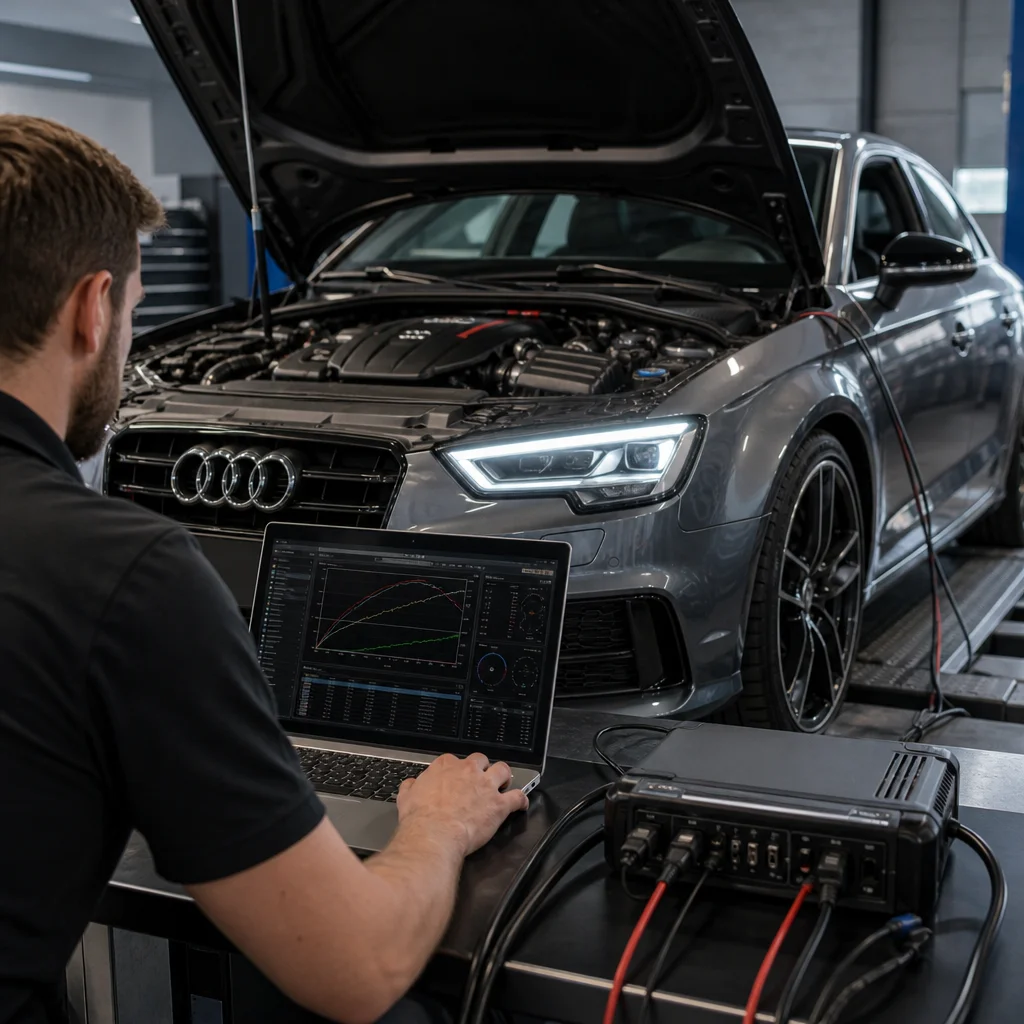
Action item: Request a pre-tune diagnostic report. Any legitimate shop should be willing to show you baseline numbers, fuel trims, and other metrics that inform their tuning strategy.
How Our Dealer-Level Diagnostics Ensure Precision Results
Dealer-level diagnostic equipment exists because Audi’s systems demand precision. Modern Audis communicate through multiple networks simultaneously, coordinating data across the engine control module, transmission computer, suspension systems, and climate controls. Generic code readers miss most of this information.
Our diagnostic setup mirrors what Audi technicians access at the dealership. This means we see real-time fuel pressure, actual boost levels, fuel trim corrections, and timing deviations across all operating conditions. We monitor oxygen sensor feedback, knock sensor activity, and turbo actuator response. This complete visibility is non-negotiable for safe, effective remapping.
Consider a practical example: two Audi A4s, both same year and engine. One owner maintains schedule religiously, the other doesn’t. The first runs tight fuel trims because the combustion chamber is clean and efficient. The second shows elevated fuel trims because carbon buildup demands richer mixture to compensate. A generic tune would lean out both equally, creating potential problems for the second car. Our diagnostics catch this before we write code.
We also validate power gains on a chassis dynamometer. This isn’t theoretical horsepower estimated from software parameters. It’s measured, repeatable power verified on the dyno. You see actual numbers, not marketing claims.
Our precision diagnostics capability is foundational to everything we do. It’s why precision matters in performance work.
APR Tuning: Understanding the Limitations
APR is a brand many Audi owners encounter first. They’ve been in the tuning space longer than most competitors and have built significant market presence. Understanding their approach helps clarify the value of localized, specialized tuning.
APR operates as a software development company. They engineer proven maps, validate them across typical conditions, then license them to a network of installers and resellers. This model has advantages: the maps are well-established, thoroughly tested, and documented across thousands of vehicles. That track record carries real value.
However, this model also creates constraints. APR tunes are standardized products. A customer in Denver installs the same ECU file as a customer in Miami. The map doesn’t account for altitude, local fuel quality, climate humidity, or the specific mechanical condition of the individual engine. APR installers apply pre-built software, they don’t create custom calibrations.
This approach also limits support. If issues arise with the tune, troubleshooting follows APR’s protocols. If your specific engine responds differently than the typical case APR engineered for, you’re working through a support ticket system rather than with a technician who knows your exact vehicle.
The business model also means APR tuning gets pushed through any installer who licenses their software, not just specialists. Your tune might be installed by a technician whose primary focus is oil changes and brake pads, not ECU calibration. Technical expertise matters for safe installation and validation.
Performance Gains and Real-World Reliability
Performance numbers matter, but reliability matters more. A tune that adds 50 horsepower at the cost of reliability problems costs more than it delivers.
We target conservative power gains that stay within the design margins of your engine’s mechanical components. A stock Audi S4 V8 might accept 600+ horsepower with aggressive tuning, but the stock transmission starts struggling significantly above 550 horsepower. We’d recommend a transmission tune alongside engine tuning to protect the drivetrain.

Real-world testing reveals reliability truth. We monitor boost levels, fuel enrichment during hard acceleration, and peak pressure rises. These parameters tell us whether the engine is responding safely or being pushed beyond comfortable margins. We specifically avoid tuning strategies that require premium fuel in one climate but fail with regular fuel in another.
Our customers report consistent power delivery across thousands of miles post-tune. That consistency reflects a calibration approach that prioritizes margin over maximum output. An extra 5 horsepower means nothing if the tune creates spark knock or fuel system stress.
The flip side of this philosophy is fuel economy often improves slightly or stays flat after our tuning. This isn’t accidental. Conservative calibration with optimized ignition timing tends to reduce inefficient combustion, offsetting the fuel consumption increase from higher power output.
Warranty Protection and OEM Compliance
ECU remapping permanently modifies your engine control module. This modification remains in your vehicle’s electronic history. OEM warranty implications matter significantly.
Audi dealers can detect that an ECU has been remapped. Most modern remaps alter checksums and security flags that OEM diagnostics recognize. Here’s the nuance: Audi warranty covers specific failures. If you remap and then experience a turbo failure unrelated to the remap, Audi might still cover it. However, any failure potentially connected to engine calibration becomes contestable.
We address this reality directly with customers. We don’t misrepresent warranty implications or suggest ways to hide remapping. Instead, we work within OEM specifications and safety margins specifically to minimize the risk that any future issue could be attributed to our tune.
Our remaps remain within OEM boost pressure limits and use approved fuel octane ratings. We don’t push structural limits of pistons or crankshafts. This approach respects Audi’s engineering while releasing performance potential that was conservative from the factory.
We also maintain detailed documentation of every tune we perform. Dyno numbers, before-and-after diagnostics, fuel quality used during testing, and ambient conditions all get recorded. This documentation supports your case if warranty questions ever arise.
The EuroX Performance Advantage: Why We’re Your Best Choice
The distinction between a tuning service and a specialized performance shop emerges in approach and accountability. We’re not installers applying pre-built files. We’re engineers building custom calibrations for your specific vehicle, then validating those calibrations on equipment that matches dealer capabilities.
That specialization exists because we’re veteran-owned and focused exclusively on European performance vehicles. We’ve chosen this niche and invested deeply in the expertise it demands. We’re not trying to be everything to everyone. We’re trying to be the best option for your Audi.
Our technical foundation includes dealer-level diagnostics, dyno validation, and custom mapping for every vehicle. Our service includes pre-tune diagnostics that identify mechanical issues needing attention, custom tune development specific to your engine and objectives, and post-tune validation confirming expected power delivery. That process takes longer and costs more than mail-in generic tunes, but it delivers results that prove themselves in real-world driving.
We also stand behind our work. Post-tune issues get troubleshooting immediately from the technician who built your map, not from a support team processing dozens of generic cases. That accountability drives precision in the work.
Custom Tuning Strategies for Your Specific Audi Model
Your Audi’s generation and engine configuration determines the optimal tuning approach. A new A4 with turbocharged four-cylinder requires completely different strategy than an older RS model with naturally-aspirated engine.
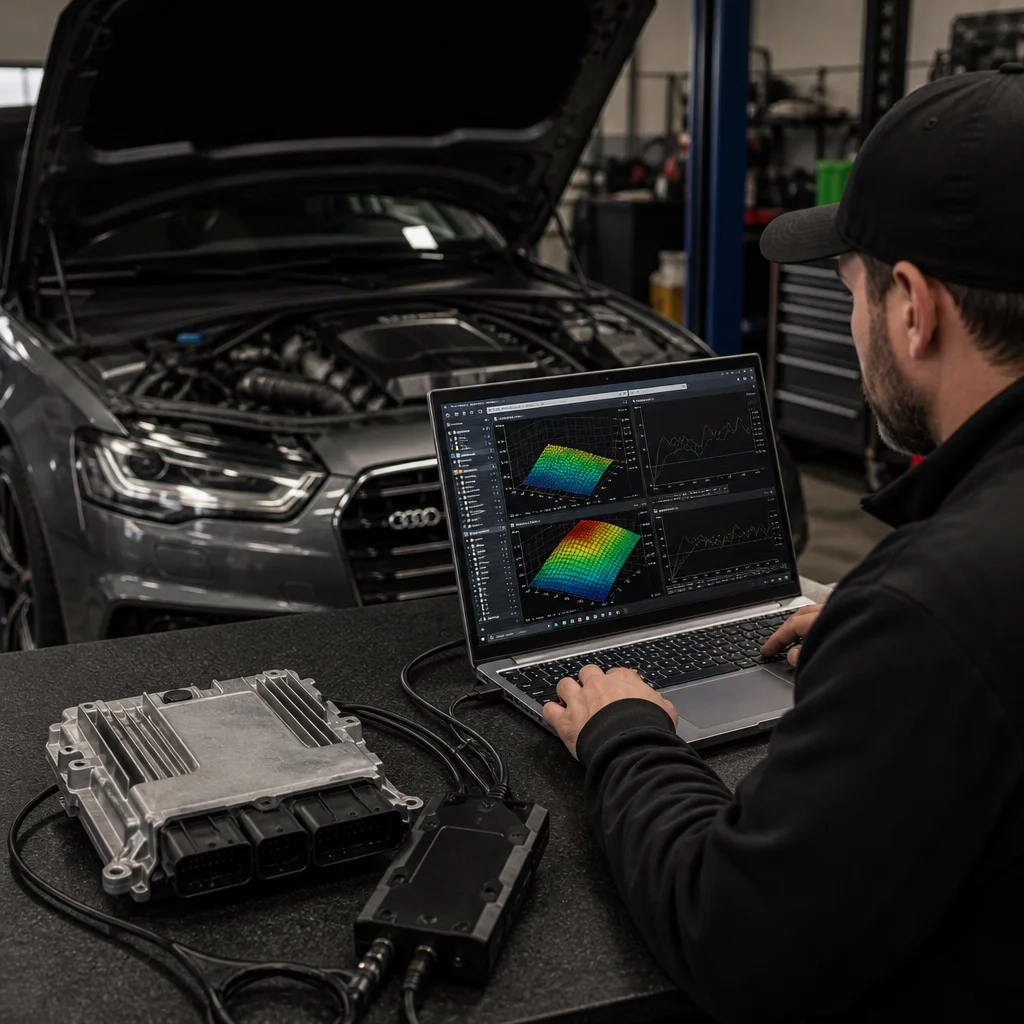
Modern turbocharged Audis respond exceptionally well to remap because factory boost and fuel delivery settings include significant conservative safety margins. Adding 40-50 horsepower means adjusting boost pressure up 2-3 psi and adding fuel proportionally. This is straightforward with low risk because the turbo and fuel system were designed to handle these levels.
Naturally-aspirated engines require different thinking. They rely on optimized spark advance and fuel mixture for gains. The upside is more modest, typically 15-25 horsepower, but the approach is correspondingly conservative. No boost pressure stress, just better combustion efficiency.
Older models with evolving engine management systems need baseline validation beyond modern vehicles. A 2010 A4 might have fuel trim quirks or sensor issues that newer models resolved through software updates. We investigate these specifically.
High-performance models like RS variants benefit from transmission tuning alongside engine work. The stock transmission holds power carefully to protect longevity. A tune that adds 80 horsepower without transmission calibration adjustment creates shift quality issues and potential longevity concerns. We coordinate both systems.
This model-specific expertise develops through sustained work with each platform. It’s not generic tuning applied broadly, it’s engineered strategy matched to your Audi’s exact architecture.
Aftercare Support and Long-Term Performance Monitoring
Your tune continues evolving after installation. We recommend data logging during the first 500 miles of driving post-tune. Real-world conditions occasionally reveal calibration adjustments that improve drivability or efficiency. These minor refinements often make significant subjective differences.
We also schedule follow-up diagnostics at 12 months post-tune. This appointment scans for any drift in fuel trims, oxygen sensor readings, or other parameters that might suggest mechanical wear or tuning drift. This monitoring catches issues before they become problems.
Our approach to support includes direct access to the technician who tuned your vehicle. Questions or concerns get answered by someone who knows your specific calibration history and can review the exact parameters we set. This isn’t a support ticket system where each inquiry requires explaining your whole situation again.
We also provide guidance on maintenance items that become more important post-tune. Spark plugs, fuel filter cleanliness, and oil change intervals merit attention. A higher-performance engine demands higher-performance maintenance. We make specific recommendations based on your driving style and tune intensity.
Making Your Decision: The Clear Path Forward
Choosing between generic mail-in tuning, standardized APR remapping, or custom professional tuning comes down to what you value. Generic tuning offers low cost but zero customization. APR tunes offer proven results through any installer, but no local expertise or custom calibration. Professional custom tuning costs more because it delivers expertise, precision, and accountability.
We believe the choice should favor your vehicle’s specific needs and your long-term satisfaction. A remap will be with your Audi for the remainder of ownership. That warrants investment in the right approach, not the cheapest option.
Our advantage is straightforward: we’re Audi specialists in Golden, CO with dealer-level diagnostics, custom mapping capabilities, and commitment to results that prove themselves in real-world driving. We validate every tune on the dyno. We monitor long-term performance. We stand behind the work with direct technician support.
Your next step is straightforward. Schedule a consultation where we can review your specific Audi model, discuss your performance objectives, and explain exactly how our custom tuning process will deliver results. No generic pitch, no pressure to decide immediately, just honest discussion of what we can accomplish with your vehicle.
That’s the path to professional ECU remapping that actually matches your Audi’s potential and your expectations for performance and reliability.