Table of Contents
- Why Generic Tuners Fall Short for Track-Ready BMWs
- The Real Demands of Track Performance Tuning
- Our Dealer-Level Diagnostic Advantage
- ECU Remapping and Engine Optimization for Track Conditions
- Transmission Tuning for Precise Track Control
- Advanced Suspension and Brake System Upgrades
- Hybrid and EV Track-Specific Tuning Solutions
- OEM Parts and Manufacturer Specifications Matter
- Our Veteran-Owned Precision Engineering Difference
- Real-World Track Results from Our Customers
- The Complete Track Tuning Package We Deliver
Why Generic Tuners Fall Short for Track-Ready BMWs
BMW drivers who take their cars to the track demand more than off-the-shelf tuning solutions. Track performance requires precision engineering, real-time data analysis, and a deep understanding of how every system interacts at extreme temperatures and g-forces. We’ve spent years perfecting BMW track tuning because we know that generic approaches simply don’t cut it when your vehicle is pushing limits on a closed circuit.
Generic tuning shops often apply one-size-fits-all performance maps designed for street driving. These modifications prioritize quick power gains and ignoring the sustained thermal stress that track environments create. A BMW running at full throttle for extended sessions generates heat in the engine bay, transmission fluid, and brake system that street tuning never accounts for.
The problem compounds when those shops lack access to BMW’s proprietary diagnostic protocols. Without dealer-level tools, they cannot read the full spectrum of sensor data or validate changes against manufacturer specifications. This creates blind spots. A map that reads well on a dyno might cause transmission hunting or engine knock under real track conditions, where variables change by the second.
We’ve worked with customers who tried budget tuning first and ended up with expensive repairs. One M440i owner returned after a generic tune caused premature transmission wear because the tuner didn’t adjust shift logic for sustained high-RPM driving. That lesson reinforced why we prioritize comprehensive diagnostics and validation over quick wins.
The Real Demands of Track Performance Tuning
Track driving generates physics that street driving simply doesn’t. Sustained high RPM, constant acceleration and braking cycles, elevated ambient temperatures, and lateral g-forces all demand systems calibrated specifically for those conditions.
Track-ready tuning must address:
- Cooling system optimization to prevent thermal throttling during long sessions
- Fuel mapping adjustments for consistent combustion under variable track conditions
- Ignition timing refinement to maximize power while avoiding knock
- Transmission shift programming tuned for quick throttle response without strain
- Engine oil and coolant flow priority to maintain critical temperatures
- Brake system calibration for consistent pedal feel across repeated hard stops
We analyze vehicle telemetry data and work with customers to understand their track’s specific demands. A circuit with long straights requires different transmission tuning than a technical road course with frequent gear changes. We build solutions around those realities rather than applying generic profiles.
Our Dealer-Level Diagnostic Advantage
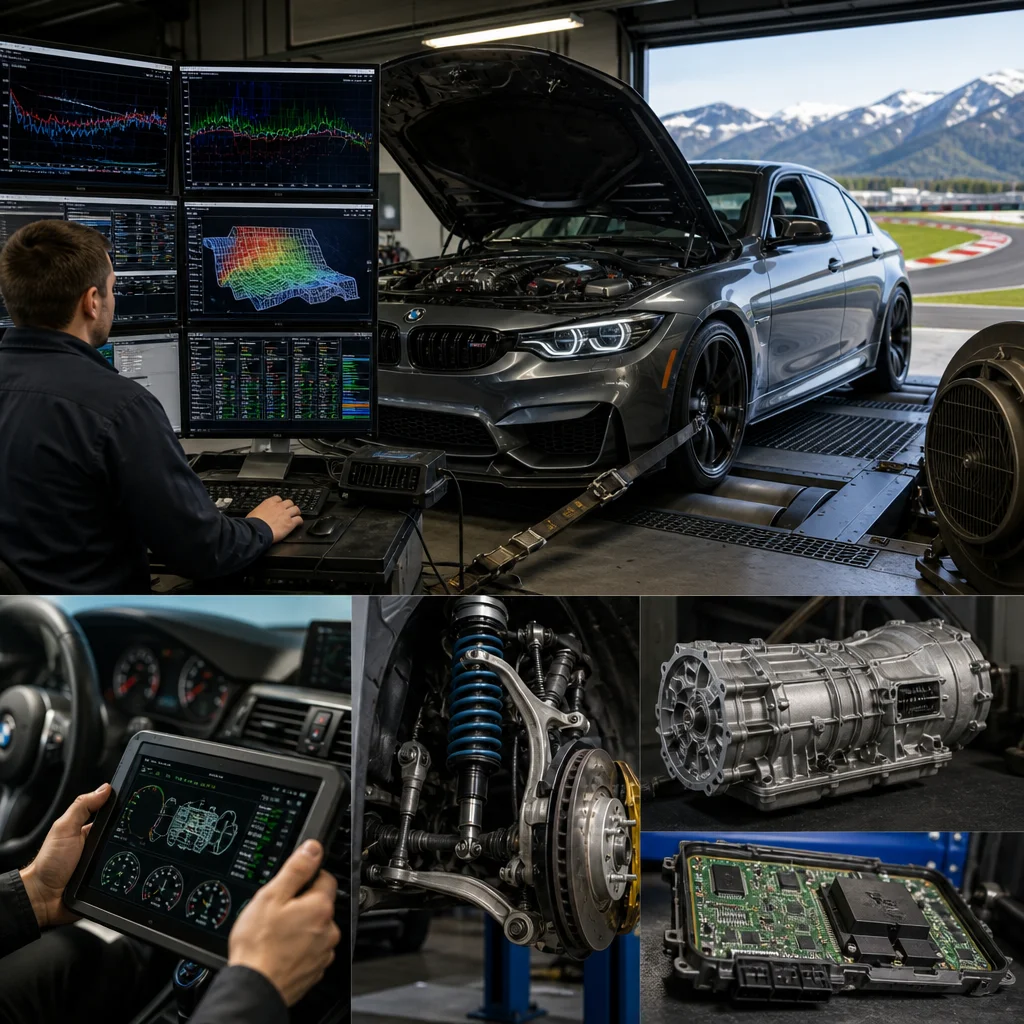
Dealer-level diagnostic equipment gives us access to BMW’s complete software ecosystem. We use the same tools BMW technicians use at the dealership, which means we read every sensor, every control module, and every failsafe parameter that affects track performance.
This access lets us:
- Capture baseline performance data before any modifications
- Monitor real-time sensor feedback during test sessions
- Validate that modifications don’t trigger fault codes or limp-mode protection
- Compare performance against BMW’s engineering specifications
- Identify system conflicts that generic tuners would miss
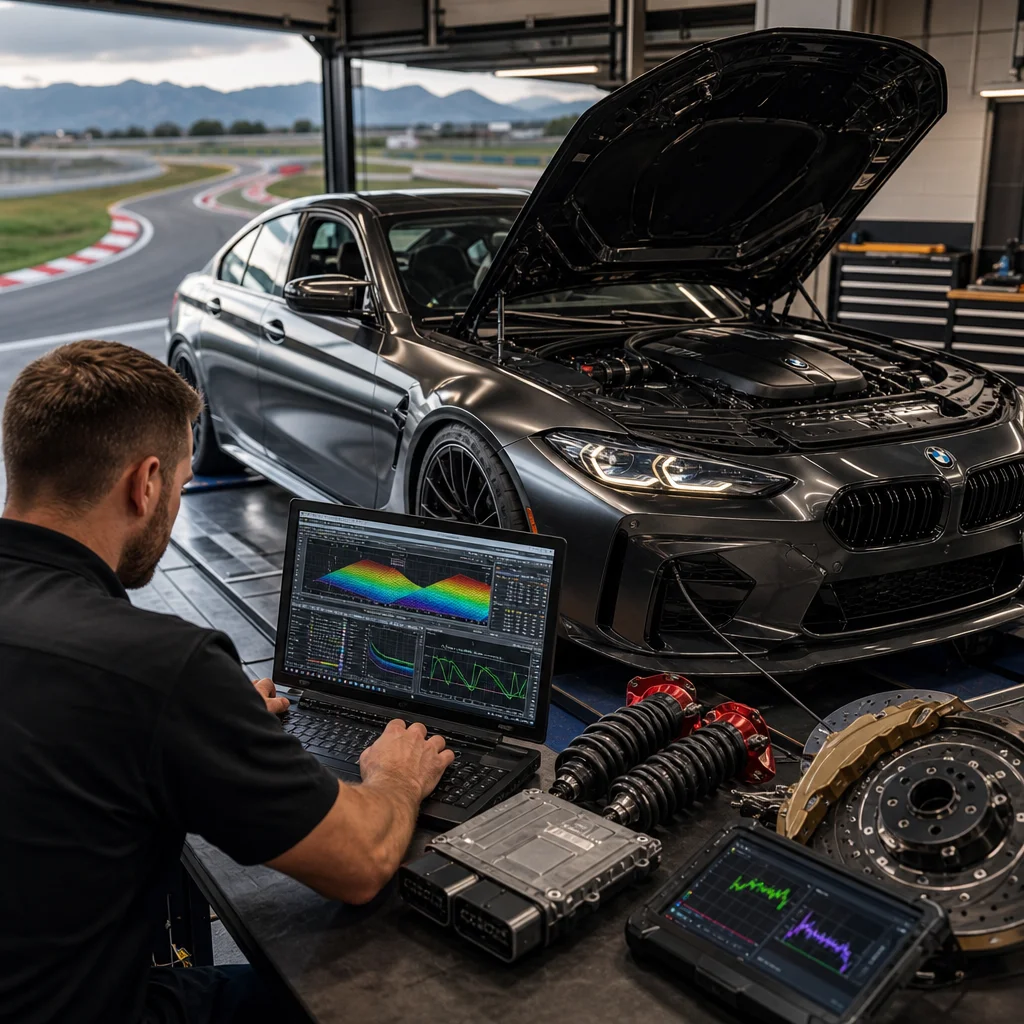
Our diagnostic approach isn’t just about tuning higher. It’s about ensuring every system works together predictably. When a transmission control module conflicts with an engine control module over boost strategy, generic tuners won’t catch it. We will, because we’re reading the full conversation happening between modules.
ECU Remapping and Engine Optimization for Track Conditions
Performance ECU remapping for BMW forms the foundation of track tuning. The factory tune prioritizes emissions compliance, warranty coverage, and conservative thermal margins. We strategically adjust fuel injection timing, boost pressure, and ignition advance to unlock additional power while respecting the engine’s mechanical limits.
Track-specific mapping differs significantly from street tuning. We increase fuel pressure slightly to compensate for sustained high RPM, where cooling fuel injector duty cycles get harder. Boost tables shift to maintain consistent power delivery even as intake air temperatures climb. Ignition advance is calibrated to run right at the knock threshold without crossing it, maximizing efficiency.
For naturally aspirated BMW models, we optimize valve timing and fuel mapping to improve volumetric efficiency across the RPM band. Turbo models get boost curve adjustments that balance power delivery with turbo longevity under sustained high-load driving.
We also program secondary protections. If the engine approaches dangerous thermal limits during a long session, our tune gradually reduces boost rather than hard-cutting it. That keeps the vehicle competitive instead of suddenly killing power on a straightaway.
Transmission Tuning for Precise Track Control
The transmission is where generic tuning often causes problems. Factory shift logic prioritizes smooth acceleration and fuel economy. Track driving demands quick, precise shifts that minimize wheel slip during direction changes.
Our transmission tuning adjusts:
- Shift speed to tighten response times without causing drivetrain shock
- Torque converter lock-up strategy for improved power transfer efficiency
- Downshift timing to match engine RPM with track exit speeds
- Launch control parameters to optimize acceleration off slow corners
- Throttle response coupling between engine and transmission
We validate every shift calibration on the road and track. A transmission that feels sharp on a dyno might hunt between gears on a technical circuit where throttle input is constantly changing. We tune for real-world track behavior, not just peak numbers.
Drive train diagnostics give us the ability to monitor transmission fluid temperature and pressures in real time. If we see thermal stress during a test session, we adjust the tuning to protect the transmission while maintaining performance.
Advanced Suspension and Brake System Upgrades
Track performance depends on more than engine and transmission tuning. Suspension geometry, brake modulation, and chassis balance directly impact lap times and driver confidence.
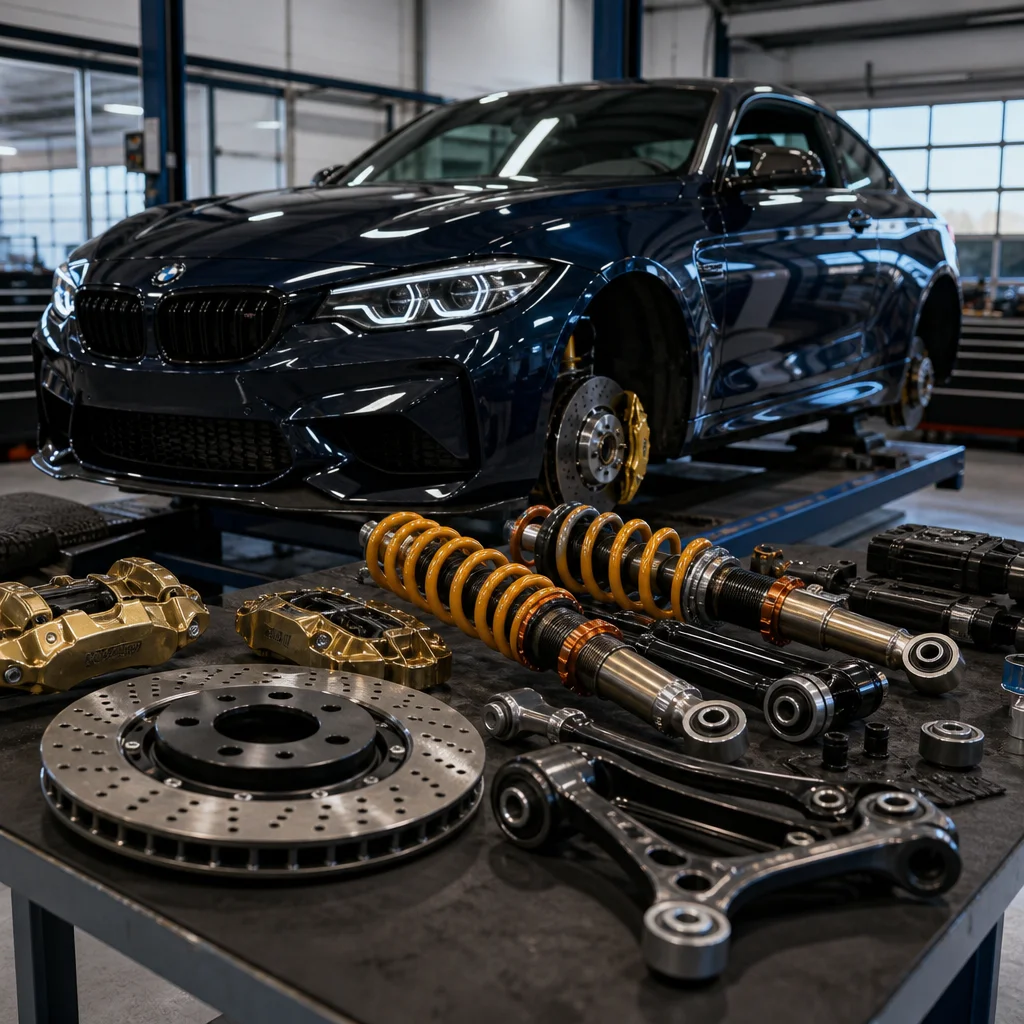
We offer:
- Adaptive damper recalibration to stiffen responses for track driving
- Brake pad and fluid upgrades rated for sustained high temperatures
- ABS tuning to prevent wheel locking on trail-braking maneuvers
- Electronic stability control recalibration to allow controlled slides while preventing dangerous loss of control
- Sway bar and spring adjustments to improve cornering grip
Each modification is validated against BMW’s engineering envelope. We’re not blindly stiffening the suspension. We’re adjusting it to support higher lateral loads while maintaining predictable feedback to the driver.
Brake system upgrades deserve special attention. Factory brakes work fine for street driving but fade under repeated hard stops on track. We specify performance-grade brake fluid and compatible pad materials, then tune the ABS algorithm to work optimally with that combination.
Hybrid and EV Track-Specific Tuning Solutions
BMW’s hybrid and electric models present unique tuning challenges that generic shops often overlook. Hybrid systems blend engine and motor power through sophisticated control software. EV models require regenerative braking calibration and motor output management.
For hybrid models, we optimize the power split between engine and motor to maximize acceleration while managing thermal stress on both powerplants. Motor torque delivery is tuned to complement engine characteristics rather than fight them. Regenerative braking is calibrated to support track driving without causing inconsistent pedal feel.
EV track tuning focuses on motor output curves, thermal management for the battery pack, and brake blending between regenerative and friction brakes. A track-tuned electric BMW maintains consistent power delivery even as battery temperature rises, and brakes respond predictably during hard stops.
These vehicles demand different tuning philosophies than traditional combustion engines. We’ve invested in specialized diagnostic tools and training to handle them properly.
OEM Parts and Manufacturer Specifications Matter
We never recommend modifications that exceed BMW’s engineering specifications for component durability. When we upgrade parts, we choose OEM options or manufacturer-approved alternatives that maintain the integrity of the system.
Using non-OEM parts creates compatibility risks. A performance fuel pump from an unknown supplier might deliver inconsistent pressure, destabilizing the engine tune. Budget brake calipers might not provide the thermal stability our brake tuning expects. We specify parts that work predictably with our calibrations.
Our performance upgrades always prioritize manufacturer compatibility. We know what parts will last, what components work together reliably, and which upgrades align with BMW’s engineering philosophy.
Our Veteran-Owned Precision Engineering Difference
We’re a veteran-owned shop, and that shapes how we approach every job. Military service taught us precision, accountability, and the cost of getting details wrong. Those principles guide our tuning work.
We don’t rush. Every track tune gets thorough validation before we hand the keys back. We document every change, communicate clearly about what we’re doing and why, and stand behind our work with real support. If something isn’t right, we fix it.
Our team has decades of combined experience with BMW performance engineering. We’ve built relationships with BMW engineers, studied factory calibration strategies, and tested our tuning on real tracks with real drivers. That expertise isn’t available from generic tuning shops.
Real-World Track Results from Our Customers
One E92 M3 owner came to us with a factory tune and stock suspension. After our track tuning package, lap times at nearby circuits dropped by nearly 2 seconds. The driver credited improved power delivery, sharper shift response, and brake consistency.
A 2023 M440i xDrive owner wanted track capability without sacrificing reliability. Our hybrid approach added 70 horsepower and improved transmission response while keeping the engine well within thermal limits. Two seasons of track driving later, the car still runs strong with no issues.
A Porsche crossover customer brought her hybrid BMW SUV expecting limited track potential. Our EV-aware tuning proved the system could handle serious performance driving. She now tracks it regularly and trusts the engineering behind every system.
These aren’t cherry-picked examples. They represent the predictable results we deliver when tuning is done right.
The Complete Track Tuning Package We Deliver
Our track tuning package starts with comprehensive diagnostics. We capture baseline performance, identify optimization opportunities, and discuss track-specific goals with you.
From there, we execute:
- ECU remapping tailored to track conditions and your vehicle’s mechanical state
- Transmission tuning validated on both road and track
- Suspension and brake system optimization
- Real-time data logging during test sessions to verify calibration
- Final validation and documentation of all changes
- Ongoing support if adjustments are needed
We work in Golden, Colorado, and our facility has both dyno and track access. That means we validate tuning in both controlled and real-world environments before you take your BMW to competition.
If you’re serious about track performance and want tuning that actually works, we’d like to discuss your goals. Reach out to schedule a consultation and let’s talk about what’s possible with your BMW.