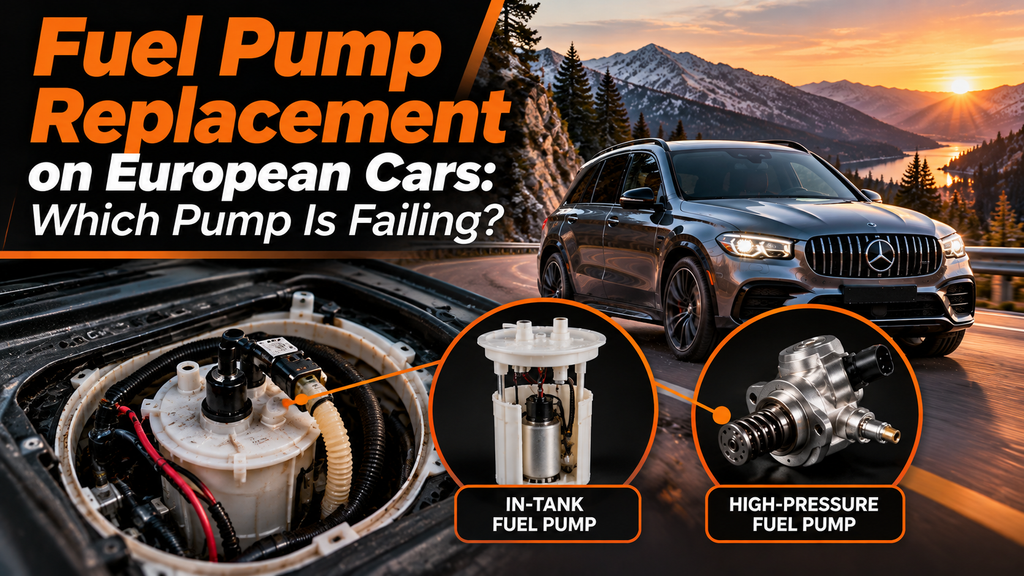
Fuel pump replacement should follow pressure testing, not symptoms alone. On a direct-injected European engine, an in-tank pump supplies fuel to a separate high-pressure pump. Comparing commanded and actual rail pressure under load, then checking the supply side, helps identify which part needs repair before you pay to replace it.
Is the fuel pump on a direct-injection European engine really one part?
A gasoline direct-injection engine uses at least two pumps. The electric low-pressure pump, usually inside the tank, feeds fuel toward the engine. The high-pressure pump raises that fuel to the pressure the injectors need. On many engines, it is a mechanical piston pump driven by the camshaft. NAPA’s parts overview of fuel pumps and tanks describes this two-pump arrangement.
The first question is which pump has failed. An in-tank pump may be reached through an access panel under the rear seat, or the tank may need to come down. A high-pressure pump sits on the engine, where damage to its camshaft drive can expand the repair beyond the pump itself. BMW owners with an N54 can compare this with our N54 high-pressure fuel pump failure guide.
Why does the engine lose power on a climb when it runs fine on flat ground?
A car that pulls normally around town but loses power on a long grade needs fuel-pressure testing under load. A weak high-pressure pump may keep up at idle and fall behind as fuel demand rises. Restricted supply from the tank can produce a similar result, so this pattern does not identify the failed part by itself.
Golden sits at roughly 5,675 feet. Sustained climbs along I-70 and through Clear Creek Canyon put the engine under loads that short trips around town may not. On a turbocharged European engine, maintaining power in thinner air can expose a marginal fuel supply. The useful check is whether actual pressure keeps pace with the engine’s commanded pressure during that load.
Does a long crank on a cold morning mean the pump is failing?
Long cranking alone does not identify a failing pump. Fuel pressure can bleed down overnight, leaving the system to rebuild pressure before the engine starts. A weak lift pump or a worn check valve can contribute, but those causes need testing rather than a pump replacement based on cranking time.
October’s first freezing nights in Golden and nearby Foothills communities can also expose a weak battery. If the starter turns slowly, check the battery and charging system before blaming fuel delivery. A cold-morning misfire may accompany starting trouble, while a battery and electrical check helps separate slow cranking from a fuel-pressure problem.
Can an additive or an in-tank treatment fix a worn high-pressure pump?
An additive cannot repair a worn pump plunger or cam follower.
Mechanical wear requires inspection and repair; pouring a treatment into the tank can delay diagnosis without correcting the cause.
A restricted fuel filter, by contrast, can make the pump work harder. NAPA advises replacing the fuel filter every 20,000 to 40,000 miles, but your vehicle’s manufacturer schedule and filter design should govern service. Fuel also cools and lubricates the in-tank pump, so avoid starting a long mountain drive with a nearly empty tank.
What does cam follower wear cost beyond the pump itself?
On engines that use this arrangement, a follower rides against the camshaft lobe and drives the high-pressure pump plunger.
If the follower wears through, it can damage the lobe. Replacing only the pump then leaves the damaged drive mechanism in place; camshaft replacement and engine disassembly may also be necessary.
Fuel-pressure faults under load warrant diagnosis. Ticking or rattling from the top of the engine adds a reason to inspect the mechanical drive, although noise alone does not prove follower damage. A camshaft and engine assessment can establish how far the damage extends before the repair scope is decided.
How do live rail-pressure readings show which pump is failing?
A pressure code identifies a problem the control unit detected, not necessarily the part that caused it. Diagnosis needs both scan-tool data and checks of the fuel supply:
- Read the stored codes. A drivetrain malfunction warning may involve something other than fuel delivery. Record the faults before deciding that either pump is responsible.
- Compare commanded and actual rail pressure under load. The control unit requests a target pressure; the rail sensor reports actual pressure. A substantial shortfall directs attention to the high-pressure system, but does not prove the pump itself has failed.
- Check low-pressure supply. A weak in-tank pump or restricted filter can starve a sound high-pressure pump. Supply pressure and flow must be checked before condemning the engine-mounted unit.
- Verify the cause before ordering parts. Delphi’s replacement guide warns that replacing a pump without first testing pressure and flow can be a costly mistake.
Do not replace a fuel pump on a direct-injected European car until its rail pressure has been measured against the target under load. EuroX Performance provides check engine light diagnostics using dealer-level tools for European and exotic vehicles.
What changes the bill on a direct-injection fuel pump job?
A useful estimate needs the exact engine and a confirmed diagnosis. A BMW in-tank pump replacement and an Audi high-pressure pump repair can involve very different access and inspection requirements.
- Tank access affects labor. Delphi notes that some vehicles have an access panel under the rear seat, while others require draining and lowering the tank.
- The failed pump determines the procedure. An engine-mounted high-pressure pump is a different repair from an electric tank pump.
- The replacement may need additional setup. Some units require components transferred from the old pump; some modern parts require programming or adaptation.
- Debris can expand the inspection. A failing high-pressure pump can shed material into the rail and injectors. Installing a new pump without checking for contamination leaves the underlying risk unresolved.
- Camshaft damage expands the repair. A worn-through follower can turn a pump replacement into a job requiring engine disassembly.
Give the shop your VIN, symptoms and any stored codes so the estimate is based on the correct engine and repair.
To request a quote, use the online form on the EuroX Performance contact page, or call (303) 562-1800.
When is a fuel symptom an emergency, and when can it be monitored?
Sudden power loss on a mountain climb is a reason to stop, not to apply more throttle and see whether the car recovers. Use the symptoms to decide the next step:
- Sudden power loss under load with a warning light: pull over safely and stop the drive. Continuing up the grade can increase the risk of damage.
- Rattling from the top of the engine or metal in the oil: stop driving and arrange a tow. These signs can indicate mechanical damage that a pump replacement alone will not address.
- Longer cranking without power loss or abnormal noise: schedule diagnosis and check battery health. Do not use a steep climb as your own pressure test.
Fuel pressure must be relieved before opening the system. Delphi’s guide is clear that pressurized fuel can cause fire or injury, and Goldfarb’s fuel pump replacement guide stresses the same precaution. After replacement, the system also needs inspection for leaks and checks for abnormal noise or fault codes.
For fuel-system symptoms on your BMW, Audi, Mercedes-Benz or Porsche, contact EuroX Performance in Golden, Colorado, at (303) 562-1800 to request diagnosis. Our ASE-certified technicians specialize in European and exotic vehicles, with OEM parts and transparent communication about the repair.
Frequently asked questions
How do I know if my high-pressure fuel pump is failing or if it’s the in-tank pump?
Symptoms alone cannot reliably separate the two. An in-tank supply problem can cause hard starting or a whine from the tank, while inadequate high-pressure delivery often appears as power loss under load. A technician should test low-side pressure and flow, then compare commanded and actual rail pressure before replacing either pump.
Can a failing fuel pump send debris into my injectors?
A failing high-pressure pump can shed debris into the fuel rail and injectors. The filter and downstream components need inspection for contamination before a replacement pump is installed. Replacing the pump alone may leave material that causes further damage.
When is a fuel pump problem an emergency versus something I can monitor?
Sudden power loss under load with a warning light means you should pull over safely and stop the drive. Top-of-engine rattling or metal in the oil warrants a tow because mechanical damage may be involved. Longer cranking without those warning signs can be scheduled for diagnosis, but worsening symptoms should not be tested on a mountain grade.
How much does high-pressure fuel pump replacement cost on a European car?
The cost depends on the exact engine, pump access and any contamination or camshaft damage found during inspection. High-pressure pumps are engine-mounted; whether the tank must be lowered affects a separate in-tank pump job. A reliable quote requires diagnosis and vehicle-specific parts information.
Does altitude make fuel pump problems worse?
High altitude and sustained climbing can expose a marginal fuel system, particularly when a turbocharged engine is working to maintain power. Losing power on I-70 near Golden does not prove the pump has failed, however. Comparing actual rail pressure with its target under load, alongside low-side supply testing, helps establish the cause.