You need a brake fluid inspection if the reservoir is low, the pedal feels soft, or the service interval has passed. To tell whether the fluid needs replacing, check its moisture content against your vehicle’s specifications. A full reservoir does not prove the fluid is in good condition.
For European vehicle owners in Golden, that distinction matters on mountain descents. Brake fluid absorbs moisture over time, lowering its boiling point. Fluid that works during ordinary stops can develop vapor under sustained braking, leaving you with a soft pedal when you need firm braking.
Why a Full Reservoir Can Still Mean Unsafe Fluid
The reservoir shows how much fluid is present, not how much water it contains. Brake fluid is hygroscopic, meaning it absorbs moisture over time through the reservoir vent, hoses, and seals.
A low level needs attention too. As brake pads wear, caliper pistons extend and more fluid stays in the calipers, lowering the reservoir level. A leak can also lower it. Check both the level and the cause rather than simply adding fluid.
What Happens to Wet Fluid on a Long Mountain Descent
Descending Lookout Mountain into Golden, Clear Creek Canyon on US-6, or Floyd Hill on I-70 puts sustained heat into your brakes. Heat passes from the pads and rotors into the calipers and nearby fluid. Moisture reduces the temperature the fluid can tolerate before boiling.
Dry boiling point and wet boiling point
The dry boiling point describes fresh fluid before it absorbs moisture. The wet boiling point describes fluid tested after taking on water, and it is lower. For mountain driving, the fluid’s condition matters more than the fresh-fluid rating on a bottle.
Why the pedal sinks partway down the hill
Boiling fluid creates vapor, which compresses under pedal pressure instead of transmitting that pressure effectively to the brakes. The pedal can feel soft or travel farther. If braking changes on a descent, pull over as soon as it is safe; cooling alone does not establish that the car is safe to drive.
First, Look for Leaks and Worn Pads
Before replacing fluid, inspect the components that contain it. If you cannot safely access the brakes, leave these checks to a technician rather than working beneath an unsupported vehicle.
- Look for leaks at each caliper and along the brake lines. Fluid loss needs a diagnosis, even if the pedal still feels normal.
- Check the rubber brake hoses and master cylinder. Dampness or staining warrants closer inspection.
- Measure the pad thickness. Worn pads can explain a lower reservoir level, but do not rule out a leak.
- Check the reservoir cap and seal. Keep the cap closed except when necessary, and replace damaged sealing components.
If you are weighing pads at the same time, our notes on high-performance brake pads for mountain driving compare ceramic and semi-metallic options.
Test the Fluid With a Moisture Reading, Not Your Eyes
Ask for a moisture reading using a tester suitable for your fluid type. The result should be assessed against the manufacturer’s service information, not a universal cutoff applied to every car. Color cannot measure moisture. Clear fluid can contain water, while dark fluid warrants inspection without proving how much moisture it holds.
What the reading decides
A moisture reading helps determine whether contamination calls for replacement. Ask which service limit applies to your model and whether the testing method is appropriate for its fluid.
Why the interval matters too
A test does not replace the manufacturer’s maintenance schedule. Brake fluid replacement is often time-based, so low annual mileage does not necessarily extend the interval. Check your service booklet even if the reservoir looks full.
Confirm the Grade Before Any Fluid Goes In
Check the reservoir cap and owner’s manual for the required specification. Many BMW, Audi, Mercedes-Benz, and Porsche models specify DOT 4 or DOT 4 LV, but the exact requirement depends on the vehicle. LV means low viscosity: the fluid flows more readily in cold conditions, supporting rapid operation of stability control valves.
DOT 3, DOT 4, and DOT 4 LV are glycol-based. DOT 5 is silicone-based and must never be mixed into a glycol-based system. Do not confuse DOT 5 with a higher-performance substitute for DOT 4.
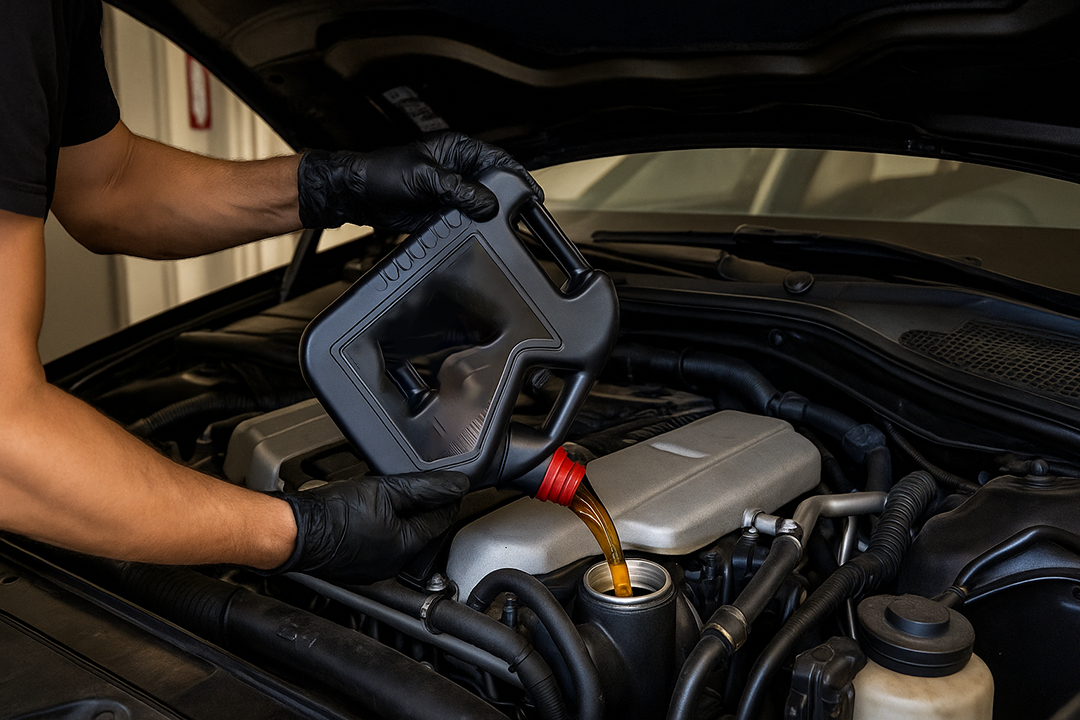
Adding fresh fluid does not remove moisture already in the system or correct a leak. Keep containers closed, and do not use fluid that has been left open to absorb moisture.
What a Proper Flush Does That Pedal Pumping Cannot
A flush replaces old fluid with new fluid of the correct specification. Bleeding removes trapped air. The procedures overlap, but they solve different problems.
Modern ABS and stability control hydraulic units can require more than gravity bleeding or pedal pumping. Follow the model-specific procedure, which may call for pressure or vacuum equipment and a scan tool to operate internal valves.
Moisture also contributes to internal corrosion, including damage inside ABS hydraulic components. Replacing fluid on schedule helps reduce that risk; it cannot repair corrosion or a failing valve.
What to Do When a Check Fails
A failed check needs a response matched to the problem. A soft pedal is a safety concern, while overdue fluid with normal braking calls for scheduled maintenance.
If the pedal feels spongy or sinks, stop safely and have the system inspected. If braking is impaired, arrange towing rather than continuing down another grade.
If moisture exceeds the limit for your model or the service is overdue, arrange replacement. Make sure the shop specifies the correct fluid and the bleeding procedure for your model.
A leak needs repair first, because fluid replacement alone cannot make a leaking system safe. If the brake warning light stays on after you check the fluid, have the cause found rather than assuming a top-off will clear it.
What to Ask a Shop Before You Approve a Brake Fluid Service
Ask which fluid specification your car requires, how its condition will be checked, and which bleeding procedure the manufacturer calls for. The answers should refer to your model, not just “European cars.”
At EuroX Performance in Golden, we specialize in European and exotic vehicles, using dealer-level tools and OEM parts. Call (303) 562-1800 or submit your vehicle details through our contact page to discuss your brake fluid concerns and request a quote. Read more about our veteran-owned and operated shop, located at 15985 S Golden Rd, Unit F, Golden CO 80401.
Frequently asked questions
How do I know if my vehicle needs new brake fluid?
Check the manufacturer’s replacement interval and have the fluid’s moisture content assessed using an appropriate test. Low fluid, a warning light, or a soft pedal also needs inspection, but these symptoms do not identify fluid condition by themselves. A full reservoir and clear color do not prove the fluid is serviceable.
Can I just add brake fluid to the reservoir?
Adding fluid does not fix a leak, worn pads, or moisture contamination. Have a low level investigated before treating a top-off as the solution. If fluid is needed, use only the specification required for your vehicle.
Why does the pedal feel fine on flat roads but spongy on a long descent?
Sustained braking heats the fluid near the calipers. Moisture lowers its boiling point, allowing compressible vapor to form under that load. Stop safely and have the brakes inspected rather than assuming the problem is resolved when they cool.
What is the difference between DOT 4 and DOT 4 LV brake fluid?
DOT 4 LV is a low-viscosity glycol-based fluid formulated to support rapid hydraulic valve operation, particularly in cold weather. Use the exact specification required by your manufacturer. Never substitute DOT 5 silicone fluid in a glycol-based system.
How often should a European car get a brake fluid flush?
Follow the interval in your model’s service booklet rather than a general mileage rule. Many schedules use elapsed time because fluid absorbs moisture even when the car is driven infrequently. If the service history is unknown, have the fluid assessed and establish when replacement is due.