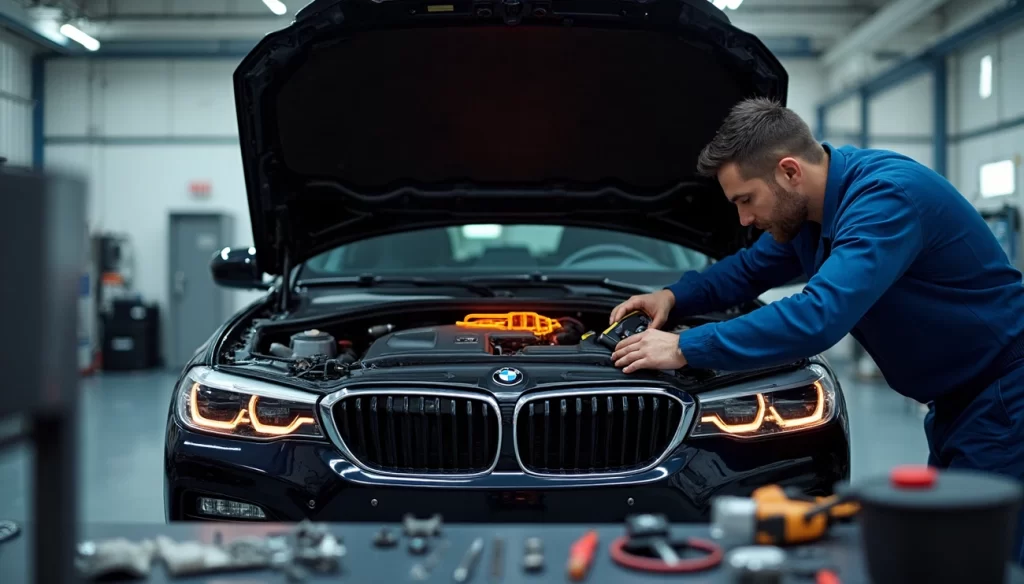
Merging onto C-470 near Lakewood, the pedal suddenly stops responding, the engine drops to about 1,200 RPM, and an EPC or Check Engine light comes on. On a modern European car, that usually means the engine computer has stopped trusting its throttle sensor tracks and cut power to protect you. The throttle position sensor is not a bolt-on part, so the right repair starts with proving which track or wire failed, then adapting any new throttle body to the car. If you are reading this with the light still on, that is the single most useful thing to remember: the fault is not gone just because the pedal came back.
This guide walks through how a throttle position sensor replacement works on a European drive-by-wire car, what the symptoms look like from the driver’s seat, why the computer cuts power instead of just setting a code, and how a technician should prove the fault before any part is bought.
Why Can’t You Just Swap the Throttle Position Sensor on a European Car?
On an older car with a cable throttle, the sensor was a simple part bolted to the throttle shaft. You could unbolt it and fit a new one, then reset the battery. European cars sold in the US for roughly the last two decades do not work that way. The throttle plate is opened by an electric motor, not a cable, and the sensor that reports its angle is built into the throttle body itself.
In practice, the throttle body on a modern European engine is a sealed unit with a motor that drives the plate and a pair of position sensor tracks. Many European platforms also carry a separate pair of tracks in the accelerator pedal module. The engine computer reads both and sets fuel and ignition from the result. It never simply trusts one number.
Two tracks that move in opposite directions
The two tracks inside a drive-by-wire sensor are designed to move in opposite directions as the plate opens. When the plate is closed, one track reads low and the other reads high; as you press the pedal, the readings move in mirror image. The computer compares them continuously. That mirror relationship is what lets it detect a failed track, a broken wire or a short, because a healthy pair always adds up to the same expected total.
The pedal sensor and the throttle body sensor are different parts
Here is where many repairs go wrong. The accelerator pedal module tells the computer how far you are pushing. The throttle body sensor tells the computer where the plate actually is. Both can set codes, and both can make the car feel dead, but they are separate components with separate connectors. Replacing the throttle body because the pedal module is at fault, or the reverse, is an expensive way to learn the difference. A proper diagnosis identifies which assembly is reporting the disagreement before any part is ordered.
What Are the Symptoms of a Failing Throttle Position Sensor?
The symptoms of a failing throttle position sensor depend on which track is failing and how the computer responds. The most common sign is a delayed or dead pedal response. Engine speed can stay low no matter how far you press, and the idle may hunt or surge. On automatics, shifts can come late or feel harsh. Some cars also show a throttle-related fault in the instrument cluster or a message asking the driver to visit a workshop.
On the diagnostic side, the classic OBD-II codes for throttle and pedal position circuit faults fall in the P0120 to P0124 range. Those codes are the record of what happened, not the full answer. Intermittent faults are especially common, because a track or connector can behave normally at the shop and fail on a cold morning, over a bump or on a grade. The driver often describes the problem as “it happened when I was merging” or “it only does it going up hills”. Take that seriously. A fault that comes and goes tends to return at the worst moment, such as a merge, a passing lane or a climb out of the canyon.
If the light is on, the car’s fault memory is a useful starting point. A scan can read the codes and the freeze-frame data showing what the engine was doing when the fault set. For a more general look at what a warning light is telling you before you book, see our guide on what a Service Engine Soon light means and what to check.
Why Does a Sensor Disagreement Cut Power Instead of Just Setting a Code?
This is the part that surprises most drivers, and it is the reason the pedal went dead on the merge. When the two track readings disagree beyond a set tolerance, the computer cannot know where the throttle really is. Acting on a wrong number could mean the engine surges or runs away, so the computer treats the signal as untrustworthy and protects the car.
That protection is called limp mode. The computer cuts throttle authority and caps engine speed, so the car drives slowly and predictably rather than unpredictably. On a European car, the Electronic Power Control (EPC) light, or a similar message, usually comes on at the same time. Limp mode is a deliberate design choice, not a glitch: the car would rather make you nervous on the shoulder than let an unknown throttle position command full power.
This is also why a sensor disagreement can feel like the car has died when it has not. The engine is running, the brakes and steering work, but the computer has taken the throttle out of your foot. The practical lesson is simple: a single limp-mode event is evidence that a track or its wiring has a fault, and the cause is still there when the light goes off.
How Do Technicians Prove Which Track or Wire Failed?
A good diagnosis follows a fixed order, and the goal is to prove the fault before any part is bought. Replacing a throttle body because a code points at it, without showing which track or wire failed, is the most common and most expensive mistake on these cars.
- Read the codes and freeze-frame data as a lead. The codes tell you which circuit the computer distrusted. They do not tell you whether the sensor, its wiring or the connector is at fault.
- Watch both track readings live while the pedal moves. With the engine running and a scan tool connected, press the pedal slowly and then quickly. Healthy tracks move in mirror image. The disagreement will show where it starts, whether in the pedal module, the throttle body or the wiring between them.
- Inspect the connector before condemning the body. Corrosion on a pin, a bent contact or moisture in a connector can read exactly like a failed track. This matters more than people expect in Golden, where cold, road salt and freeze-thaw cycles work on exactly these connectors.
- Check battery and charging voltage. A weak battery or low system voltage on a cold Foothills morning can make a sensor fault appear and disappear. Check it early so you do not chase a ghost.
- Use a scope where the fault is intermittent. A brief dropout that a scan tool misses will often show up on an oscilloscope as a spike or gap in one track’s signal. Capturing that is how an intermittent fault gets proven.
Watch both tracks while the pedal moves
This single check does more than any part swap. If the two readings disagree at rest, the fault is in the static circuit. If they agree at rest and split only as the pedal moves, the fault is likely a worn track or a contact that opens under movement. Ask to see both readings yourself. A shop that can show you the correlation, not just a part number, is doing the diagnosis.
Inspect the connector before condemning the body
Pull the connector, look for green or white corrosion on the pins, check the latch and the seal, and clean the contacts with an approved electrical contact cleaner where the manufacturer allows it. A good connector repair costs far less than a new throttle body, and it is a common cause. If the wiring harness shows chafing or heat damage, the repair belongs with our Automotive Electrical Services, not the throttle.
Check voltage before chasing a ghost
Confirm the sensor supply and ground voltages are within the manufacturer’s range with the engine running and, if possible, under a load such as the headlights and blower on. Voltage that sags under load points to a power or ground problem, which will make a perfectly good sensor look bad. These are the checks that separate a proven repair from a guess.
When Is Carbon Buildup the Real Problem, and How Should It Be Cleaned?
Carbon and oil-vapor deposits build up on the throttle plate and inside the bore over time, especially on turbocharged engines and cars that do a lot of short trips. The deposits can cause a rough idle and hesitation that look a lot like a sensor fault. That is why a careful look inside the bore belongs early in the diagnosis.
Cleaning can be the right fix when the bore is dirty and the tracks still read correctly. Clean the plate and bore by hand with a soft cleaner and a lint-free cloth, and keep the motor and its gears out of the spray. Never spray harsh solvent or brake cleaner into an electronic throttle body. The motor and its gearing are not built for that, and a solvent-soaked motor can fail in a way that looks like a new sensor fault.
Be clear about what cleaning does not do. Carbon can explain rough idle, but it does not repair a track that disagrees with its partner. If the readings still split after a clean bore and a good connector, the body or the pedal module is the next suspect, and the cleaning was not the repair.
Why Does a New Throttle Body Need Adaptation Before It Drives Right?
When an electronic throttle body is replaced, the computer does not automatically know where the new unit’s mechanical end stops are or what the closed-throttle position feels like. It must be adapted, or relearned, so it can set the plate’s closed and fully open limits for that specific unit. Without that step, the idle may be poor, the pedal may feel soft or the original fault may return.
Adaptation on most European platforms needs factory-level or equivalent software, not a generic code reader. A reader that only clears the light does not teach the computer the new end stops, and a battery disconnect is not a substitute either. Clearing the codes and resetting the battery will make the warning go away for a while, which is exactly why this step gets skipped and the fault comes back.
If a shop tells you a new throttle body is installed and the job is done without mentioning adaptation, ask how the computer was taught the new unit. A throttle body swapped without adaptation is not a finished repair, no matter who installed it.
What Should You Do When the Pedal Goes Dead in Traffic?
The first priority is the moment itself. If the pedal goes dead, take your foot off the accelerator, keep both hands on the wheel and steer toward the shoulder or the nearest safe exit as soon as you can. Do not keep stabbing the pedal to force power back; in limp mode that will not help and may make the car feel more unpredictable. Turn on your hazard lights and, where traffic allows, pull fully off the road.
Once you are stopped, let the engine idle, check whether the light stays on and try the pedal gently. If the car recovers and drives normally, that does not mean the problem is gone. The fault is still there, and the next limp-mode event could land on a grade or a merge. Golden drivers face this on I-70 west of town, the climb out of Clear Creek Canyon and the C-470 merge, where a power cut on a steep grade with a narrow shoulder is a safety event, not an inconvenience.
Local conditions add to the risk. At about 5,675 feet, thin air already taxes turbocharged and high-compression European engines, so losing throttle authority on a climb is felt immediately. Colorado’s magnesium chloride, traction grit and freeze-thaw cycles are hard on undercarriage connectors and harnesses, which is one reason intermittent electrical faults are common here.
- Get off the throttle and keep the wheel steady when the pedal goes dead.
- Move to the shoulder or a safe exit, then use the hazard lights.
- Do not keep forcing the pedal to regain power.
- Note what you were doing: speed, grade, temperature and whether the light came on.
- Book a diagnosis before the next long drive, not after the next limp-mode event.
If you are in the Golden area and the light or the pedal behavior has returned, contact EuroX Performance or call (303) 562-1800 to book a diagnosis. We will show you both track readings and the connector findings before we recommend any part.
Frequently asked questions
Does a throttle position sensor affect the transmission?
On automatics, the computer uses throttle position to set shift timing and torque, so a faulty track can cause late, harsh or odd shifts. A limp-mode cut also changes shift behavior, so the transmission can feel wrong during the event. A transmission fault can set codes of its own, so the right answer is to diagnose rather than assume the sensor is the cause.
How do I reset the throttle position sensor?
Clearing a code or disconnecting the battery is not a repair, and it often just lets the fault return. After a throttle body is replaced, the computer must be adapted with factory-level or equivalent software so it learns the new end stops. A generic reader that only clears the light does not do that job.
Can I bypass the TPS sensor?
No. The throttle protection exists so the computer cuts power when it cannot trust the throttle position. Bypassing it removes that protection and can leave the engine unpredictable at speed. The correct fix is a diagnosis of which track or wire failed and a repair to that specific fault.
How much does it cost to fix a throttle position sensor?
Cost depends on whether the fault is a connector, the throttle body, the pedal module or the adaptation, and only the test results show which one it is. A proven fault is usually cheaper to fix than a guessed one. Call (303) 562-1800 or use the contact page to book a diagnosis.
Can a dirty throttle body cause TPS trouble codes, or does the unit need replacement?
Carbon can cause rough idle, hesitation and occasionally throttle-related codes, so cleaning by hand is the right first step when the bore is dirty. Replacement is only justified when the tracks still prove faulty after cleaning and a connector check, and the codes return. Replacing the unit before that is proof of nothing.