Table of Contents
- Why European Vehicle Owners Choose ECU Tuning Over Stock Performance
- Understanding the Difference Between Track and Street Tuning Profiles
- How Track Tuning Maximizes Horsepower and Acceleration
- Street Tuning: Balancing Performance with Daily Drivability
- Our Diagnostic Process: Assessing Your Vehicle's Current Performance Baseline
- ECU Remapping Technology and What Sets Our Approach Apart
- Real-World Results: Performance Gains You Can Expect
- Transmission Tuning and Engine Integration for Optimal Power Delivery
- Maintaining Your Tuned European Vehicle: Service and Support
- Custom Tuning Solutions for BMW, Porsche, Audi and Exotic Imports
Why European Vehicle Owners Choose ECU Tuning Over Stock Performance
European vehicle manufacturers build impressive power into their factory settings, but they deliberately hold back. Insurance liability, emissions compliance, and warranty considerations mean your BMW, Porsche, or Audi leaves the dealership with conservative ECU parameters that don’t reflect the engine’s true potential.
We’ve seen it countless times: owners discover their turbocharged engine can safely produce 15-30% more horsepower simply by adjusting fuel injection timing, boost pressure, and ignition curves. Your vehicle’s engine was engineered to handle this additional output; the manufacturer just didn’t enable it from the factory.
ECU tuning unlocks that capability without compromising reliability when done correctly. Unlike bolt-on modifications that add stress to internal components, remapping optimizes how the engine operates within its design envelope. You’re not asking the engine to do something it wasn’t built for; you’re asking it to perform closer to its maximum safe capability.
Understanding the Difference Between Track and Street Tuning Profiles
The fundamental split comes down to operating conditions and priorities. Track tuning assumes controlled environments, premium fuel, consistent temperatures, and the ability to monitor engine vitals closely. Street tuning must handle variable fuel quality, ambient temperatures, traffic patterns, and the reality that most driving happens in city or highway conditions, not on a circuit.
Track profiles typically:
- Maximize boost pressure without safety margins
- Use advanced ignition timing that demands high-octane fuel
- Prioritize peak power output over throttle response smoothness
- Reduce engine longevity tolerances slightly in favor of raw performance
- Assume frequent ECU monitoring and engine maintenance
Street profiles prioritize:
- Reliable operation on 91-93 octane pump gas
- Consistent throttle response and drivability
- Margin for varying fuel quality and environmental factors
- Extended service intervals and component lifespan
- Smooth power delivery in everyday traffic
Think of it this way: a track tune is like race fuel in a purpose-built vehicle that sees a trailer between events. A street tune is your daily driver that needs to start reliably in winter, handle premium or regular gas interchangeably, and maintain turbocharger longevity for 100,000 miles.
How Track Tuning Maximizes Horsepower and Acceleration
Track tuning removes the governor limiting your vehicle’s performance. On a properly maintained European sports car or performance sedan, we can extract dramatic improvements through aggressive ECU remapping.
A stock Porsche 911 Turbo might produce 540 hp. A comprehensive track tune with supporting modifications can yield 620-650 hp. A turbocharged BMW M340i at 382 stock hp can reach 480+ hp with the right ECU parameters and supporting work.
The gains come from several simultaneous adjustments:
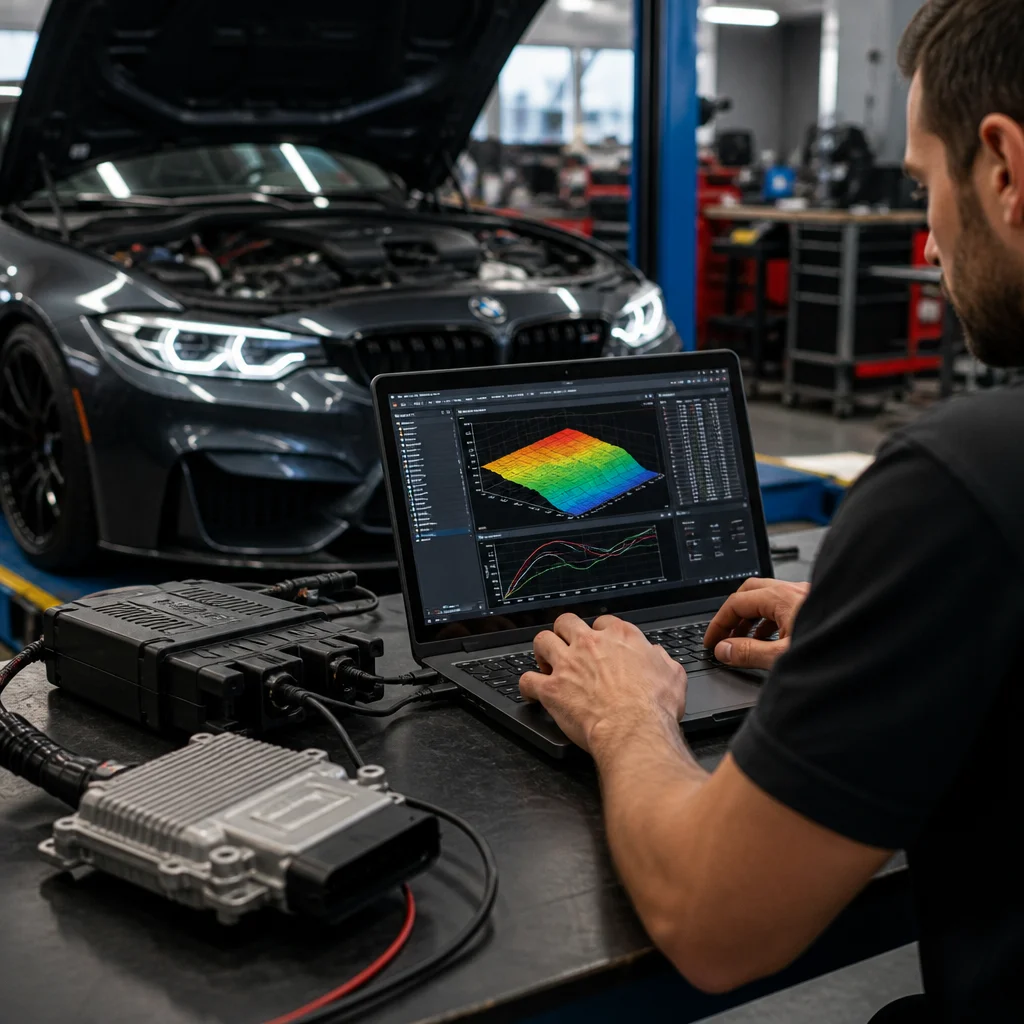
- Increasing turbocharger boost pressure to manufacturer limits
- Advancing ignition timing for optimal combustion
- Enriching fuel delivery in the high-RPM range
- Removing electronic throttle limiting
- Optimizing variable valve timing profiles
Track tuning also demands supporting modifications. Fuel system upgrades ensure adequate supply at peak demand. Engine oil quality and cooling system capacity matter significantly. We assess whether your current intake, exhaust, and fuel filter systems can support the tuned output without becoming bottlenecks.
The measurable result: 0-60 times drop by 0.3-0.5 seconds, mid-range acceleration feels noticeably sharper, and top-end power extends higher in the RPM band.
Street Tuning: Balancing Performance with Daily Drivability
Our street tuning philosophy keeps your European vehicle both responsive and reliable as an everyday car. We’re looking for the sweet spot between noticeable performance improvement and predictable operation in real-world conditions.
A well-executed street tune on a BMW M340i might deliver 420-450 hp instead of the full track potential of 480+. You’re leaving some power on the table intentionally. That additional margin protects against variations in fuel quality, excessive heat buildup during stop-and-go traffic, and the inevitable day when you’re driving with a full fuel tank in 95-degree heat.
Street tuning adjusts several parameters differently than track work:
- Conservative boost levels that prioritize turbocharger lifespan
- Ignition timing that performs well on 91-octane fuel
- Engine temperature thresholds that account for traffic conditions
- Transmission shift logic that feels responsive but not jarring
- Emissions sensor calibration that maintains vehicle diagnostics
The practical benefit: your car feels noticeably quicker in daily driving, throttle response improves noticeably, and you maintain the reliability profile owners expect. No surprise check-engine lights. No transmission hunting for gears.
Our Diagnostic Process: Assessing Your Vehicle’s Current Performance Baseline
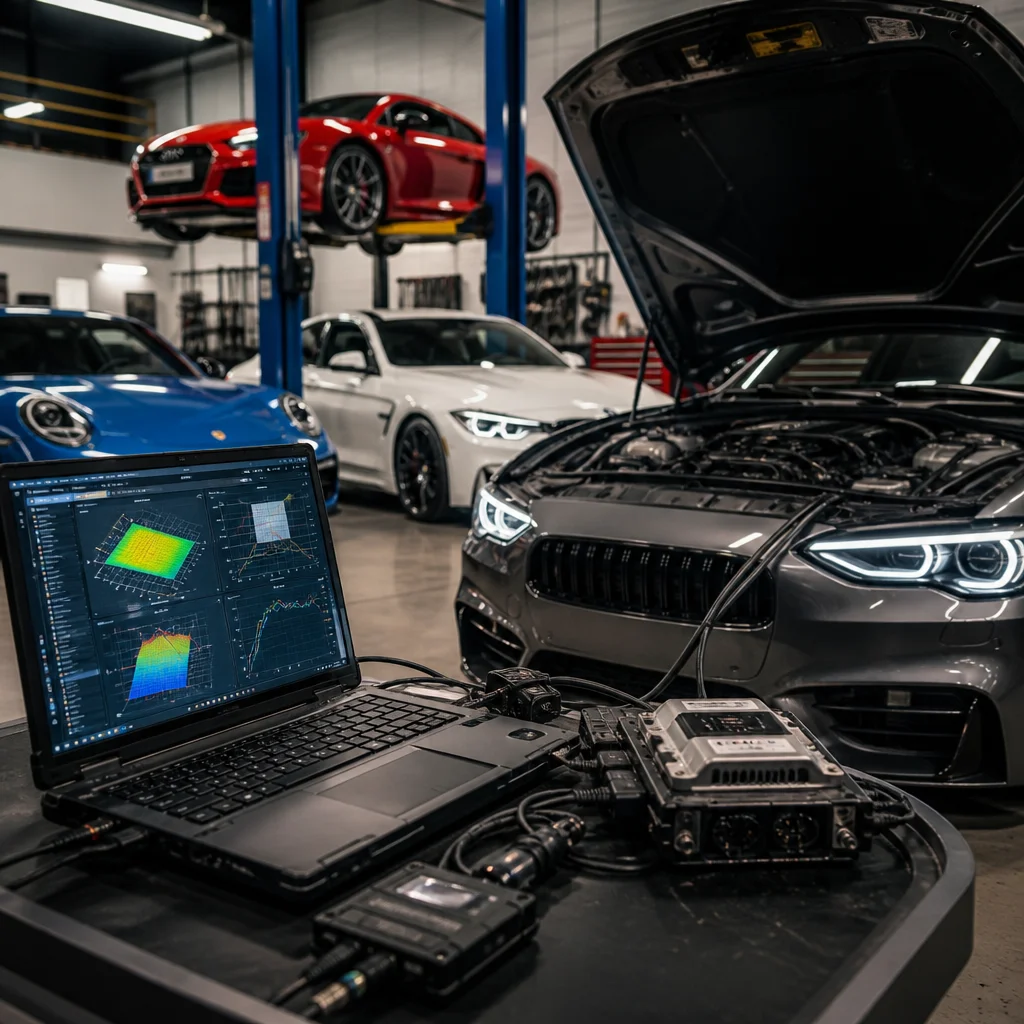
We begin every tuning project with comprehensive diagnostics using dealer-level equipment. Our process captures your vehicle’s baseline performance before any modifications, which becomes the measurement against which we verify results.
We pull multiple data streams: current ECU parameters, fuel mixture readings across RPM ranges, ignition timing tables, turbocharger boost profiles, transmission adaptive learning values, and emissions system status. We check for any existing faults or indicators that might compromise tuning safety.
Next, we conduct controlled performance testing. Your vehicle runs on our dyno under consistent conditions, and we capture horsepower, torque, and power delivery curves. This baseline measurement proves what the stock tune produces and becomes our before-and-after reference point.
We also assess your supporting systems. Is the fuel system delivering consistently at peak demand? Are intercooler temps stable under load? Does the cooling system handle sustained high-output operation? Are all sensors functioning within specification?
Only after this thorough evaluation do we develop a tuning strategy tailored to your vehicle’s condition, your intended use (track, street, or hybrid), and your reliability expectations.
ECU Remapping Technology and What Sets Our Approach Apart
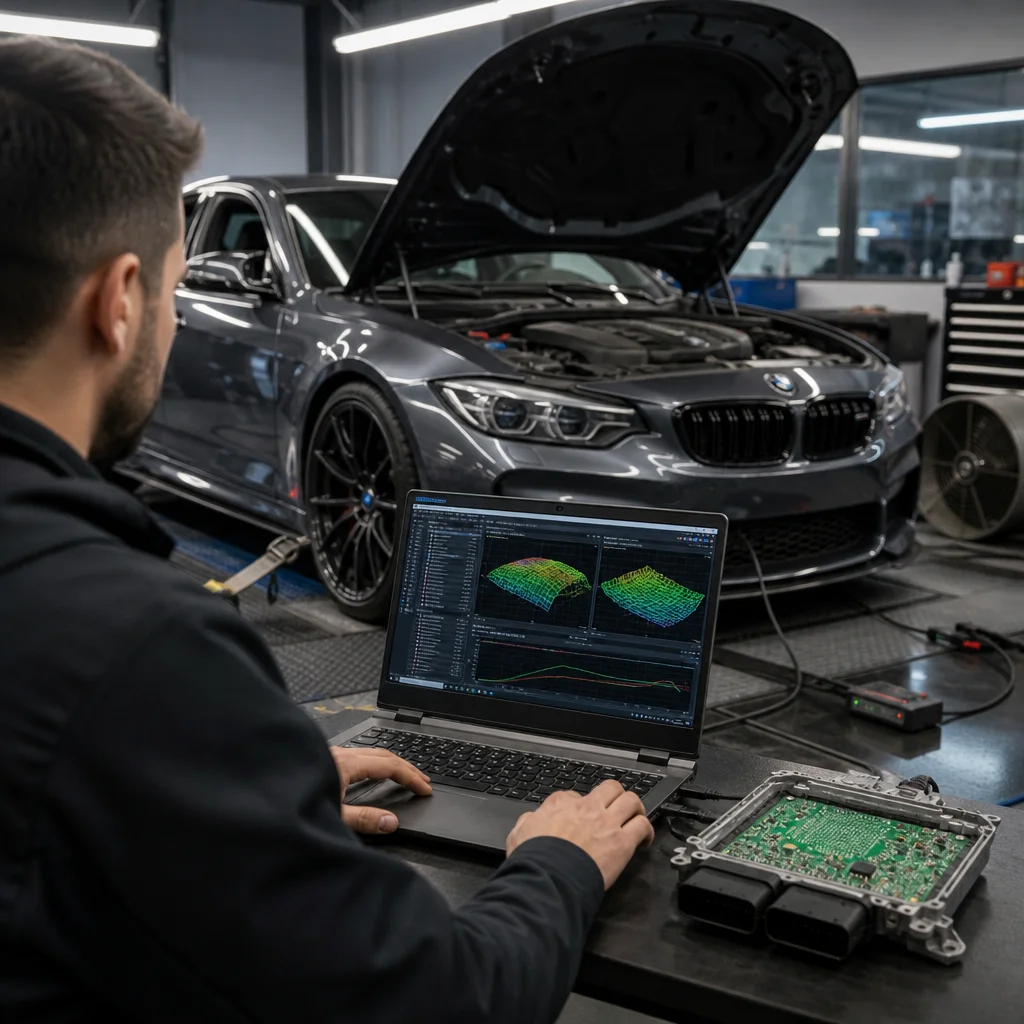
ECU remapping rewrites the software that controls your engine’s operation. Modern European vehicles run sophisticated engine management systems monitoring dozens of sensors and adjusting parameters thousands of times per second. We work within that established framework, modifying tables and thresholds rather than creating entirely new logic.
Our approach uses proven calibration tools designed specifically for European platforms. We don’t apply generic tuning; each file is validated against your vehicle’s complete sensor network, transmission type, and emissions equipment.
The critical distinction between quality remapping and risky modifications comes down to validation and verification. We test on dynos, perform extended runs to verify stability, and monitor engine parameters continuously during calibration. Every tune includes comprehensive logging so we can see exactly what the engine is doing under load.
We also maintain ongoing calibration updates as manufacturer software evolves and as we gather performance data from similar vehicles in real-world use.
Real-World Results: Performance Gains You Can Expect
Actual results vary based on platform, displacement, existing modifications, and whether you choose track or street tuning. Here’s what our typical European vehicle owners experience:
Audi S4/S5 (3.0L turbo): 20-28 hp gain with street tuning; 35-45 hp gain with track tuning and supporting modifications.
BMW M340i (3.0L turbo): 40-60 hp gain on street tune; 80-120 hp gain on comprehensive track tune with fuel and cooling upgrades.
Porsche 911 Turbo (3.8L twin-turbo): 50-80 hp gain on conservative street tune; 150-200 hp gain with full track configuration and engine bay optimization.
Beyond horsepower, owners consistently report improved throttle response, sharper acceleration in mid-range RPM, and power delivery that feels more linear. Transmission tuning (when integrated with ECU work) typically yields quicker downshift response and smoother power application.
These aren’t theoretical numbers. We measure results on our dyno and our customers experience the difference immediately during first test drives.
Transmission Tuning and Engine Integration for Optimal Power Delivery
Your transmission’s electronic control module works continuously with the engine ECU, and tuning one without the other leaves performance on the table. We integrate transmission calibration into every performance package we develop.
Modern dual-clutch and automatic transmissions learn shift points based on driving patterns and throttle input. A tuned engine produces power differently than the stock calibration, so transmission adaptation needs adjustment too. We optimize shift timing, pressure modulation, and adaptive learning parameters to match your engine’s new power curve.
Properly integrated transmission tuning delivers:
- Quicker, more responsive upshifts and downshifts
- Reduced turbo lag during manual gearbox acceleration
- Improved traction off-line by better power application
- Transmission hold at lower gears during aggressive driving
- Launch control optimized for your specific power output
We handle all of this during the comprehensive drive train diagnostics phase. The engine and transmission become a coordinated system rather than independent components responding to separate tuning strategies.
Maintaining Your Tuned European Vehicle: Service and Support
A tuned vehicle requires consistent maintenance discipline. We’re not suggesting exotic service schedules; we’re emphasizing that performance work demands that owners follow OEM specifications precisely.
Oil changes become more important. Tuned engines generate higher combustion temperatures and increased bearing load, so proper oil change intervals and premium synthetic lubricants aren’t optional. We recommend interval monitoring rather than fixed schedules, tracking oil condition through analysis rather than calendar dates.
Fuel quality matters significantly. Premium gas isn’t just recommended for street tunes; it’s essential. We maintain detailed calibration notes for your vehicle that track what fuel quality assumptions we built into your tune.
Air filter cleanliness, spark plug condition, and coolant maintenance all influence tuned engine performance and longevity. We schedule periodic checks to ensure everything operates within specification.
Our performance upgrades package includes ongoing support. We monitor your tuned vehicle’s performance through data logging, check in annually to verify parameters are stable, and adjust calibration if environmental factors or service items require recalibration.
Custom Tuning Solutions for BMW, Porsche, Audi and Exotic Imports
Every European platform presents unique tuning opportunities and constraints. We’ve developed deep expertise across manufacturer families because each brand’s engine management architecture requires specific knowledge.
BMW platforms benefit from our multi-year experience with their N-series and S-series turbocharged engines. We understand their boost control logic, their knock sensor sensitivity, and how their transmission learning systems respond to calibration changes.
Porsche tuning demands precision because these are already high-performance vehicles with conservative factory settings. The margin for error is smaller, but the performance gain justifies the meticulous work. We handle everything from base 911 models to 911 Turbo and Cayman platforms.
Audi owners benefit from our deep familiarity with their EA888 and 4.0L TFSI powerplants, and we maintain current calibration experience across their entire performance lineup.
We also work with exotic imports including McLaren, Ferrari, and Lamborghini platforms. Exotic vehicle tuning requires even more precision because factory parameters are already aggressive and margin is limited.
Your next step: Schedule a diagnostic appointment. Bring your vehicle in, and we’ll assess its current performance baseline, discuss your driving priorities, and outline realistic tuning expectations specific to your platform. We’ll show you baseline dyno results and walk through supporting modifications that might enhance your final outcome. From there, you decide whether track or street tuning aligns with your goals and how we move forward.