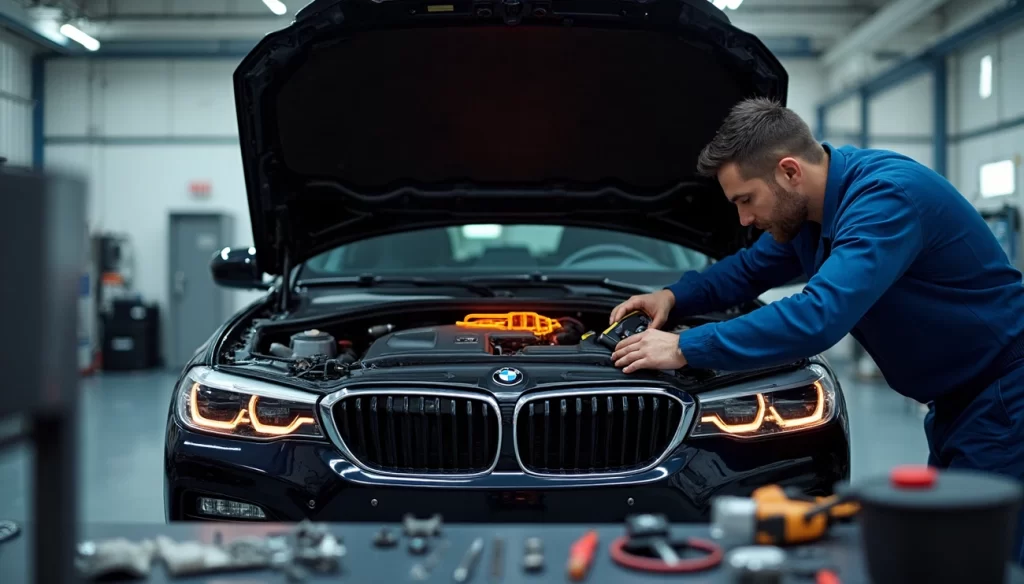
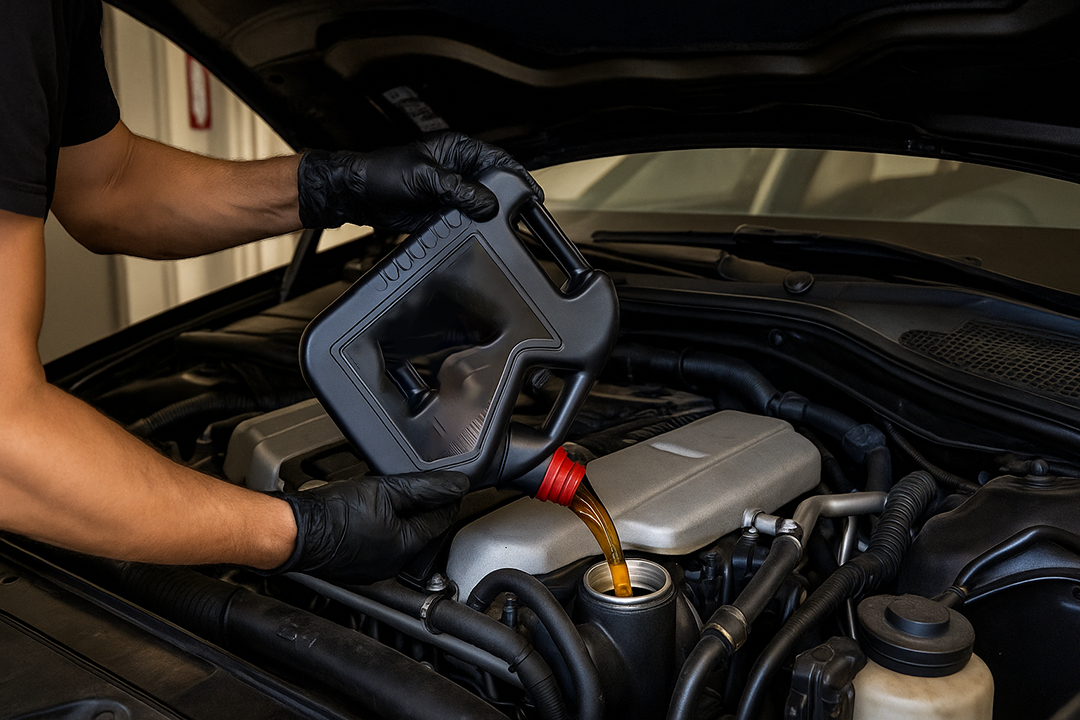
When your car’s coolant level is low, check it with the engine fully cold and add only the fluid specified in your owner’s manual. Repeated top-ups need a leak inspection, not another bottle. If a red coolant warning appears, pull over safely and shut the engine off rather than driving to a shop.
For European vehicles in Golden and Evergreen, freeze protection matters as much as the level. A typical 50/50 mix of the correct antifreeze and distilled water protects to roughly -34°F. Verify the actual concentration with a calibrated optical refractometer, especially if you do not know what was added previously.
Can I top it up and keep driving when the coolant light comes on?
A top-up alone does not establish that the car is safe to drive. Check the warning’s meaning in your owner’s manual, then distinguish a low-level warning from an overheating warning.
If the light is red
Pull over safely and turn the engine off. A red warning can indicate overheating or a dangerously low coolant level. Continuing to drive can cause serious engine damage.
Wait until the engine is fully cold before checking the reservoir. Never open its cap while the system is hot or pressurized, because escaping coolant can cause serious burns. Arrange a tow rather than driving with an overheating warning.
If the light is amber
An amber warning commonly indicates low coolant and needs prompt attention. Park on level ground, let the engine cool completely, and compare the reservoir level with its molded marks. If it is below MIN, add the specified coolant to the manufacturer’s cold-fill level without exceeding the maximum.
If the reservoir is empty, the level drops again, or an overheating warning appears, do not assume topping up has made the vehicle safe to drive.
Is tap water a safe stopgap to reach a shop?
Tap water is not a suitable routine top-off. Its minerals can contribute to deposits, and adding water alone dilutes the coolant’s corrosion and freeze protection. That dilution matters before a freezing night in Golden.
Use the manufacturer-approved premix or prepare the specified concentrate with distilled water at the prescribed ratio. If the engine is overheating, adding fluid is not permission to continue driving.
Can I mix whatever coolant color is closest to what is in the reservoir?
Choose coolant by its manufacturer specification, not its color. Two bottles with the same shade can contain different additive packages.
European cooling systems may specify OAT, HOAT or Si-OAT formulations, which use different combinations of corrosion inhibitors. Some Volkswagen-group vehicles specify G12+ or G13, but that is not a recommendation for every Audi or Volkswagen. Check the specification for your exact vehicle.
| Question | Conventional silicate coolant | OAT, HOAT or Si-OAT coolant |
|---|---|---|
| Corrosion chemistry | Uses silicate inhibitors | Uses organic acid inhibitors, sometimes combined with other additives |
| Can color identify it? | No, verify the specification | No, verify the specification |
| Can it be mixed freely? | Only when compatibility is confirmed | Only when compatibility is confirmed |
Incompatible coolants can reduce corrosion protection or form deposits that restrict coolant flow. If the heater stops producing warm air after a coolant problem, investigate the cause rather than adding another formula. The heater core symptoms guide explains signs to watch for inside the cabin.
Does a lower reading on a freezing morning mean a leak?
A lower cold reading does not establish a leak if your previous check was on a warm engine. Coolant contracts as it cools. Compare cold readings taken on level ground, and follow the reservoir markings and owner’s manual rather than comparing a hot reading with a cold one.
A cold level within the specified range does not need topping up simply because it is below FULL. Do not fill above the manufacturer’s cold-fill limit.
Where the cold finds weak parts
Temperature changes can expose leaks at aging plastic tanks or hose connections. Look for dried coolant residue around seams and fittings. A sweet smell after parking also warrants attention, even if the driveway stays dry.
A small leak can spray onto hot metal and evaporate before you park. A cold-system pressure test helps a technician find damp areas that disappear when the engine is hot.
When a drop stops being normal
A cold level that steadily falls is not explained by normal expansion and contraction. Modern cooling systems are sealed; needing coolant more than once every few months warrants an inspection.
Record the date and amount whenever you add coolant. That gives a technician a measurable rate of loss. For repair considerations by component, see the coolant leak repair cost guide.
Does a full reservoir with the light still on mean I need more coolant?
A correctly filled reservoir with a persistent low-level warning points toward a possible level sensor or wiring fault. Adding more coolant will not repair that circuit. An overheating warning, however, still requires attention even when the reservoir looks full.
On some vehicles, a blue coolant symbol at startup simply indicates a cold engine. Check your manual to identify the symbol. If a fault warning persists, diagnosis may include circuit testing and a scan for stored codes; If you want the fault traced, EuroX Performance’s check engine light diagnostics covers that scan and circuit testing.
Is a 50/50 mix good enough without testing it?
A correctly prepared 50/50 mix generally provides suitable freeze protection, but the reservoir’s appearance cannot confirm its concentration. Previous water additions may have weakened it. A calibrated optical refractometer measures concentration and indicates the corresponding freeze point.
Let the engine cool completely before you open the reservoir. Then follow the calibration steps in the refractometer’s instructions, place a few drops on the prism, and read the scale that matches the coolant you are testing.
Compare the reading with the freeze protection your manufacturer specifies for your vehicle. If the concentration is wrong, have it corrected to specification rather than guessing how much concentrate or water to add.
Is coolant only a summer concern?
Coolant protects against freezing as well as overheating. Its additives also protect internal surfaces from corrosion. Before winter driving between Golden and surrounding foothill communities, verify the fluid rather than relying on a warning light that does not measure freeze protection.
- Check the reservoir against its cold-fill markings with the car parked level.
- Confirm the required coolant specification in the owner’s manual.
- Have the concentration checked with an optical refractometer.
- Inspect accessible tank seams and hose connections for residue or dampness.
- If your records show repeated additions, arrange a cooling system inspection instead of continuing to top up.
EuroX Performance in Golden provides European and exotic vehicle diagnostics using dealer-level tools and ASE-certified technicians. If the level keeps falling, call (303) 562-1800 or describe the warning and your top-up history through the contact page.
Frequently asked questions
Can I keep driving with the coolant warning light on?
A red coolant warning means pull over safely and shut the engine off. An amber warning commonly indicates low coolant and needs a prompt check with the engine fully cold. Follow your owner’s manual, and do not continue driving if the engine is overheating.
Why does my coolant level drop when it gets cold?
Coolant contracts as it cools, so a cold reading can be lower than a warm one. Compare readings with the engine cold and the car parked level. A level that keeps dropping under those same conditions warrants a leak inspection.
What freeze protection should my coolant have in Colorado?
Follow your vehicle manufacturer’s coolant specification and concentration requirements. A typical 50/50 antifreeze-and-distilled-water mix protects to roughly -34°F. A calibrated optical refractometer can confirm the actual protection rather than relying on the bottle used at the last top-up.
What happens if I mix European coolant with generic green antifreeze?
Incompatible additives can reduce corrosion protection or form deposits that restrict coolant flow. Green dye alone does not identify the formula or establish compatibility. Match the exact manufacturer specification before adding coolant.
Is it normal to lose coolant over the winter?
Repeated coolant loss is not normal in a sealed cooling system. If you need to add coolant more than once every few months, or the cold level steadily falls between services, arrange an inspection. A pressure test can reveal small leaks that never leave a puddle.