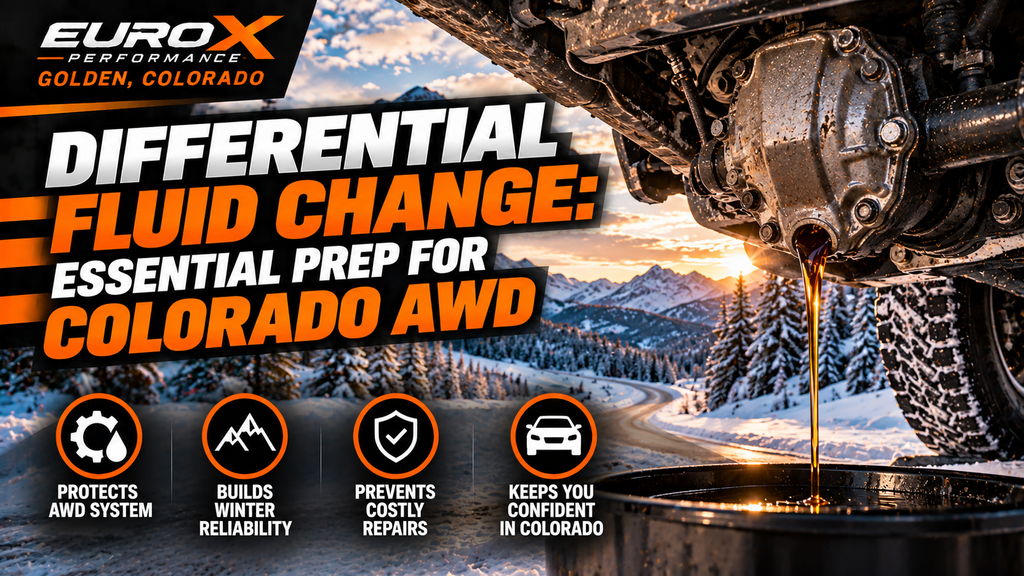
A differential fluid change replaces the heavy gear oil that lubricates your axle’s ring and pinion gears, bearings, and clutch packs. European vehicles driven along the Front Range require fresh differential fluid every 30,000 to 40,000 miles to prevent hypoid gear wear and clutch chatter. Sustained climbs along I-70 and sub-freezing Colorado mornings shear down factory lubricants long before dealership milestones, making scheduled drain intervals necessary to avoid gear scoring and four-figure axle rebuilds.
Differentials lack internal oil filters. Metal wear debris and sheared friction material circulate constantly against hypoid gear teeth until the housing is drained manually. Routine fluid changes clear out this abrasive slurry and maintain the friction modifiers your all-wheel-drive system needs to distribute torque reliably across mountain roads.
Why Lifetime Drivetrain Fluid Is a Costly Myth for European AWD Vehicles
Automakers advertise lifetime fluids to make projected ownership costs appear lower during initial lease cycles. That corporate metric does not protect vehicle longevity. In mechanical reality, no gear oil resists shear forces indefinitely.
What Manufacturers Mean by Lifetime Fill
When an automaker designates axle fluid as lifetime, that interval covers only the original warranty period, usually 50,000 miles. Beyond that mileage, the manufacturer bears no financial responsibility for worn bearings or chipped gear teeth. Quick-lube chains and dealerships that repeat this lifetime claim set owners up for expensive mechanical repairs once factory warranties expire.
Why Axle Housings Accumulate Wear Debris Without an Oil Filter
Engines rely on pleated filters to extract carbon and metal contaminants. Differential housings have no internal filters. As hypoid ring and pinion gears mesh under heavy load, fine steel particles slough off. Clutch-type limited-slip units shed friction disc material during normal cornering. These abrasive particles remain suspended in the fluid, circulating indefinitely until you drain the housing. Left in place, that debris turns synthetic fluid into a scouring compound that rapidly pits polished bearing surfaces.
The 30,000 to 40,000 Mile Rule for Front Range Drivers
Baseline trade guidelines summarized by the Universal Technical Institute automotive differential guide indicate differentials need fresh fluid every 30,000 to 50,000 miles under normal driving, dropping closer to 15,000 to 30,000 miles under severe use. For European all-wheel-drive cars operating in Golden, servicing front and rear axles every 30,000 to 40,000 miles prevents premature bearing wear. Transfer cases using wet multi-plate clutch packs run under higher friction loads and require fresh oil every 30,000 miles.
How Mountain Ascents and Cold Snaps Break Down Gear Oil
Front Range driving subjects European drivetrains to stresses flatland vehicles never encounter. Golden sits at 5,675 feet, where mountain highway climbs begin immediately.
High-Load Thermal Oxidation Along the I-70 Corridor
Climbing west through Clear Creek Canyon or heading up toward the Eisenhower Tunnel on I-70 demands sustained engine torque under heavy vehicle loads. Hypoid gearsets feature an offset pinion gear that drives across the face of the ring gear with continuous sliding friction. That contact generates substantial heat. Under continuous mountain ascents, factory gear oil oxidizes quickly as heat breaks apart its polymer viscosity modifiers. Once those molecules shear, the oil thins permanently, losing the protective fluid film that keeps steel gear teeth from scuffing under throttle.
Cold Morning Viscous Drag and Pinion Bearing Starvation
Winter brings fast temperature drops across Golden, Arvada, Lakewood, Wheat Ridge, and Evergreen. When overnight temperatures drop below freezing, oxidized gear oil thickens into a heavy paste. This thick oil delays critical splash lubrication to the upper pinion bearings during initial morning driving. That cold boundary friction accelerates gear tooth wear miles before the axle housing reaches full operating temperature.
How to Tell Transfer Case Shudder from Differential Bearing Whine
Drivetrain problems announce themselves through distinct noises and sensations. Knowing how to distinguish clutch binding from bearing wear helps you identify the failing component early.
Low-Speed Binding During Tight Turns
A sharp shudder or binding sensation through the chassis while parking indicates slipping and grabbing within an all-wheel-drive transfer case or limited-slip clutch pack. In most cases, low-speed drivetrain binding can be resolved with fresh, factory-specified fluid rather than replacing the assembly. Internal multi-plate clutches rely on specific friction modifiers to slip smoothly during turns. When fluid degrades, the clutch discs stick and release erratically.
If you see warning lights accompany this binding, read our guide on handling a service 4 wheel drive light in Colorado snow for help identifying transfer case actuator faults.
Whining That Shifts With Vehicle Speed
Bearing wear produces a continuous whining noise that changes pitch with vehicle speed, pointing toward worn pinion or carrier bearings caused by fluid starvation. Pinion bearing noise typically alters tone when switching between acceleration and coasting. Once metal-on-metal friction pits the case-hardened race of a bearing, fresh gear oil will not quiet it. The differential requires a full mechanical overhaul.
Visual and Olfactory Signs of Degraded Fluid
Field maintenance procedures from the Fleet Rabbit AWD differential service guide show that physical fluid condition reveals internal component wear. Look for four specific signs when inspecting drained gear oil:
A dark metallic sheen with suspended silver flakes points to active gear tooth abrasion. A scorched sulfur odor indicates high-load thermal breakdown of extreme-pressure additives. A milky tan emulsion reveals water contamination from a clogged or submerged breather vent, which destroys lubrication properties. Heavy metallic paste on the magnetic drain plug, especially slivers thicker than a coin, signals internal component failure.
Why European Drivetrains Require Factory-Approved GL-5 and LSD Formulations
European all-wheel-drive vehicles require exact fluid formulations across different axles. Pouring generic gear oil into every housing causes rapid mechanical failure.
API GL-5 Hypoid Protection Versus Standard Gear Lubricants
Hypoid gears operate under extreme surface pressure. As detailed in technical documentation by Castrol on API gear lubricant classifications, hypoid differentials require an API GL-5 formulation containing specialized sulfur-phosphorus extreme-pressure additives. Using an API GL-4 lubricant or an unapproved multi-vehicle fluid in an axle requiring GL-5 protection allows gear surfaces to micro-weld and tear apart under load, destroying ring and pinion teeth within a few thousand miles.
Limited-Slip Friction Modifiers for Multi-Plate Clutches
Differentials with limited-slip clutch packs demand exact friction modifier chemistry to control plate engagement. Generic multi-vehicle gear oils lack the shear stability and OEM friction modifiers required by Audi, BMW, and Mercedes-Benz. Front differentials, center transfer cases, and rear differentials often use entirely different lubricants on the very same chassis.
High-performance engines require that same level of fluid precision. Review our guide on Audi OEM oil change requirements to see how manufacturer specifications protect close-tolerance mechanical assemblies.
Drivetrain Fluid Specifications Across Major European Marques
The table below outlines common factory specifications across European all-wheel-drive systems:
| Platform | Drivetrain Assembly | Required Fluid Specification | Key Mechanical Consideration |
|---|---|---|---|
| Audi Quattro (Torsen) | Center Differential | Synthetic gear oil with Sturaco additive | Requires Sturaco modifier to stop center differential binding |
| BMW xDrive | ATC Transfer Case | BMW DTF-1 / Shell TF 0870 | Wet multi-plate clutch; wrong oil causes rapid clutch glazing |
| Mercedes-Benz 4MATIC | Front and Rear Axles | MB 235.7 / MB 235.74 (75W-85) | High thermal stability; protects pinion bearings and reduces drag |
| Porsche Cayenne / Macan | Active AWD Transfer Case | Porsche Hang-On Transfer Case Fluid | Dynamic clutch slip; incorrect fluid causes immediate low-speed shudder |
The Critical Steps of a Professional European Differential Fluid Service
Changing gear oil on European drivetrains requires specific safety steps and diagnostic software. Missing a step risks stranding the car or damaging internal clutches.
1. Loosen the Fill Plug First
The primary rule of differential servicing is loosening the fill plug before touching the lower drain plug. Front Range winter roads are coated with magnesium chloride and volcanic traction sand, which corrodes underside fasteners. If you drain the fluid first and find the upper fill plug stripped or seized, the vehicle cannot be refilled and cannot be driven. Removing the fill plug first guarantees you can service the axle safely.
2. Warm the Housing and Drain Contaminants
Cold gear oil sticks to internal casing walls. Running the vehicle for ten to fifteen minutes warms the gear oil, lowering its viscosity so suspended metal filings and oxidation sludge drain out cleanly. Once the casing drains, clean the magnetic plug and install a new crush washer, torquing the plug to factory specifications. Pump fresh fluid in until it sits flush with the lower lip of the fill port, then seal the port with a new washer.
3. Reset Adaptation Values with Diagnostic Software
On modern BMW xDrive and Audi Haldex systems, fluid service is incomplete without dealer-level diagnostic scan tools. Drivetrain control modules adjust clutch clamping pressure over time to compensate for thinning, sheared fluid. Exchanging the fluid without resetting adaptation counters leaves the computer applying clamping pressure meant for degraded oil. Resetting adaptation values calibrates clutch actuators to the fresh fluid, preserving friction plate life and restoring smooth low-speed engagement.
If your car shudders during low-speed turns or you are preparing for mountain winter driving, book an inspection through the EuroX Performance drivetrain services page or call (303) 562-1800 to schedule service with our certified technicians in Golden.
Frequently Asked Questions
How often should differential fluid be changed on an AWD European vehicle?
European all-wheel-drive vehicles driven in Colorado require front and rear differential fluid changes every 30,000 to 40,000 miles. Center transfer cases containing wet clutch packs should be serviced every 30,000 miles. These intervals offset the thermal breakdown caused by mountain highway ascents and cold morning starts.
Why does my AWD European car shudder during tight turns on cold mornings?
Low-speed shudder during parking maneuvers indicates oxidized fluid in your transfer case or limited-slip differential. As chemical friction modifiers shear down, internal clutch discs chatter and grab instead of slipping smoothly. Refilling the housing with factory-approved fluid usually eliminates the shudder without hardware replacement.
Should front and rear differential fluids be replaced at the same time?
Yes. Both differentials cover the same road mileage and manage continuous torque loads through the all-wheel-drive system. Servicing both axles during the same appointment ensures uniform protection across all gearsets and keeps your maintenance records aligned.
What happens if you use standard generic gear oil in a European limited-slip differential?
Generic gear oils lack the specific shear stability and OEM friction modifiers required by European engineering standards. Using an unapproved lubricant causes harsh clutch chatter, glazes internal friction discs, and accelerates gear wear. Severe hypoid gear tooth scoring can occur within a few thousand miles.
Why is an electronic adaptation reset necessary after changing AWD transfer case fluid?
Modern electronic all-wheel-drive control modules increase clutch clamping pressure as drivetrain fluid ages and shears. If you install fresh oil without resetting these adaptations using diagnostic software, the vehicle continues using high clamping pressures meant for worn fluid. That mismatch causes jerky engagement and rapid clutch wear.