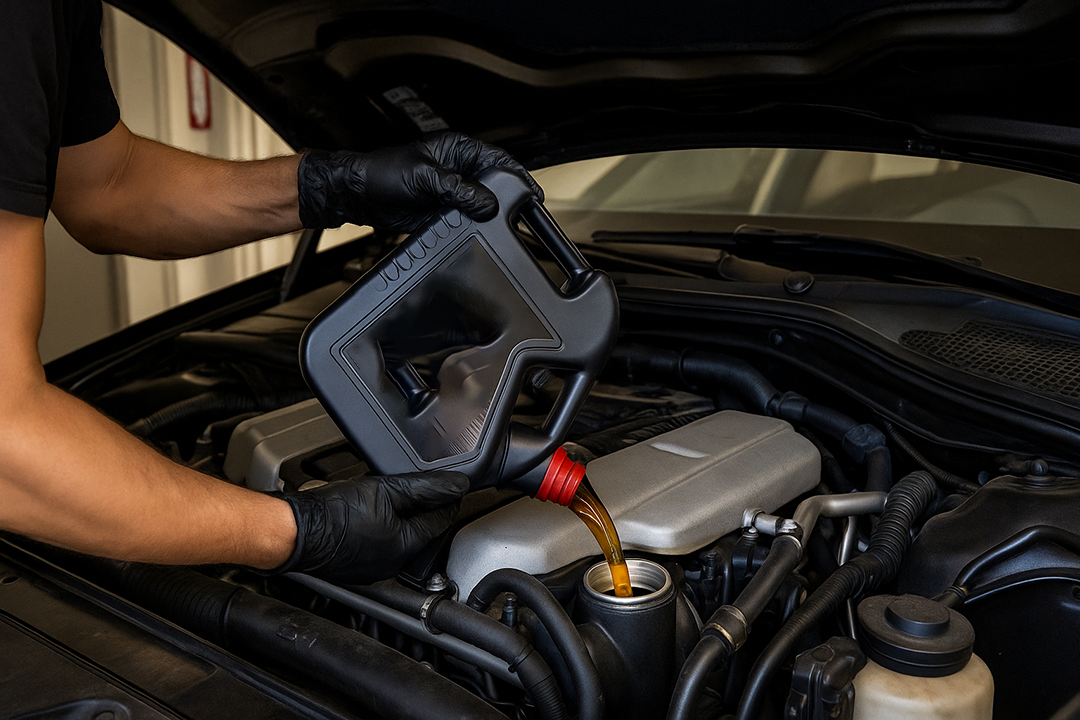
European synthetic oil has to match the viscosity and manufacturer specification in your owner’s manual. “Full Synthetic” alone does not establish that match, and neither does an API service category. Look for the required approval code, such as BMW LL-01 or MB-Approval 229.5, before comparing prices.
For an Audi, BMW, Mercedes-Benz or Porsche, the wrong specification can matter even when the viscosity looks correct. Two bottles marked 5W-30 are not necessarily interchangeable.
What the Approval Code on the Back Label Actually Certifies
An OEM approval means the formula has satisfied the carmaker’s approval requirements. “Meets the requirements of” is a different claim: the oil blender states that its product meets a published specification. Do not treat those phrases as interchangeable.
An oil brand’s undated product page for a European-approved 5W-30 illustrates the distinction. It lists approvals for VW 502.00/505.00, BMW LL-01 and MB-Approval 229.5, 229.3 and 226.5. Separately, it says the oil meets API SL and ACEA A3/B4 requirements. The approval list and the standards list serve different purposes.
Start with your owner’s manual, not a shelf label or a broad model-year chart.
Then match the required specification and viscosity to the exact product you intend to buy. The viscosity grade on the front label is not enough on its own.
A Standard Full Synthetic and an OEM-Approved Oil Side by Side
“Full Synthetic” describes neither a complete performance specification nor compatibility with every European engine. Read the approval list on the back label.
| Criteria | Full synthetic with an API category only | Synthetic with a European OEM approval |
|---|---|---|
| Front-label wording | May show “Full Synthetic” and a viscosity grade | May show the same wording and viscosity grade |
| API category | Names an API service category | May also name an API service category |
| OEM approval | No European approval listed | Lists specific approvals, such as BMW LL-01 or MB-Approval 229.5 |
| Base stock | May include hydrocracked Group III oil or PAO | May also include Group III oil or PAO; European approval does not mean all-PAO |
| SAPS level | Cannot be established from “Full Synthetic” alone | Depends on the particular specification, not simply the European label |
| What it establishes | The stated API category does not establish a European approval | The named approval applies to engines requiring that specification |
A European-approved oil is not automatically suitable for every European car. An approval for one BMW engine or Mercedes-Benz application does not replace the different approval another engine requires.
What SAPS Levels Protect Once the Oil Has Burned
SAPS is shorthand for the oil’s additive content, measured largely as sulfated ash. When an engine burns oil, the residue can settle in the exhaust aftertreatment hardware and impair its performance.
One oil brand’s product page warns that these additives can damage emissions systems in some European vehicles. The practical rule is to use the specification required by your engine and its emissions equipment, rather than assuming that more additives provide better protection.
Why SAPS Levels Differ Between Oils
Oils are sold at several SAPS levels, and each sets its own limit on that additive content. Lower SAPS is not automatically better for every engine, and European oils are not all low-SAPS. An engine requiring a particular additive balance needs that formulation, even if another bottle advertises emissions compatibility.
The approval code is the useful purchasing check. You should not have to guess the correct SAPS level from the vehicle’s badge.
How Golden’s Altitude and Cold Mornings Load the Oil
At altitude, a turbocharger may need to spin faster to maintain the same manifold pressure it produces at sea level. That increases thermal demands on the turbocharger and its lubricating oil. Sustained climbs along I-70 add another reason to respect the manufacturer’s maintenance schedule, but altitude alone does not establish a specific reduction in oil life.
Cold starts create a different demand: oil must flow through the engine and reach the turbocharger bearings promptly. Use a viscosity grade permitted by the manual for the expected temperatures. Do not substitute a heavier oil simply because the car will also face mountain climbs.
Why Short Winter Trips Can Dilute Oil and What the Dipstick Shows
Repeated short trips in cold weather can leave fuel and moisture in the oil, particularly in direct-injection engines. If the engine rarely reaches full operating temperature, those contaminants may accumulate between changes.
- Park on level ground and follow the manual’s oil-level procedure. Some vehicles require a warm engine or use an electronic measurement instead of a dipstick.
- Record the level. If a dipstick is fitted, note an unusually strong fuel odor or abnormal appearance.
- Check again after several days of short drives, using the same procedure.
- Have a rising oil level or persistent fuel odor assessed rather than adding more oil.
A milky deposit under the filler cap can result from condensation, but milky oil on the dipstick needs investigation. Appearance and smell are warning signs, not substitutes for diagnosis.
Which Oil Fits Your Car and How Often to Change It
Choose the oil specification first, then follow the service interval that fits your driving. Correct oil does not make an extended interval appropriate for every use pattern.
When a Standard API Oil Is Enough
If the manual requires an API service category without a separate OEM approval, an oil meeting that category and the specified viscosity can be appropriate. Check for any additional requirements before buying. “Synthetic” does not override them.
When Your Manual Names a European Approval
Buy an oil carrying the required approval. Match the complete code rather than assuming that any approval from the same manufacturer will work.
For frequent steep climbs or repeated short winter trips, check whether the manual specifies a severe-service schedule. Use that schedule when your driving meets its conditions rather than stretching the interval to avoid a service visit.
What to Compare in an Oil Change Quote
Ask which oil specification and viscosity the quote covers, and whether the filter is included. The total also depends on the engine’s oil capacity. A lower price is not a useful saving if the oil does not meet the required specification.
For context on the expense of major engine work, see our engine replacement cost breakdown. Using the correct oil reduces an avoidable maintenance risk; it does not guarantee against engine failure.
If the Wrong Oil Is Already in Your Engine
A non-spec fill does not prove that damage has occurred. Keep the bottle or service receipt and have a shop compare the product with your vehicle’s requirements. How much was added, and whether the specification really mismatches, decides whether an immediate change is appropriate.
Arrange an assessment if you notice:
- An oil warning light or message.
- A level that repeatedly drops between changes.
- Burning-oil odor through the vents.
A red oil-pressure warning requires a different response from a routine service reminder: stop safely, shut off the engine and follow the manual’s instructions. Oil loss and burning smells can have several causes; our guide to diagnosing oil leaks without tearing down the engine explains how leaks are investigated.
Bring Your Manual to EuroX Performance Before Winter
EuroX Performance provides oil changes using oils that meet or exceed manufacturer specifications. Our veteran-owned shop in Golden, Colorado, has ASE-certified technicians specializing in European and exotic vehicles.
For an oil-change quote, have your vehicle details and any recent oil-use concerns ready. Call (303) 562-1800 or use the quote request form on our contact page. Our oil change service in Golden page explains the service.
Frequently asked questions
How much does European synthetic oil cost?
There is no single price for European-spec synthetic oil or an oil change. The required formulation, engine oil capacity and filter affect the total. Request a vehicle-specific quote that identifies the oil specification being supplied.
Is European synthetic oil different from standard synthetic oil?
It can carry manufacturer approvals and additive requirements that a general API-category oil does not. Both products may use similar types of synthetic base stock. The required approval and viscosity, not the word “European,” determine suitability.
Is European oil better for American cars?
Not automatically. Use the viscosity and specifications required by the vehicle’s manufacturer, regardless of where the vehicle was built. An additional European approval is not a substitute for the requirements in an American vehicle’s manual.
How often should I change oil if I drive mountain roads regularly?
Follow the manufacturer’s interval for your driving conditions, including its severe-service schedule where applicable. Frequent steep climbs and short cold-weather trips warrant checking those conditions carefully. There is no single mileage interval that fits every European engine used on Colorado mountain roads.